


Two senior members of Taiwan's government are in the US to meet people connected to US President-elect Donald Trump's transition team, several sources told Reuters, in an effort by Taiwan to establish ties with the incoming administration.
Lin Fei-fan (林飛帆) and Hsu Szu-chien (徐斯儉), both deputy secretaries-general of the National Security Council and several of their staff, have traveled to the Washington area for meetings through this week, the sources said on condition of anonymity.
Reuters was not able to confirm who from the US side would join the meetings or the agenda.
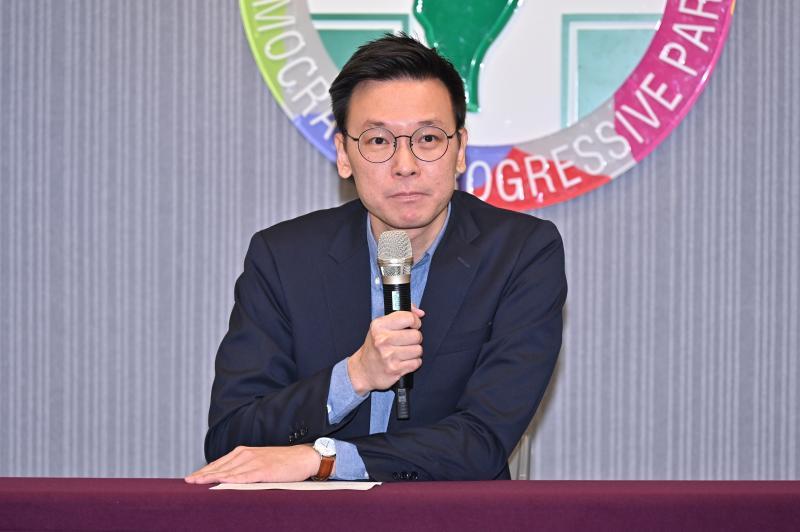
Photo: Tu Chien-jung, Taipei Times
Taiwan’s Presidential Office spokesperson today declined to confirm that Taiwanese national security officials were in the United States to meet with Trump's transition team.
Spokesperson Karen Kuo (郭雅慧) said in a brief statement that
"[conducting] visits and exchanges is part of the national security team's routine work" and that she "has no further comment" on the matter.
China's embassy and the Trump transition team did not respond to requests for comment.
The reported visit by Lin and Hsu comes as China's military has stepped up activity near the Taiwan Strait, in what Taiwan has said is Beijing's effort to set a "red line" for the incoming Trump administration and US allies.
One of the sources said the meetings were with people in Trump transition circles, but would not include nominees for top positions in Trump's next administration, given sensitivity in Beijing over any talks between Taiwanese and US officials.
The meetings are with "Republicans likely to populate mid-tier political positions" in the Trump administration, a second source said.
A third source said it was "safe to say" Lin and Hsu were meeting the Trump transition team.
Trump's electoral win last month has sparked hope in Taipei that he is to pursue a tough line with China, but also anxiety given his comments that Taiwan should pay the US for its defense.
Trump has named numerous China hawks to key posts in his incoming administration, including US Senator Marco Rubio as secretary of state, who has called for unfettered interaction between US and Taiwan officials.
Those nominations have been encouraging for Taipei, which Reuters has reported may make large new arms orders to show it takes seriously Trump's statements that Taiwan should pay "protection" money to the US.
Engagement to date between Taiwan and the incoming administration appears to fall in a gray area of unofficial contact and has been low-key.
That is a departure from the period before Trump's first term, when in December 2016, the month before his inauguration, he held a phone call with then-president Tsai Ing-wen (蔡英文).
That call marked the first time since 1979 that a US president-elect had spoken with Taiwan's president.
Ahead of his second inauguration, scheduled for Jan. 20, CBS News reported yesterday that Trump had invited Chinese President Xi Jinping (習近平) to attend the event, something that would be unprecedented for a Chinese leader.
The president-elect's camp and China did not immediately respond to a request for comment on the report, but Trump said in an interview with NBC News conducted Friday last week that he "got along very well" with Xi and that they had "had communication as recently as this week."
Additional reporting by CNA

Considering that most countries issue more than five denominations of banknotes, the central bank has decided to redesign all five denominations, the bank said as it prepares for the first major overhaul of the banknotes in more than 24 years. Central bank Governor Yang Chin-lung (楊金龍) is expected to report to the Legislative Yuan today on the bank’s operations and the redesign’s progress. The bank in a report sent to the legislature ahead of today’s meeting said it had commissioned a survey on the public’s preferences. Survey results showed that NT$100 and NT$1,000 banknotes are the most commonly used, while NT$200 and NT$2,000

The Centers for Disease Control (CDC) yesterday reported the first case of a new COVID-19 subvariant — BA.3.2 — in a 10-year-old Singaporean girl who had a fever upon arrival in Taiwan and tested positive for the disease. The girl left Taiwan on March 20 and the case did not have a direct impact on the local community, it said. The WHO added the BA.3.2 strain to its list of Variants Under Monitoring in December last year, but this was the first imported case of the COVID-19 variant in Taiwan, CDC Deputy Director-General Lin Ming-cheng (林明誠) said. The girl arrived in Taiwan on

South Korea is planning to revise its controversial electronic arrival card, a step Taiwanese officials said prompted them to hold off on planned retaliatory measures, a South Korean media report said yesterday. A Yonhap News Agency report said that the South Korean Ministry of Foreign Affairs is planning to remove the “previous departure place” and “next destination” fields from its e-arrival card system. The plan, reached after interagency consultations, is under review and aims to simplify entry procedures and align the electronic form with the paper version, a South Korean ministry official said. The fields — which appeared only on the electronic form

The Ministry of Foreign Affairs (MOFA) is suspending retaliation measures against South Korea that were set to take effect tomorrow, after Seoul said it is updating its e-arrival system, MOFA said today. The measures were to be a new round of retaliation after Taiwan on March 1 changed South Korea's designation on government-issued alien resident certificates held by South Korean nationals to "South Korea” from the "Republic of Korea," the country’s official name. The move came after months of protests to Seoul over its listing of Taiwan as "China (Taiwan)" in dropdown menus on its new online immigration entry system. MOFA last week


 RSS
RSS