


The Formosan landlocked salmon, once on the brink of extinction, has experienced a remarkable recovery over the past three decades. From a population of roughly 200 individuals in 1994 to 18,630 by 2023, and its habitat now spans five major river basins. This transformation stands as a testament to the power of collaboration between local communities, indigenous groups, and government institutions.
When Shei-Pa National Park was established in 1992, the salmon faced threats from pollution, habitat fragmentation, and declining numbers. The Qijiawan River, a critical habitat, was polluted by agricultural runoff, compounded by deforestation and development. By 2000, the population had dwindled to alarmingly low levels.
To address these issues, the park launched artificial breeding programs, producing approximately 10,000 salmon annually under the leadership of LIAO Lin-Yen, the program now produces around 10,000 salmon annually, ensuring the species’ sustainability. The early years were challenging, as the wild population dwindled to just 450 individuals, making capturing even a single salmon a major hurdle.
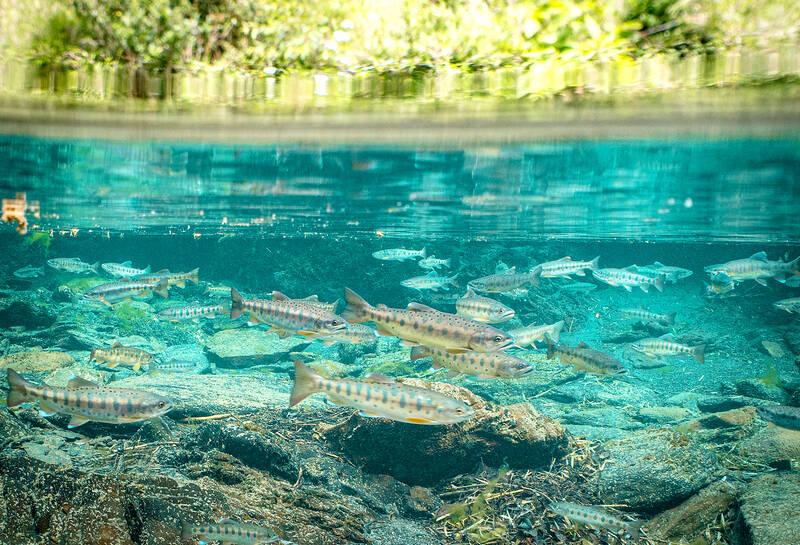
Photo courtesy of Shei-Pa National Park Headquarters
Despite early setbacks, such as Typhoon Aere destroying the Qijiawan hatchery in 2004, efforts intensified. A new ecological center opened in 2005, and by 2006, salmon were released into historical streams, including Hehuan and Nanhu Rivers, and Sijielan, Leshan, and Luoyewei Creeks. Although initial results were discouraging, with some failures reported in 2008, the team persisted, employing innovative methods like small radio transmitters to track individual salmon and understand their behavior.
Habitat restoration was equally crucial. In 1997, the park began planning a wastewater treatment system to address pollution from agricultural activities and recreational areas nearby Wuling Farm. By 2002, the first facility was operational, significantly reducing contaminants in the river. The park also partnered with Wuling Farm to from agriculture to eco-tourism, reclaiming farmland for reforestation. Over 500,000 native trees were planted along riverbanks, and in 2006, the park acquired 8.1 hectares of private land to further protect salmon habitats.
In addition, hydraulic structures like silt traps and weirs disrupted salmon migration. In 1996, the park began studying the feasibility of removing or modifying these barriers. Over time, several silt traps were dismantled, and boulders were returned to riverbeds, stabilizing the substrate and creating deeper pools for spawning. A major breakthrough came in 2011 when the 15-meter-high No. 1 Weir was removed, allowing salmon to migrate upstream even after typhoons. By 2012, the population in the Qijiawan River had rebounded to 5,400 individuals, underscoring the importance of restoring ecological connectivity.
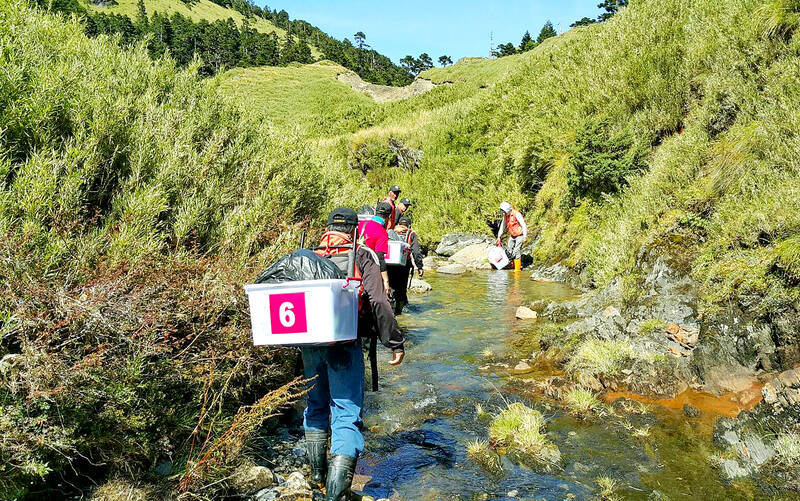
Photo courtesy of Shei-Pa National Park Headquarters
A key component of the recovery efforts was the involvement of local communities. Recognizing the effectiveness of local participation, the Park formalized partnerships with indigenous Atayal communities. In 2000, the Sqoyaw Village and Nanshan Tribe communities formed informal fish protection teams, helping to safeguard salmon habitats and monitor ecological changes. Over the years, these partnerships grew, and in 2004, the park began collaborating with the Sqoyaw community to patrol streams such as Yousheng, Sijielan, and Nanhu River. Subsequent collaborations included partnerships with the Nanshan, Tabuk, and Qalang Mkbubun communities to monitor and protect other key salmon habitats.
The salmon’s recovery also required the team to explore new habitats. With global warming posing a serious threat to the species, as rising temperatures make it more difficult for the salmon to thrive in lower-altitude streams, the team began releasing salmon into higher-altitude locations such as Hehuan and Nanhu Rivers, which provided more suitable conditions for the salmon’s survival.
In 2017, Shei-Pa National Park collaborated with Taroko National Park to release salmon into the Hehuan and Nanhu rivers. By 2018, successful wild populations were observed in Hehuan River, the second-largest population outside the Qijiawan River. This marked a significant step forward in the conservation efforts for the Formosan landlocked salmon.
By 2022, the wild population of Formosan landlocked salmon had reached 15,374 individuals, a 60-fold increase from the early stages of restoration. And in 2023, the team achieved a breakthrough in fish transport techniques, successfully moving over 10,000 fertilized salmon eggs to the Zhongyangjian River at an altitude of 2,200 meters. This pioneering method, which involved waterless transportation, allowed the team to expand the salmon’s range further, and by 2024, they discovered that the salmon had established a viable population in the Zhongyangjian River.
The population of Formosan landlocked salmon has not only rebounded, but its habitat has expanded, and the species is now thriving in multiple locations across Taiwan. This success story is a shining example of how collaboration, innovation, and long-term commitment to conservation can reverse the damage done to fragile ecosystems and endangered species. The recovery of the Formosan landlocked salmon serves as a reminder of the importance of preserving our natural heritage for future generations.

NATIONAL SECURITY: Authorities are working to confirm the identities of the military personnel involved and investigating possible illegal conduct and regulatory violations Authorities are probing possible national security implications after Kinmen police and immigration officers on Sunday found a Chinese woman allegedly posing as a tourist while engaging in prostitution involving more than 10 military personnel. The woman, surnamed Chen (陳), has since been deported, authorities said, adding that investigators are still working to confirm the identities of those implicated, as the records only listed code names and aliases. The case stemmed from a report received by the Kinmen District Prosecutors’ Office on Friday last week from the Jinhu Precinct of the Kinmen County Police Bureau. On Sunday, police, along with the National Immigration

GLOBALGIVING: ‘ Caving to external pressure is not acceptable for an organization that has cultivated justice reform and human rights for 30 years,’ one NGO said A slew of non-government organizations (NGOs) have withdrawn from the GlobalGiving fundraising platform after it announced it would use “Chinese Taipei” instead of “Taiwan” from next month. The Taiwan Good Rice Association wrote on Facebook on Friday that it was informed on April 28 via a teleconference call of the change, which was made because the platform wanted to operate in China. Taiwan Good Rice is to terminate all cooperative relationships with GlobalGiving in response to the platform’s “unilateral and non-negotiable” decision to remove references to Taiwan, the NGO said. “Taiwan is in the official name of Taiwan Good Rice Association and the

HEAVY WEATHER: Typhoon Jangmi is due to crash straight into the Ryukyus as airlines look to shift flights to larger aircraft or cancel flights to Okinawa entirely Taiwan’s international air carriers announced flight adjustments over the weekend as Typhoon Jangmi is forecast to hit the Ryukyu Islands today and tomorrow. The Central Weather Administration (CWA) upgraded Jangmi from a tropical storm to a typhoon at 8am yesterday, with the eye located 580km south of Naha city. It was moving north at 19kph. Today, China Airlines’ CI-120, CI-121, CI-122 and CI-123 flights between Taoyuan and Naha, Okinawa, have been canceled as well as CI-132 and CI-133 between Kaohsiung and Naha. EVA Air’s BR-112, BR-113, BR-186 and BR-185 flights between Taoyuan and Naha are also canceled. Low-cost carrier Tigerair Taiwan canceled IT-230,

MULTIPRONGED APPROACH: China has sought to pressure Palau across a number of fronts, but the island nation has staunchly resisted overtures to ditch Taiwan Palau has been firm in backing Taiwan despite Chinese pressure that uses tourism economics, cyberattacks and criminal infiltration as tools to threaten the Pacific ally into renouncing its recognition of Taiwan as a sovereign state. The Presidential Office yesterday announced that Vice President Hsiao Bi-khim (蕭美琴) would visit Palau from Saturday to Wednesday next week at the invitation of Palauan President Surangel Whipps Jr. Whipps in April said in an interview that China had outspokenly asked Palau to “denounce Taiwan.” “And we have said: ‘We have no enemies, but nobody tells us who our friends are,’” he said. Whipps has told reporters multiple times


 RSS
RSS