


Chinese Nationalist Party (KMT) caucus whip Fu Kun-chi’s (傅?萁) trip to Hong Kong served China’s interests and he acts as though the enemy is Taiwan’s ruling party, Democratic Progressive Party caucus secretary-general Tsai Yi-yu (蔡易餘) told a news conference at the legislature in Taipei yesterday.
“The KMT is embracing the Chinese Communist Party as a friend, while it treats the DPP as the enemy,” Tsai said.
China is conducting its largest military exercise in three decades, with drills by Chinese naval and coast guard vessels along China’s coast, including in the Taiwan Strait, while its aircraft have also been active, he said, adding that Taiwan’s defenses are on high alert.
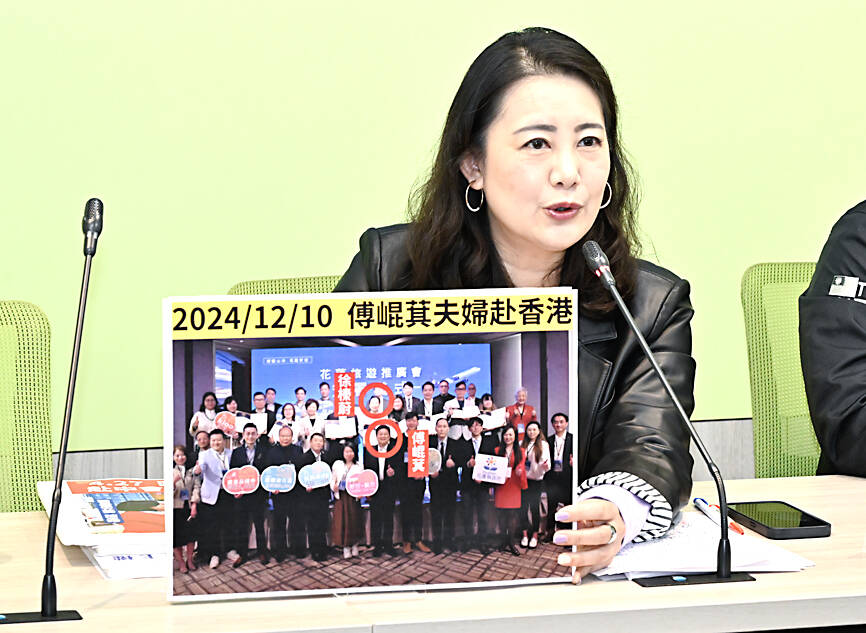
Photo: Chen Chih-chu, Taipei Times
“Yet as this is going on, the largest opposition party and its caucus leader are on a trip to Hong Kong and meeting with Chinese officials,” he said. “Fu is acting as a foot soldier of China.”
It is disheartening, because DPP lawmakers have proposed amendments to enhance national security and bolster military defenses to deter a Chinese invasion, but the KMT is doing the opposite by cooperating with Beijing and undermining the effort to safeguard Taiwan’s sovereignty, he said.
Fu and his wife, KMT Hualien County Commissioner Hsu Chen-wei (徐榛蔚), are in Hong Kong to promote Hualien’s agricultural products and tourism, he said.
They plan to sign a direct air flight agreement between Hong Kong and Hualien City.
DPP Legislator Puma Shen (沈伯洋) said it is no wonder that each time he proposed tougher national security laws to help combat pervasive infiltration by Chinese agents and proxies, Fu and the KMT blocked them.
They have done so 26 times this year, Shen said.
DPP caucus chief executive Rosalia Wu (吳思瑤) said that Fu was more like a Chinese government official than a legislator representing a constituency in Taiwan.
It is uncertain which country Fu is serving, Wu said.
Fu has traveled to China often, including heading a group of 17 KMT legislators to Beijing to meet with top Chinese government officials in April, she said.
“Fu is the KMT’s caucus whip. He should be working with his party at committees and at cross-party negotiations, but he is in Hong Kong and the meetings are delayed,” Wu said.

FUKUOKA SITUATION: Japanese media reported that the pathogen is expected to be identified by the summer, while the CDC downplayed the idea that it was hMPV A “mysterious cold-like illness” reported in Japan’s Fukuoka Prefecture does not seem to be a new disease, but Japanese authorities have been asked about the situation, the Centers for Disease Control (CDC) said yesterday. The Fukuoka Prefectural Medical Association on Wednesday told a news conference that a “mystery cold” that has become a hot topic on social media is “highly likely to be caused by some kind of viral infection,” Japan’s KBC News reported. “Many people are experiencing symptoms starting with a sore throat, followed by a runny nose, phlegm and a severe cough,” KBC News reported, citing association officials. Health authorities are

Nvidia Corp CEO Jensen Huang (黃仁勳) arrived in Taiwan yesterday ahead of upcoming AI and technology events, saying he plans to meet with clients and Taiwan Semiconductor Manufacturing Co Chairman C.C. Wei (魏哲家) during his visit. After landing at Taipei Songshan Airport, Huang posed for photos with fans and handed out Yakult drinks to reporters and supporters waiting at the scene, saying he has “a lot to do” during the trip. Asked about reports that Nvidia’s planned headquarters site in Taipei’s Beitou Shilin Technology Park could break ground on May 27, Huang said that if the company holds an event, he would

Carrefour Taiwan is to begin using a new name from the start of July, but it cannot divulge the name until then, the chairman of the supermarket chain's parent company said today. President Chain Store Co chairman Lo Chih-hsien (羅智先) was asked by reporters after a shareholders' meeting to confirm whether the company has settled on a new name for the supermarket brand. In March, the government-registered name of two Carrefour Taiwan branches was quietly changed to "Le Chia Kang" (樂家康) in Chinese, raising speculation that has been selected as the name. Lo said that because of local regulations and contractual obligations, the
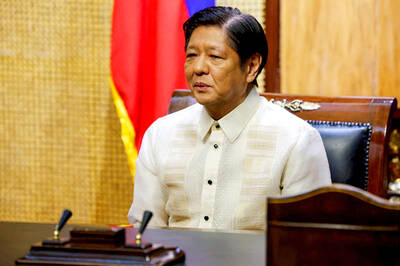
The Philippines would likely be involved in any conflict over Taiwan due to its proximity to the democracy claimed by China, President Ferdinand Marcos Jr said, reiterating a stance that risks angering Beijing. “In the Philippines, we do not have a choice because Taiwan is so close to the Philippines and we have almost 200,000 Filipino nationals living and working in Taiwan,” Marcos said in an interview with Japanese media in Manila on Monday. The Philippine leader’s comments come ahead of a state visit to Japan next week, where he is to meet with Japanese Prime Minister Sanae Takaichi to discuss security


 RSS
RSS