


The Supreme Court yesterday upheld a guilty verdict and prison sentence of ten years and five months for former Chinese Nationalist Party (KMT) Kaohsiung City Councilor Chen Tsui-luan (陳粹鑾) for embezzling public funds.
Through her unwitting daughter, Cheng An-li (鄭安秝), also a Kaohsiung City councilor, Chen falsified a list of assistants and claimed NT$4.49 million (US$138,000) in fraudulent fees in nine years.
In February 2013, Chen, then a city councilor, took her family on a trip, then falsely filed NT$30,000 in travel expenses using receipts from the travel agency, claiming it was a domestic study tour.
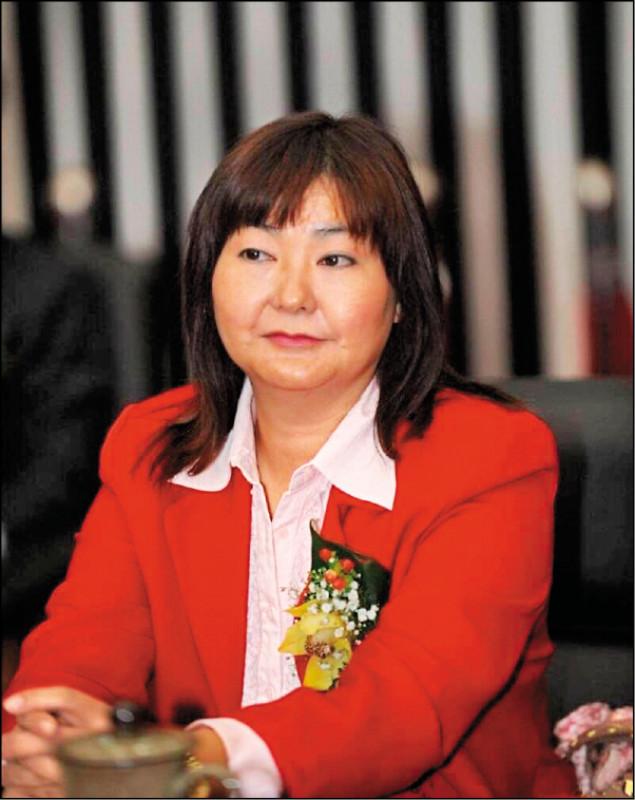
Photo: Taipei Times
She was sentenced to three years and eight months for forgery and corruption, which she appealed and lost.
She was released from prison in August 2020 on parole.
Cheng became the youngest member of the Kaohsiung City Council in KMT history after running in her mother’s place in 2018.
Chen, from prison, worked with her son Cheng Chia-hong (鄭嘉宏), and her daughter’s office manager, Wang Mei-chu (王美珠), to take advantage of Cheng An-li’s city councilor position.
Chen, Wang and Cheng Chia-hong falsified lists of aides, including using the names of relatives and associates, to claim public assistant subsidies from the council.
Cheng An-li was unaware of the scheme.
In their first trial, the Kaohsiung District Court found that across her terms in office as well as her daughter’s term, Chen defrauded the city of NT$1.14 million, NT$2.65 million, and NT$690,000 respectively, for a total of NT$4.49 million.
The court sentenced Chen to 10 years and five months in prison, Wang to two years and six months and Cheng Chia-hong to one year and four months.
In a second trial this year, the Kaohsiung High Court upheld the sentence for Chen but commuted Cheng Chia-hong’s sentence to four years of probation, while Wang withdrew the appeal before the verdict, making the sentence final.
Chen and her son appealed again to the Supreme Court, which did not find a reason for further appeal, making their verdicts final.

Considering that most countries issue more than five denominations of banknotes, the central bank has decided to redesign all five denominations, the bank said as it prepares for the first major overhaul of the banknotes in more than 24 years. Central bank Governor Yang Chin-lung (楊金龍) is expected to report to the Legislative Yuan today on the bank’s operations and the redesign’s progress. The bank in a report sent to the legislature ahead of today’s meeting said it had commissioned a survey on the public’s preferences. Survey results showed that NT$100 and NT$1,000 banknotes are the most commonly used, while NT$200 and NT$2,000

The Centers for Disease Control (CDC) yesterday reported the first case of a new COVID-19 subvariant — BA.3.2 — in a 10-year-old Singaporean girl who had a fever upon arrival in Taiwan and tested positive for the disease. The girl left Taiwan on March 20 and the case did not have a direct impact on the local community, it said. The WHO added the BA.3.2 strain to its list of Variants Under Monitoring in December last year, but this was the first imported case of the COVID-19 variant in Taiwan, CDC Deputy Director-General Lin Ming-cheng (林明誠) said. The girl arrived in Taiwan on

South Korea is planning to revise its controversial electronic arrival card, a step Taiwanese officials said prompted them to hold off on planned retaliatory measures, a South Korean media report said yesterday. A Yonhap News Agency report said that the South Korean Ministry of Foreign Affairs is planning to remove the “previous departure place” and “next destination” fields from its e-arrival card system. The plan, reached after interagency consultations, is under review and aims to simplify entry procedures and align the electronic form with the paper version, a South Korean ministry official said. The fields — which appeared only on the electronic form

The Ministry of Foreign Affairs (MOFA) is suspending retaliation measures against South Korea that were set to take effect tomorrow, after Seoul said it is updating its e-arrival system, MOFA said today. The measures were to be a new round of retaliation after Taiwan on March 1 changed South Korea's designation on government-issued alien resident certificates held by South Korean nationals to "South Korea” from the "Republic of Korea," the country’s official name. The move came after months of protests to Seoul over its listing of Taiwan as "China (Taiwan)" in dropdown menus on its new online immigration entry system. MOFA last week


 RSS
RSS