


A study published by scientists at National Sun Yat-sen University has shown how microplastic pollution is altering the structure of coral skeletons, putting them at greater risk of being damaged or dissolving.
The study, led by department of chemistry chair Hsieh Shu-chen (謝淑貞) and Chen Chen-tung (陳鎮東), chair professor for research in the department of oceanography, was published last month in the journal Environmental Chemistry Letters, the university said last week.
Summarizing the study’s results, Hsieh said it showed how microplastic pollution directly drives the degradation of coral reefs and the diverse ecosystems they support.
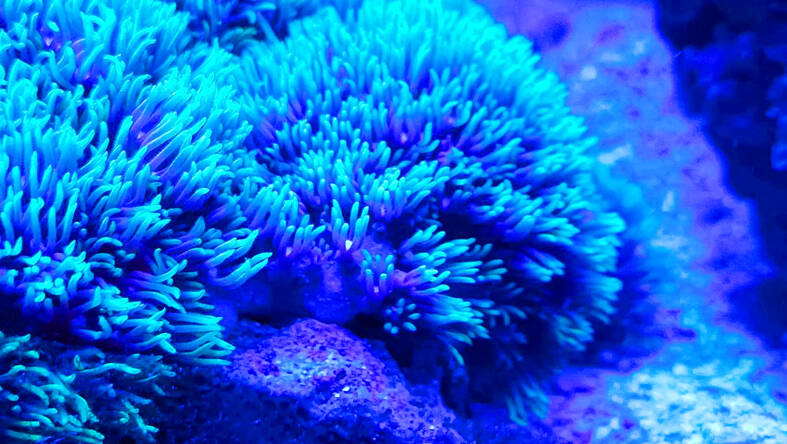
Photo courtesy of National Sun Yat-sen University
An increasing number of coral reefs, particularly those in polluted environments, are likely to face such degradation unless stronger measures are taken to mitigate plastic pollution, Hsieh said.
In the study, the team cultivated the coral species Briareum violacea and exposed it to polyethylene microplastics at concentrations of 0, 5, 10, 50, 100 and 300 milligrams per liter for seven days.
Following the exposure, the team measured the changes in the coral’s skeletal structure, solubility and the levels of calcium in the seawater, the university said.
The researchers found that of the two calcium carbonite crystal structures found in healthy coral — calcite and aragonite — exposure to microplastics caused the structure of calcite to weaken significantly.
As calcite crystals gradually disappeared from the coral, they were replaced by a much more unstable crystalline form, known as amorphous calcium carbonate, the university said.
The team said these changes harmed the structural integrity of the coral, causing it to degrade more easily, while also raising the calcium ion concentration in the surrounding seawater.

Considering that most countries issue more than five denominations of banknotes, the central bank has decided to redesign all five denominations, the bank said as it prepares for the first major overhaul of the banknotes in more than 24 years. Central bank Governor Yang Chin-lung (楊金龍) is expected to report to the Legislative Yuan today on the bank’s operations and the redesign’s progress. The bank in a report sent to the legislature ahead of today’s meeting said it had commissioned a survey on the public’s preferences. Survey results showed that NT$100 and NT$1,000 banknotes are the most commonly used, while NT$200 and NT$2,000

The Centers for Disease Control (CDC) yesterday reported the first case of a new COVID-19 subvariant — BA.3.2 — in a 10-year-old Singaporean girl who had a fever upon arrival in Taiwan and tested positive for the disease. The girl left Taiwan on March 20 and the case did not have a direct impact on the local community, it said. The WHO added the BA.3.2 strain to its list of Variants Under Monitoring in December last year, but this was the first imported case of the COVID-19 variant in Taiwan, CDC Deputy Director-General Lin Ming-cheng (林明誠) said. The girl arrived in Taiwan on

South Korea is planning to revise its controversial electronic arrival card, a step Taiwanese officials said prompted them to hold off on planned retaliatory measures, a South Korean media report said yesterday. A Yonhap News Agency report said that the South Korean Ministry of Foreign Affairs is planning to remove the “previous departure place” and “next destination” fields from its e-arrival card system. The plan, reached after interagency consultations, is under review and aims to simplify entry procedures and align the electronic form with the paper version, a South Korean ministry official said. The fields — which appeared only on the electronic form

The Ministry of Foreign Affairs (MOFA) is suspending retaliation measures against South Korea that were set to take effect tomorrow, after Seoul said it is updating its e-arrival system, MOFA said today. The measures were to be a new round of retaliation after Taiwan on March 1 changed South Korea's designation on government-issued alien resident certificates held by South Korean nationals to "South Korea” from the "Republic of Korea," the country’s official name. The move came after months of protests to Seoul over its listing of Taiwan as "China (Taiwan)" in dropdown menus on its new online immigration entry system. MOFA last week


 RSS
RSS