

All of the nearly 2,000 passengers currently stranded on a cruise ship in Naha, Japan, are to return by Thursday, Minister of Transportation and Communications Chen Shih-kai (陳世凱) said today.
Mediterranean Shipping Co’s (MSC) ship the MSC Bellissima had a malfunction, stranding it at the Okinawa port with 1,857 Taiwanese passengers on board.
The Ministry of Transportation and Communications has coordinated with domestic airlines and the Japanese government to use larger aircraft and increase the number of flights, adding about 748 seats over today and tomorrow, Chen told legislators during a committee hearing at the legislature.

Photo: Lu Hsien-hsu, Taipei Times
With the help of additional charter flights, the ministry expects all affected travelers to return by Thursday, he added.
Democratic Progressive Party Legislator Lee Kun-tse (李昆澤) said that although there are administrative procedures to overcome, the ministry should work efficiently to allow all passengers to return by tomorrow.
While MSC has offered compensation for affected travelers, the costs of tickets and shore excursions are not the same, so the Tourism Administration should work with the Travel Quality Assurance Association to protect passengers’ rights, Lee added.
MSC is to cover the ticket costs, Chen added.
The MSC Bellissima, carrying 4,341 passengers, departed from Keelung on Wednesday last week for Okinawa, with planned stops at Miyako Island, Naha and Ishigaki Island.
It was set to return to Taiwan on Sunday.
Passengers who arranged their own transportation from Naha can claim compensation of up to US$400 if they traveled outside Japan and up to US$200 for domestic travel within Japan, the cruise operator said.
A separate trip of 2,080 passengers scheduled to board the MSC Bellissima in Keelung on Sunday was canceled.
The cruise operator said it had informed all those affected on Saturday.
To compensate for the disruption, the operator promised full refunds to all impacted passengers.
It would also provide a voucher worth up to 50 percent of the ticket value that is to be valid until Dec. 31 next year.
Additional reporting by CNA
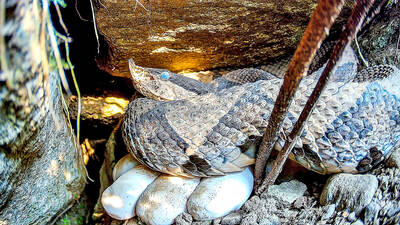
NATURE TAKES ITS COURSE: The agency’s head said he felt a sense of loss watching red-banded snakes eat the babies, as they had decided on non-intervention The Forestry and Nature Conservation Agency yesterday released a documentary on a hundred-pace viper that had incubated 16 eggs, all of which hatched, but only a baby viper escaped after they were attacked by red-banded snakes. The agency’s Taichung branch last year launched the viper reproduction monitoring project soon after forest rangers Lin Chun-yu (林俊佑) and Chou Chia-cheng (周家成) spotted a pregnant hundred-pace viper in a grass-covered burrow near a parking lot in Tbulan Village (松鶴部落). The Atayal village, in Taichung’s Heping District (和平), is headed by Ecyang Yapu, who was positive about the project and assisted in access control and power
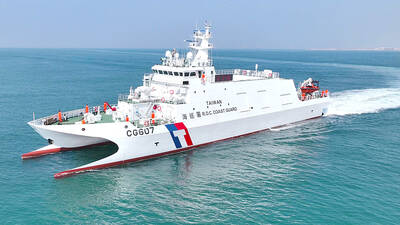
The Coast Guard Administration (CGA) yesterday said that it had deployed vessels to “monitor” Chinese ships operating in waters off the east coast. The CGA said it dispatched vessels in response to a China Coast Guard announcement that it had carried out another “routine law-enforcement patrol” in waters off the east coast. “The CGA firmly rejects China’s cognitive warfare campaign of ‘law enforcement in name, jurisdictional expansion in practice,’” it said on X. As of 11am yesterday, two China Coast Guard ships were “loitering and drifting” about 105 nautical miles (195km) and 74 nautical miles east of Green Island (綠島) respectively, it said. It
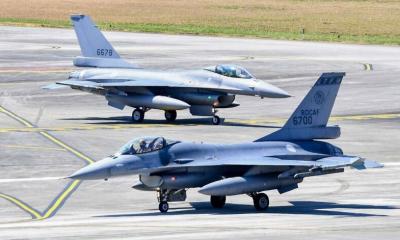
The first two F-16V Block 70 jets Taiwan purchased from the US were spotted unexpectedly turning back after departing from Hawaii yesterday, potentially further delaying delivery of the aircraft. Taiwan has purchased 66 of the F-16 C/D Block 70 jets to be deployed at Chihhang Air Base (志航基地) in Taitung County and operated by the air force's 7th Tactical Fighter Wing to defend Taiwan’s eastern region. Two single-seat jets, bearing serial No. 6727 and 6728, were spotted taking off from Hickam Field in Hawaii yesterday, observers said. Based on the precedent set during the delivery of Taiwan's older F-16 Block 20s, the new
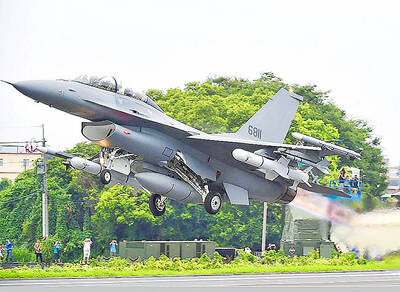
A sharp rise in compensation to be paid by air force officers who leave before completing their required service could indicate an increase in pilots leaving the military early, an analyst said on Friday, warning that the trend could worsen a shortage of experienced personnel. Chieh Chung (揭仲), a researcher at the Association for Strategic Foresight, issued the warning even though the number of volunteer military personnel is expected to increase next year. The planned headcount for volunteer military personnel, covering officers, noncommissioned officers (NCO) and enlisted soldiers, is 158,223 for next year, up 4,258 from 153,965 this year, Chieh said. The increase


 RSS
RSS