


Forming or joining a political party in Taiwan under instructions from the Chinese Communist Party (CCP) would be “crossing the red line,” the Mainland Affairs Council (MAC) said yesterday on the latest alleged CCP approach to influencing Taiwan.
Singer Alexis Ho (何以奇) and musician Hsieh Ho-hsien (謝和弦) in June said they were among a group of Taiwanese entertainers who received letters urging them to join a political party backed by NT$450 million (US$14.6 million) from “overseas sources.”
More recently, Ho disclosed that she received instructions on a “plan to build a new cross-strait relationship,” which would involve the establishment of a “Taiwan Embrace Peace Party” (台灣擁和黨), with Ho serving as the party’s deputy chairman.

Photo: Screen grab from Alexis Ho’s Facebook page
The party would then participate in the 2026 local elections with the aim of securing the mayorship of at least one city or county, she said, adding that it would also aim for 10 party members to secure positions as municipal or county councilors.
As the Ministry of the Interior said in June, anyone who forms a political party or develops a networking organization at the direction of foreign entities or with financial support from abroad could be contravening the National Security Act (國家安全法) or the Anti-Infiltration Act (反滲透法), the MAC said yesterday.
The National Security Act in particular prohibits “initiating, funding, hosting, manipulating, directing or developing an organization” for “a foreign country, Mainland China, Hong Kong, Macau” or “organizations, institutions, or groups established or substantially controlled by them,” it said.
Additionally, the Anti-Infiltration Act stipulates that “no one may be instructed, entrusted, or funded by foreign hostile forces to engage in activities that disrupt social order, spread false information or interfere with elections,” it said.
Article 33-1 of the Act Governing Relations Between the People of the Taiwan Area and the Mainland Area (臺灣地區與大陸地區人民關係條例) also prohibits “any cooperative activity of a political nature with any individual, juristic person, organization, or other institution of the Mainland Area.”
“The Republic of China Constitution guarantees freedom of speech and political participation, but that which involves cooperation with the CCP crosses the legal red line,” MAC said, adding that the government would investigate all cases of suspected collaboration with the CCP.
Separately, Democratic Progressive Party (DPP) caucus chief executive Rosalia Wu (吳思瑤) yesterday said that Taiwanese artists who work in China have always been forced to express support for the CCP’s united front efforts.
If Taiwan’s democratic elections are infiltrated through those efforts, the consequences would be “catastrophic,” she said.
“We must take a serious look at the possibility that legislators from China could be elected into Taiwan’s Legislative Yuan,” she said.
“We call on national security officials to respond sternly to those suspected of cooperating with China’s united front,” she added.
Additional reporting by Liao Chia-ning


UPGRADE: The Kang Ding-class frigate is replacing its Chaparall missiles with Tien Chien II and Hua Yang VLS, which would provide it with long-range, 360° air defense Taiwan plans to produce 1,200 to 1,376 Hai Chien II missiles (海劍二, Sea Sword II) — also known as TC-2N — to serve as the standard air defense system of the navy’s surface combatant fleet, a source said yesterday. Last week, the Hai Chien II, the naval version of the Tien Kung II missile (天劍二, Sky Sword II), completed a live-fire test in waters off the National Chungshan Institute of Science and Technology’s Jiupeng facility (九鵬) in Pingtung County’s Manjhou Township (滿州). The MIM72 Chaparral and other dated air defense missiles that currently arm Taiwanese ships have inadequate range to combat Chinese

REASONS FOR TRAVEL: An assistant professor said that proposed amendments to penalize drivers if they used drugs overseas would not deter people from traveling People who operate a motor vehicle under the influence of marijuana would have their driver’s license revoked, even if they used the substance while overseas, the Ministry of Transportation and Communications said yesterday, citing proposed amendments to the Road Traffic Management and Penalty Act (道路交通管理處罰條例). The amendments would also authorize the government to revoke the licenses of people determined to have used Category 1 or Category 2 narcotics, even if they were not operating a vehicle while under the influence of drugs, as well as ban them from taking the license test for three years, the ministry said. People aged 18 or
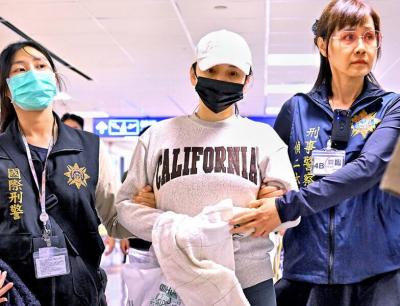
Johanne Liou (劉喬安), a Taiwanese woman who shot to unwanted fame during the Sunflower movement protests in 2014, returned to Taiwan last night after being deported from the US. She is to stand trial in Taiwan for charges involving embezzlement, fraud and drug crimes. The Criminal Investigation Bureau (CIB) said it took her into custody at Taiwan Taoyuan International Airport and would first question her before transferring her to the New Taipei District Prosecutors’ Office. She was arrested upon disembarking a flight from San Francisco that landed shortly before 7pm. Liou absconded to the US in 2019 after jumping bail
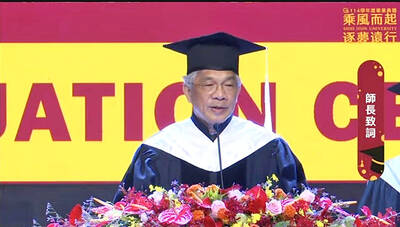
Shih Hsin University President Chen Ching-he (陳清河) yesterday issued a public apology for comments made in his commencement speech last week, stating that he has asked the school to suspend his duties and halt his wages for two months as a show of contrition. At the commencement ceremony on May 30, Chen said, “If you don’t manage your time well, or your own emotions, or your health, then I am telling every one of you — put a quick end to ‘you,’ because the world has no need for ‘you.’” The comments have sparked significant controversy online, and Chen through an open


 RSS
RSS