


The Office of Trade Negotiations yesterday said it was disappointed by what appears to be a delay in the consideration of Taiwan’s application to join the Comprehensive and Progressive Agreement for Trans-Pacific Partnership (CPTPP).
The office in a statement expressed “deep regret and disappointment” that CPTPP members did not reach an agreement to initiate Taiwan’s accession process during their commission meeting in Vancouver, Canada, on Wednesday and Thursday.
The office urged CPTPP members to “not have political considerations” and to agree to establish a working group to handle Taiwan’s membership.
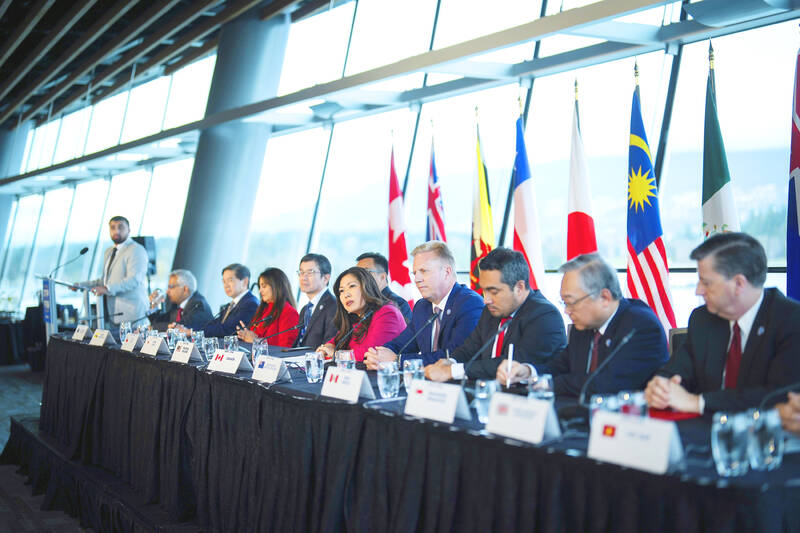
Photo: AP
The office was likely referring to the reluctance of some CPTPP member states to address the Taiwan issue as it might alienate their main trading partner China, which has submitted its own application to the bloc and opposed Taiwan’s accession.
Achieving a consensus among CPTPP members remained a major hurdle for Taiwan’s bid, the office said.
However, it is committed to bolstering economic ties with them to gain their support for Taiwan’s inclusion, it added.
Taiwan has launched a diplomatic push to improve official engagements with individual CPTPP members since submitting its application in September 2021 and has completed legislative reforms to bring Taiwan’s trade-related regulations in line with the bloc’s standards, it said.
At the CPTPP meeting, the members approved Costa Rica’s bid to commence the accession process.
The Central American nation applied to join the bloc in August 2022.
“The CPTPP family is expanding,” Canadian International Minister of Trade Mary Ng told a news conference following the meeting, adding that the bloc was establishing a working group to work toward Costa Rica’s accession.
Ng did not respond directly to a question about Taiwan’s application status, saying instead: “We remain completely open to having new members join the CPTPP” as long as they adhere to “the Auckland principles.”
She was referring to the requirements set by the CPTPP for memberships, which are meeting the trade pact’s high standards, demonstrating a strong track record of meeting trade obligations and garnering a consensus among all members.
Asked if Taiwan’s application has been put on hold because of China, Ng said that Canada’s “one China” policy had not changed.
However, “the work that we do together as CPTPP partners is one where we do work on consensus, and consensus means all of the partners would need to achieve that consensus in order for us to move to that next step,” she added.
The CPTPP is one of the biggest trade blocs in the world, representing about 15 percent of the global economy.
It has 11 members: Australia, Brunei, Canada, Chile, Japan, Malaysia, Mexico, New Zealand, Peru, Singapore and Vietnam, with the UK set to become the 12th member next month.
Canada is the chair of the CPTPP Commission for this year. Australia is to take the baton next year.

NATIONAL SECURITY: Authorities are working to confirm the identities of the military personnel involved and investigating possible illegal conduct and regulatory violations Authorities are probing possible national security implications after Kinmen police and immigration officers on Sunday found a Chinese woman allegedly posing as a tourist while engaging in prostitution involving more than 10 military personnel. The woman, surnamed Chen (陳), has since been deported, authorities said, adding that investigators are still working to confirm the identities of those implicated, as the records only listed code names and aliases. The case stemmed from a report received by the Kinmen District Prosecutors’ Office on Friday last week from the Jinhu Precinct of the Kinmen County Police Bureau. On Sunday, police, along with the National Immigration
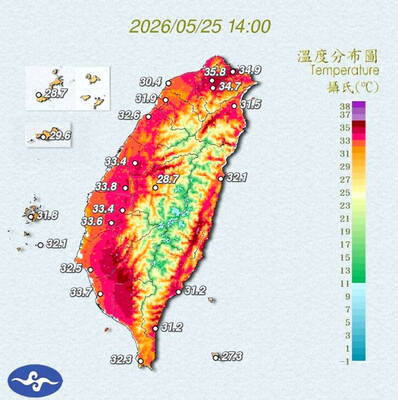
STAY COOL: The HPA recommended that people stay hydrated, use air-conditioning or fans while indoors, wear loose-fitting clothes and walk in the shade while outdoors Employers must implement measures such as installing cooling equipment, and providing drinking water and rest breaks for outdoor workers starting from Monday next week, the Taipei Department of Labor said on Sunday. Employers who fail to comply could face fines of NT$30,000 to NT$300,000 under the Occupational Safety and Health Act (職業安全衛生法), the department said. Businesses in Taipei employing fewer than 100 workers, as well as registered self-employed workers with labor insurance coverage, could receive on-site assessments and guidance from occupational safety consultants to help them apply for central government subsidies to implement or improve heat-protection measures, it said. Under the Ministry of

GLOBALGIVING: ‘ Caving to external pressure is not acceptable for an organization that has cultivated justice reform and human rights for 30 years,’ one NGO said A slew of non-government organizations (NGOs) have withdrawn from the GlobalGiving fundraising platform after it announced it would use “Chinese Taipei” instead of “Taiwan” from next month. The Taiwan Good Rice Association wrote on Facebook on Friday that it was informed on April 28 via a teleconference call of the change, which was made because the platform wanted to operate in China. Taiwan Good Rice is to terminate all cooperative relationships with GlobalGiving in response to the platform’s “unilateral and non-negotiable” decision to remove references to Taiwan, the NGO said. “Taiwan is in the official name of Taiwan Good Rice Association and the

Chinese Nationalist Party (KMT) Chairwoman Cheng Li-wun (鄭麗文) yesterday briefed her party’s Central Standing Committee regarding her scheduled visit to the US between Monday next week and June 16, saying that her purpose would be to persuade the US that the Republic of China (ROC) Constitution was a “one China” constitution that would foster stable and peaceful cross-strait relations. The ROC Constitution is the most important defense for all Taiwanese citizens, as it upholds our democracy and has contributed to our robust economy, which aligns with international and US interests, she said. “We would not be troublemakers and drag the US under,”


 RSS
RSS