


The Democratic Progressive Party (DPP) yesterday accused the Chinese Nationalist Party (KMT) of creating a stir on social media by implying that the government supports martial law, adding that the KMT is the least qualified to criticize others after decades of martial law in Taiwan under the former KMT regime.
After South Korean President Yoon Suk-yeol late on Tuesday night declared martial law (which was rescinded six hours later), the DPP caucus issued a statement on Thread saying that Taiwan’s legislature was facing a situation similar to that in South Korea, which had prompted Yoon to declare martial law.
“The South Korean parliament has been manipulated by North Korean forces... It led to South Korean President Yoon Suk-yeol announcing emergency martial law nationwide to protect the free constitutional system... In Taiwan’s legislature, the blue [KMT] and white [Taiwan People’s Party, TPP] political forces have proposed cutting the national defense budget, expanding legislative powers through unconstitutional means, suspending the Constitutional Court, rewriting the law on fiscal budget, setting restrictions on the recall of unfit politicians,” the DPP post said. “We are Team Taiwan, and are working every second to fight the global dark and evil forces intruding into our nation.”
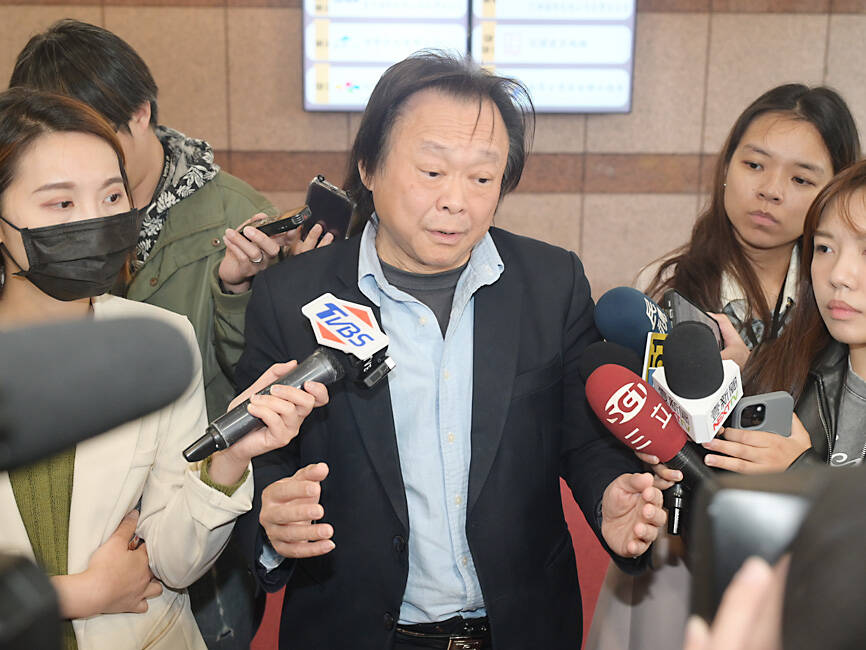
Photo: Wang Yi-song, Taipei Times
The DPP later deleted its post, but not before drawing criticism from the KMT and the TPP.
The KMT issued a statement and held a news conference, where it insinuated that the DPP supports martial law and demanded that President William Lai (賴清德) should apologize.
It added that the “long-term leadership” of the DPP presidency in Taiwan is similar to that of the South Korean president.
The TPP in a news release said that the “DPP is using democracy as a cover to disguise its authoritarian ideology, showing the public it is a party of ‘democratic regression’ ... and at heart it has a martial law mentality.”
In response to the criticism, DPP officials held a news conference, saying: “Our party was established during Taiwan’s martial law era, and we know full well the harm that martial law has done to democratic societies... The [DPP] post absolutely did not mean support for martial law, but was only meant to share international information, to compare it with the domestic political situation.”
“Some people are making incorrect insinuations and making projections to arouse controversy... We regret that the opposition has chosen to interpret it [the DPP post] this way, but it should stop such actions,” the DPP said.
“Who placed Taiwan under martial law for 38 years? It was the KMT, so it has no right to use this issue to create political disturbance,” DPP caucus chief executive Rosalia Wu (吳思瑤) asked.
“Taiwan is not under martial law now, and opposition parties must not use the issue to cause division in society,” she said.
Asked to comment, DPP Legislator Wang Shih-chien (王世堅) told reporters: “It was the KMT that imposed martial law for decades in Taiwan, and it should reflect on its own past.”
“Taiwanese fought for more than 70 years to attain democracy because of the decades-long martial law rule by the KMT,” Wang said. “Now we are close to achieving a full-fledged democracy, and our political parties and citizens are intelligent and know that martial law cannot return to Taiwan.”
Living under martial law, which was imposed in 1949 by the KMT government, was the most painful memory for many Taiwanese, with countless people being killed during that period, said new DPP Legislator-at-large Wang Yi-chuan (王義川), who was sworn in on Tuesday.
“Taiwanese still feel the pain and sadness when they remember those years. Now we have freedom and democracy in Taiwan, and the ruling party [the DPP] will not declare martial law,” he told reporters.
“Imposing martial law for any reason would have a great impact on democracy and the political system, leading to turmoil in society,” New Power Party Chairperson Claire Wang (王婉諭) said in a post on social media. “Although South Korea faces domestic troubles and external enemy threats, and the opposition controls parliament... these may be similar in Taiwan, but it does not mean our ruling party has any legitimate reason to declare martial law. Other parties should not even think about martial law rule returning to Taiwan.”
The Taiwan Statebuilding Party also issued a news release, saying: “Taiwan’s current political situation operates within a democratic system, and these problems must be dealt with through democratic means.”
Declaring martial law as South Korea did would mean suspending the democratic system, it said.
“Martial law would mean banning political activities and crowd gatherings, suspending media rights, and restricting freedom of expression, with the military and police forces taking control of society... In Taiwan, we have learned from history and nobody wants to return to that path,” it said. “The KMT has no right to stir up trouble over this issue, since it is the one that imposed martial law in Taiwan for nearly four decades.”

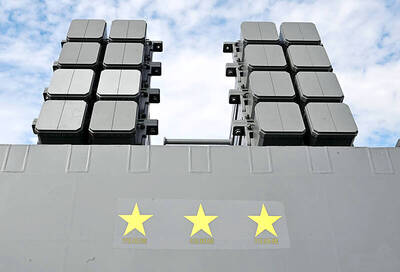
UPGRADE: The Kang Ding-class frigate is replacing its Chaparall missiles with Tien Chien II and Hua Yang VLS, which would provide it with long-range, 360° air defense Taiwan plans to produce 1,200 to 1,376 Hai Chien II missiles (海劍二, Sea Sword II) — also known as TC-2N — to serve as the standard air defense system of the navy’s surface combatant fleet, a source said yesterday. Last week, the Hai Chien II, the naval version of the Tien Kung II missile (天劍二, Sky Sword II), completed a live-fire test in waters off the National Chungshan Institute of Science and Technology’s Jiupeng facility (九鵬) in Pingtung County’s Manjhou Township (滿州). The MIM72 Chaparral and other dated air defense missiles that currently arm Taiwanese ships have inadequate range to combat Chinese

REASONS FOR TRAVEL: An assistant professor said that proposed amendments to penalize drivers if they used drugs overseas would not deter people from traveling People who operate a motor vehicle under the influence of marijuana would have their driver’s license revoked, even if they used the substance while overseas, the Ministry of Transportation and Communications said yesterday, citing proposed amendments to the Road Traffic Management and Penalty Act (道路交通管理處罰條例). The amendments would also authorize the government to revoke the licenses of people determined to have used Category 1 or Category 2 narcotics, even if they were not operating a vehicle while under the influence of drugs, as well as ban them from taking the license test for three years, the ministry said. People aged 18 or
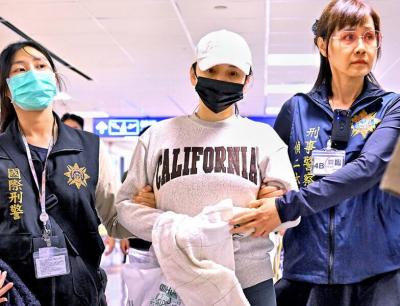
Johanne Liou (劉喬安), a Taiwanese woman who shot to unwanted fame during the Sunflower movement protests in 2014, returned to Taiwan last night after being deported from the US. She is to stand trial in Taiwan for charges involving embezzlement, fraud and drug crimes. The Criminal Investigation Bureau (CIB) said it took her into custody at Taiwan Taoyuan International Airport and would first question her before transferring her to the New Taipei District Prosecutors’ Office. She was arrested upon disembarking a flight from San Francisco that landed shortly before 7pm. Liou absconded to the US in 2019 after jumping bail
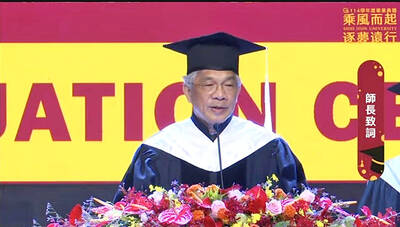
Shih Hsin University President Chen Ching-he (陳清河) yesterday issued a public apology for comments made in his commencement speech last week, stating that he has asked the school to suspend his duties and halt his wages for two months as a show of contrition. At the commencement ceremony on May 30, Chen said, “If you don’t manage your time well, or your own emotions, or your health, then I am telling every one of you — put a quick end to ‘you,’ because the world has no need for ‘you.’” The comments have sparked significant controversy online, and Chen through an open


 RSS
RSS