


The government would soon propose creating five NT$10 billion (US$307.6 million) funds to promote development in key fields, including artificial intelligence (AI), “smart” healthcare and green growth, Premier Cho Jung-tai (卓榮泰) said yesterday.
Cho revealed the plan in a speech at a business breakfast hosted by the Taipei-based Chinese National Association of Industry and Commerce, in which he laid out the government’s economic development goals.
Taiwan’s economic growth this year could exceed 4 percent and would build on the eight years under former president Tsai Ing-wen (蔡英文) in which annual economic growth averaged 3.14 percent, Cho said.
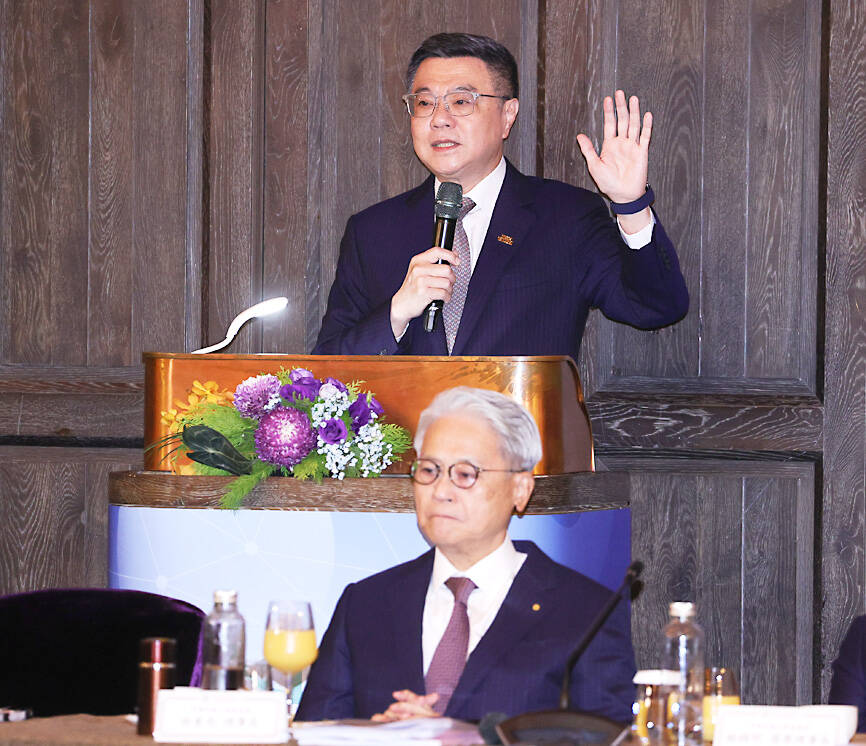
Photo: CNA
To sustain that momentum, the Executive Yuan would convene a third meeting of its Economic Development Commission next month, at which it would propose the creation of five NT$10 billion funds aimed at increasing Taiwan’s competitiveness, he said.
The commission was established in July with tasks focusing on strengthening the country’s economic development. It is headed by the premier.
The five funds would promote AI development, cultural and creative industries, “smart” healthcare, green growth and a youth overseas dream fund — a new program backing the participation of young people in volunteering, internships or other overseas learning activities, Cho said.
“Smart healthcare” refers to the use of technologies such as the Internet of Things, big data or AI to improve healthcare, while “green growth” refers to the harmonizing of economic development with environmental sustainability.
On the issue of Taiwan’s energy supply, the government would continue its efforts to gradually replace coal with natural gas in the electricity mix while also increasing production from renewable sources, Cho said.
He said he is confident that the government would be able to meet Taiwan’s growing electricity demand by building new energy facilities and developing green energy.
However, he also left the door open to the use of nuclear power, appearing to back off the Democratic Progressive Party’s long-standing pledges of a “nuclear-free homeland” and the phaseout of nuclear power by next year.
“There are new nuclear energy technologies being developed around the world, and the government will not be absent from that,” Cho said.
As long as nuclear energy can be used safely, a solution can be found for nuclear waste disposal and the Taiwanese public can reach a consensus on the issue, “we are actually very open to [it],” he said.
Last year, 42.2 percent of Taiwan’s electricity came from coal, 39.5 percent from natural gas, 6.3 percent from nuclear, 9.5 percent from renewable sources and 2.4 percent from other sources, Energy Administration data showed.
Over the next four years, the government hopes to keep GDP growth above 3 percent and raise GDP per capita to US$40,000 (up from US$32,319 last year), while keeping unemployment under 3.5 percent and holding inflation steady at 2 percent, Cho said.
To prepare for US president-elect Donald Trump taking office on Jan. 20, the Executive Yuan has also set up a specialized team focused on Taiwan-US trade ties, he said.
The government would also continue to pursue the completion of a Taiwan-US trade agreement, as well as membership in other international and regional trade pacts, he said.

Yangmingshan National Park authorities yesterday urged visitors to respect public spaces and obey the law after a couple was caught on a camera livestream having sex at the park’s Qingtiangang (擎天崗) earlier in the day. The Shilin Police Precinct in Taipei said it has identified a suspect and his vehicle registration number, and would summon him for questioning. The case would be handled in accordance with public indecency charges, it added. The couple entered the park at about 11pm on Thursday and began fooling around by 1am yesterday, the police said, adding that the two were unaware of the park’s all-day live

A former soldier and an active-duty army officer were yesterday indicted for allegedly selling classified military training materials to a Chinese intelligence operative for a total of NT$79,440. The Taipei District Prosecutors’ Office indicted Chen Tai-yin (陳泰尹) and Lee Chun-ta (李俊達) for contravening the National Security Act (國家安全法) and the Anti-Corruption Act (貪污治罪條例). Chen left the military in September 2013 after serving alongside then-staff sergeant Lee, now an army lieutenant, at the 21st Artillery Command of the army’s Sixth Corps from 2011 to 2013, according to the indictment. Chen met a Chinese intelligence operative identified as “Wang” (王) through a friend in November

Minister of Digital Affairs Lin Yi-ching (林宜敬) yesterday cited regulatory issues and national security concerns as an expert said that Taiwan is among the few Asian regions without Starlink. Lin made the remarks on Facebook after funP Innovation Group chief executive officer Nathan Chiu (邱繼弘) on Friday said Taiwan and four other countries in Asia — China, North Korea, Afghanistan and Syria — have no access to Starlink. Starlink has become available in 166 countries worldwide, including Ukraine, Malaysia, the Philippines and Vietnam, in the six years since it became commercial, he said. While China and North Korea block Starlink, Syria is not
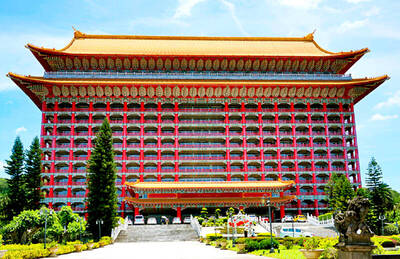
The Grand Hotel Taipei has rejected media reports claiming that the hotel had prevented CBS from broadcasting coverage of the Beijing summit between U.S. President Donald Trump and Chinese President Xi Jinping (習近平) on its premises. Media reports alleging that the hotel owner, dissatisfied with CBS’s coverage, prohibited the network from broadcasting political content on the hotel premises, are not true, the hotel said in a statement issued last night. The reports were “inconsistent with how the hotel actually handled the matter,” it said. The hotel said it received a refund request from a


 RSS
RSS