


The Mainland Affairs Council (MAC) yesterday expressed support for a proposed amendment that would sanction retired military officers who participate in activities held by Chinese political agencies or organizations, and engage in “conduct that harms national dignity.”
Article 9-3 of the Act Governing Relations Between the People of the Taiwan Area and the Mainland Area (臺灣地區與大陸地區人民關係條例) restricts the sanctions to “deputy minister[s] as a political appointee, major general or a higher rank post in national defense, foreign affairs, China affairs or government agencies related to national security, or who served as the chief officer of intelligence agencies.”
Conduct that is harmful to national dignity includes saluting flags or emblems, singing anthems or any other similar behaviors symbolizing the political authority of China.
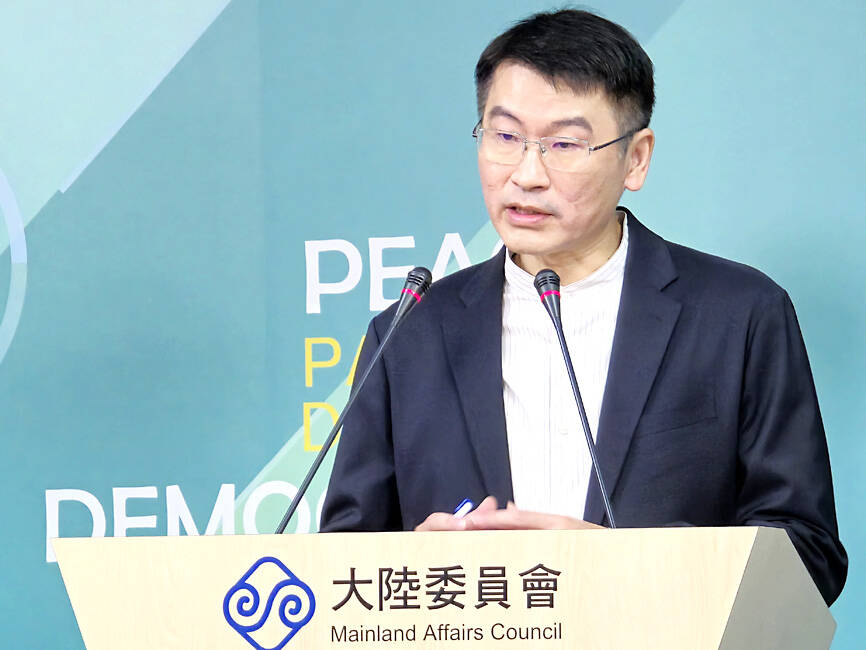
Photo: Fang Wei-li, Taipei Times
Those who contravene the regulation could see their monthly pension and medals removed, depending on the severity of their offenses.
Democratic Progressive Party Legislator Chiu Chi-wei (邱志偉), who proposed the amendment, said that the personnel subject to sanctions should be expanded to include retired military officers, after former navy lieutenant commander Lu Li-shih (呂禮詩) at the China International Aviation and Aerospace Exhibition in Zhuhai last week said that the event demonstrated “our China’s” strength.
Veterans Affairs Council Minister Yen De-fa (嚴德發) also endorsed the amendment yesterday.
MAC Deputy Minister and spokesperson Liang Wen-chieh (梁文傑) said that the council also thinks the problem needs to be addressed.
“However, we also want to remind the public that laws cannot fully regulate all sorts of conduct. People need to realize that they must not cross certain lines for moral reasons and to maintain a good conscience. People need to cherish Taiwan’s democracy, instead of harming our freedom using their freedom of speech,” Liang said.
“Without the Republic of China, we would have no freedom at all. We saw what happened to Next Media founder Jimmy Lai (黎智英) and 47 democracy leaders who were jailed in Hong Kong on Wednesday,” he said.
Meanwhile, Liang said that Bo Guagua (薄瓜瓜), the son of former Chinese Communist Party Central Committee Politburo member Bo Xilai (薄熙來), applied to enter Taiwan as a Chinese national to reunite with his wife.
“When reviewing his application, we did not know that he has British citizenship,” he said.
Asked what the council would do if Bo Guagua tries to stay in Taiwan for the long run, and whether giving him residency would send a signal to corrupt officials in China that Taiwan is a haven, Liang said that the council would handle Bo Guagua’s residency application based on the standard procedures if he files one.
“For corrupt officials in China, the first choice would be to go to the US, not Taiwan,” he said.
Liang also confirmed that 85 Chinese nationals have filed applications to enter Taiwan to attend the Golden Horse Awards tomorrow.
A total of 276 Chinese movies participated in the event, only one movie short of that from Taiwan, he added.
“We encourage people to watch some of the Chinese movies about COVID-19 restrictions and social phenomenon that might not be aired publicly in China,” he said.

Actor Darren Wang (王大陸) was sentenced to six months in prison, commutable to a fine, by the New Taipei District Court today for contravening the Personal Data Protection Act (個人資料保護法) in a case linked to an alleged draft-dodging scheme. Wang allegedly paid NT$3.6 million (US$114,380) to an illegal group to help him evade mandatory military service through falsified medical documents, prosecutors said. He transferred the funds to Chen Chih-ming (陳志明), the alleged mastermind of a draft-evasion ring, although he lost contact with him as he was already in detention on fraud charges, they said. Chen is accused of helping a

SECURITY: Starlink owner Elon Musk has taken pro-Beijing positions, and allowing pro-China companies to control Taiwan’s critical infrastructure is risky, a legislator said Starlink was reluctant to offer services in Taiwan because of the nation’s extremely high penetration rates in 4G and 5G services, the Ministry of Digital Affairs said yesterday. The ministry made the comments at a meeting of the legislature’s Transportation Committee, which reviewed amendments to Article 36 of the Telecommunications Management Act (電信管理法). Article 36 bans foreigners from holding more than 49 percent of shares in public telecommunications networks, while shares foreigners directly and indirectly hold are also capped at 60 percent of the total, unless specified otherwise by law. The amendments, sponsored by Chinese Nationalist Party (KMT) Legislator Ko

The eastern extension of the Taipei MRT Red Line could begin operations as early as late June, the Taipei Department of Rapid Transit Systems said yesterday. Taipei Rapid Transit Corp said it is considering offering one month of free rides on the new section to mark its opening. Construction progress on the 1.4km extension, which is to run from the current terminal Xiangshan Station to a new eastern terminal, Guangci/Fengtian Temple Station, was 90.6 percent complete by the end of last month, the department said in a report to the Taipei City Council's Transportation Committee. While construction began in October 2016 with an
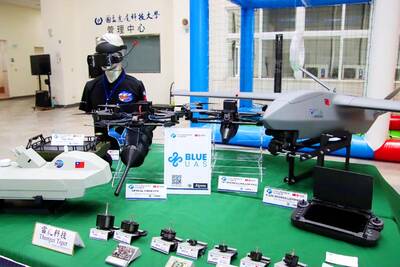
NON-RED SUPPLY: Boosting the nation’s drone industry is becoming increasingly urgent as China’s UAV dominance could become an issue in a crisis, an analyst said Taiwan’s drone exports to Europe grew 41.7-fold from 2024 to last year, with demand from Ukraine’s fight against Russian aggression the most likely driver of growth, a study showed. The Institute for Democracy, Society and Emerging Technology (DSET) in a statement on Wednesday said it found that many of Taiwan’s uncrewed aerial vehicle (UAV) sales were from Poland and the Czech Republic. These countries likely transferred the drones to Ukraine to aid it in its fight against the Russian invasion that started in 2022, it said. Despite the gains, Taiwan is not the dominant drone exporter to these markets, ranking second and fourth


 RSS
RSS