


Filmmaker Ang Lee (李安) was honored as the first Taiwanese laureate of this year’s Praemium Imperiale, a global arts prize awarded annually by the Japan Art Association, for promoting “the cultures and arts of the world” at an awards ceremony in Tokyo on Tuesday.
Lee, who has won two Oscars for best director, was honored alongside four others by the Japan Art Association, with each receiving a medal from Princess Hitachi at the ceremony.
“Japanese cinema has a long history of cultural influence, especially for Asian filmmakers and I’m no exception. As the first person from Taiwan to receive this award, I’m proud and deeply grateful,” Lee told a news conference in Tokyo on Monday.

Photo: AFP
“Theater is like a temple for me and a movie is a ritual through which we hold a mirror up to our lives and hope to touch the truth,” he said. “I’d like to think that my career is a never-ending school, where I learn about cinema and about myself and about the world. There is no end to that learning.”
Lee was honored in the theater/film category in the 35th edition of the awards ceremony, which is widely considered Japan’s arts equivalent of the Nobel Prize.
He first won an Oscar when Crouching Tiger, Hidden Dragon (臥虎藏龍) was named best foreign film in 2000. He then won best director awards for Brokeback Mountain in 2005 and Life of Pi in 2012.
This year’s laureates also include French conceptual artist Sophie Galle in the painting category, Colombian artist Doris Salcedo in sculpture, Voluntary Architects’ Network founder Shigeru Ban from Japan in architecture and Portugal-born pianist Maria Joao Pires in music.
During the ceremony on Tuesday, Princess Hitachi said the arts are crucial for bringing people together, enriching lives and consoling those caught up in conflicts.
Former Japanese prime minister Fumio Kishida said the Japan Art Association aims to promote world peace through the arts, a wish of the late Prince Takamatsu, who served as the honorary patron of the association for 58 years until early 1987.
On the sidelines of Tuesday’s ceremony, Lee told reporters that Asian voices are important in the film industry when fewer people are going to cinemas, news Web site Japan Forward reported on Wednesday.
“We need to cherish our cultural heritage and speak up in cinema,” he said.
The Praemium Imperiale prize was established in 1988 when the Japan Art Association marked its centennial and in honor of the late Prince Takamatsu, who died the previous year.
Princess Hitachi was installed to succeed his role as the honorary patron.
Six artists “who transcend national and ethnic boundaries” with their “exceptional achievements,” including Chinese-American architect Ieoh Ming Pei (貝聿銘), French film director Marcel Carne, and painters Willem de Kooning and David Hockney received the first edition of the prize in 1989.
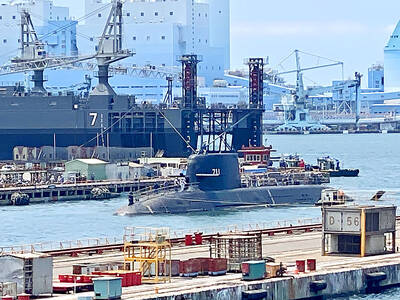
AGING: While Japan has 22 submarines, Taiwan only operates four, two of which were commissioned by the US in 1945 and 1946, and transferred to Taiwan in 1973 Taiwan would need at least 12 submarines to reach modern fleet capabilities, CSBC Corp, Taiwan chairman Chen Cheng-hung (陳政宏) said in an interview broadcast on Friday, citing a US assessment. CSBC is testing the nation’s first indigenous defense submarine, the Hai Kun (海鯤, Narwhal), which is scheduled to be delivered to the navy next month or in July. The Hai Kun has completed torpedo-firing tests and is scheduled to undergo overnight sea trials, Chen said on an SET TV military affairs program. Taiwan would require at least 12 submarines to establish a modern submarine force after assessing the nation’s operational environment and defense

A white king snake that frightened passengers and caused a stir on a Taipei MRT train on Friday evening has been claimed by its owner, who would be fined, Taipei Rapid Transit Corp (TRTC) said yesterday. A person on Threads posted that he thought he was lucky to find an empty row of seats on Friday after boarding a train on the Bannan (Blue) Line, only to spot a white snake with black stripes after sitting down. Startled, he jumped up, he wrote, describing the encounter as “terrifying.” “Taipei’s rat control plan: Release snakes on the metro,” one person wrote in reply, referring
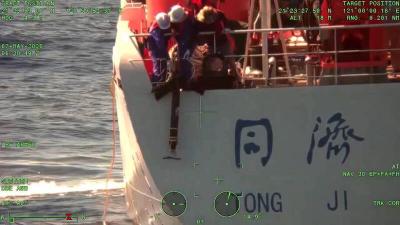
The coast guard today said that it had disrupted "illegal" operations by a Chinese research ship in waters close to the nation and driven it away, part of what Taipei sees a provocative pattern of China's stepped up maritime activities. The coast guard said that it on Thursday last week detected the Chinese ship Tongji (同濟號), which was commissioned only last year, 29 nautical miles (54km) southeast of the southern tip of Taiwan, although just outside restricted waters. The ship was observed lowering ropes into the water, suspected to be the deployment of scientific instruments for "illegal" survey operations, and the coast

Taiwan’s two cases of hantavirus so far this year are on par with previous years’ case numbers, and the government is coordinating rat extermination work, so there should not be any outbreaks, Centers for Disease Control (CDC) Director-General Philip Lo (羅一鈞) said today in an interview with the Liberty Times (the Taipei Times’ sister newspaper). An increase in rat sightings in Taipei and New Taipei City has raised concerns about the spread of hantavirus, as rats can carry the disease. In January, a man in his 70s who lived in Taipei’s Daan District (大安) tested positive posthumously for hantavirus, Taiwan’s


 RSS
RSS