


Physical altercations broke out at the legislature in Taipei yesterday after Chinese Nationalist Party (KMT) lawmakers rushed through procedures on proposed amendments to increase the threshold to recall elected representatives.
The KMT, the Democratic Progressive Party (DPP) and the Taiwan People’s Party (TPP) could not agree on the wording of the proposed amendments to the Public Officials Election and Recall Act (公職人員選舉罷免法) at an Internal Administration Committee meeting, which was attended by Central Election Commission officials.
KMT Legislator Hsu Hsin-ying (徐欣瑩), a committee coconvener, was presiding, but DPP lawmakers occupied the podium area to protest alleged contraventions of procedures by Hsu.
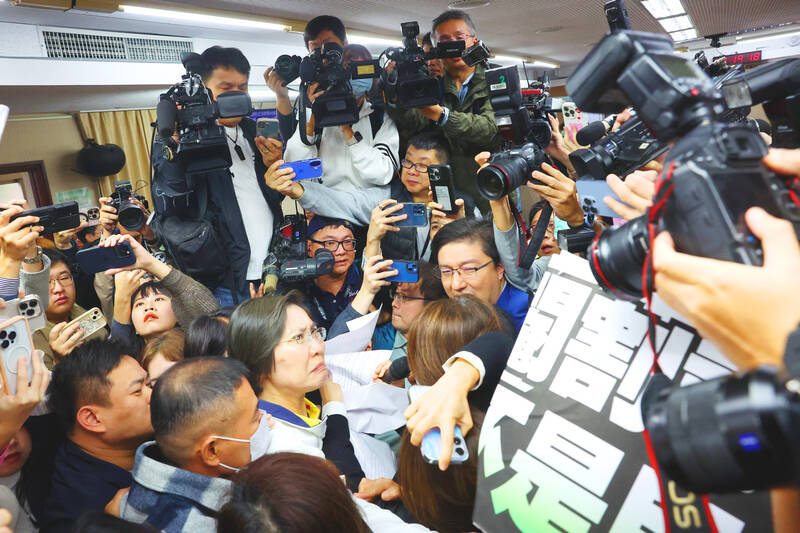
Photo: CNA
The proposal to increase the recall threshold would deprive Taiwanese of their right to recall unfit, incompetent elected officials, or those found guilty of crimes, they said.
The three parties have tabled their own versions of the proposed amendments, with the KMT’s version the most restrictive, requiring submission of copies of national ID cards in signature drives, while for a recall to succeed, it must garner more votes than were cast for the election winner.
There was pushing and shoving as Hsu, supported by other KMT lawmakers, called for the meeting to start and gave no time for examination of the proposed amendments before suspending proceedings.
Legislator Chang Hong-lu (張宏陸) and DPP colleagues said that Hsu had not adhered to legislative procedures and contravened the rules by bringing a microphone from outside to make announcements.
DPP caucus chief executive Rosalia Wu (吳思瑤) said that the KMT was only interested in political struggle when legislators should be focused on economic and social issues, and working to improve people’s livelihoods.
Moreover, there should be public consultation on whether to change the rules regarding recalls, Wu said.
KMT Legislator Hsu Yu-chen (許宇甄), who initiated the amendments, said that they are needed, as recalls have succeeded “too easily” due to low thresholds.
The first-stage threshold for signatures runs counter to the “values of a democratic society” and wastes resources on political battles, she said.
TPP caucus whip Huang Kuo-chang (黃國昌) said that his party opposed the KMT’s version, as it is difficult to gauge the majority viewpoint among the myriad opinions of the public.
However, a survey conducted on behalf of the TPP showed that most respondents agreed that “more rigorous conditions must apply for signature campaigns in a recall bid, Huang said.
The survey showed 63.9 percent agreed with an ID requirement in signature drives, while 28.5 percent were not in favor and 7.6 percent did not express an opinion, he said.
DPP Legislator Puma Shen (沈伯洋) disputed the survey’s findings.
The pollsters used “suggestive questions” to lead respondents to give the answers favorable to the TPP, Shen said.
Huang’s citing of the survey were a tactic to avoid the core issue of whether TPP supports the KMT on the proposed amendments, Shen said.
While the TPP refuses to take a clear stance on many issues, wanting to seem as if there is distance between it and the KMT, its lawmakers are nonetheless cooperating with the KMT on many issues, he said.

UPGRADE: The Kang Ding-class frigate is replacing its Chaparall missiles with Tien Chien II and Hua Yang VLS, which would provide it with long-range, 360° air defense Taiwan plans to produce 1,200 to 1,376 Hai Chien II missiles (海劍二, Sea Sword II) — also known as TC-2N — to serve as the standard air defense system of the navy’s surface combatant fleet, a source said yesterday. Last week, the Hai Chien II, the naval version of the Tien Kung II missile (天劍二, Sky Sword II), completed a live-fire test in waters off the National Chungshan Institute of Science and Technology’s Jiupeng facility (九鵬) in Pingtung County’s Manjhou Township (滿州). The MIM72 Chaparral and other dated air defense missiles that currently arm Taiwanese ships have inadequate range to combat Chinese

REASONS FOR TRAVEL: An assistant professor said that proposed amendments to penalize drivers if they used drugs overseas would not deter people from traveling People who operate a motor vehicle under the influence of marijuana would have their driver’s license revoked, even if they used the substance while overseas, the Ministry of Transportation and Communications said yesterday, citing proposed amendments to the Road Traffic Management and Penalty Act (道路交通管理處罰條例). The amendments would also authorize the government to revoke the licenses of people determined to have used Category 1 or Category 2 narcotics, even if they were not operating a vehicle while under the influence of drugs, as well as ban them from taking the license test for three years, the ministry said. People aged 18 or

HEAVY WEATHER: Typhoon Jangmi is due to crash straight into the Ryukyus as airlines look to shift flights to larger aircraft or cancel flights to Okinawa entirely Taiwan’s international air carriers announced flight adjustments over the weekend as Typhoon Jangmi is forecast to hit the Ryukyu Islands today and tomorrow. The Central Weather Administration (CWA) upgraded Jangmi from a tropical storm to a typhoon at 8am yesterday, with the eye located 580km south of Naha city. It was moving north at 19kph. Today, China Airlines’ CI-120, CI-121, CI-122 and CI-123 flights between Taoyuan and Naha, Okinawa, have been canceled as well as CI-132 and CI-133 between Kaohsiung and Naha. EVA Air’s BR-112, BR-113, BR-186 and BR-185 flights between Taoyuan and Naha are also canceled. Low-cost carrier Tigerair Taiwan canceled IT-230,
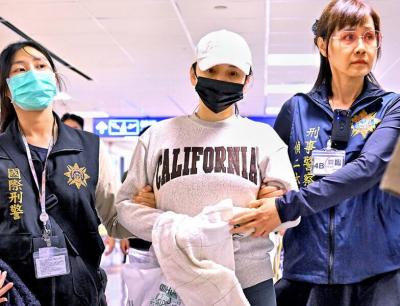
Johanne Liou (劉喬安), a Taiwanese woman who shot to unwanted fame during the Sunflower movement protests in 2014, returned to Taiwan last night after being deported from the US. She is to stand trial in Taiwan for charges involving embezzlement, fraud and drug crimes. The Criminal Investigation Bureau (CIB) said it took her into custody at Taiwan Taoyuan International Airport and would first question her before transferring her to the New Taipei District Prosecutors’ Office. She was arrested upon disembarking a flight from San Francisco that landed shortly before 7pm. Liou absconded to the US in 2019 after jumping bail


 RSS
RSS