


Generic drugs can go through a bioequivalence (BE) study to determine if they have the same safety and efficacy of the innovator (brand-name) drugs, the Food and Drug Administration (FDA) said yesterday, as it clarified four common misconceptions about generic drugs.
When a brand-name drug’s patent expires, other companies can start selling generic versions of the drug, FDA Medicinal Product Division deputy head Lin Yi-chu (林意筑) said.
Of the 23,472 FDA-issued drug permit licenses that are currently valid, 17,510 are for generic drugs, or about 74 percent, Lin said.
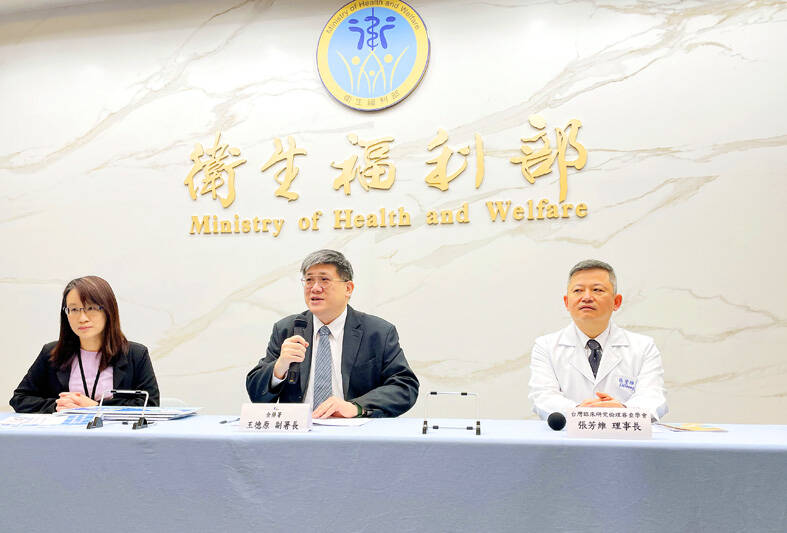
Photo: CNA
A drug company that applies for a drug permit license for a generic drug with the same active ingredient, dosage form (the physical form in which a drug is administered) and dosage as a brand-name drug, needs to go through a BE study to prove that its safety and efficacy are the same as the brand-name drug, she said.
However, many people have misconceptions about generic drugs, including that they have not undergone clinical trials, their efficacy is only about 80 percent of the brand-name drugs, attending a BE study is a means to earn money, or that anyone can become a BE study participant, FDA Deputy Director-General Wang Der-yuan (王德原) said.
When an oral drug is administered, it is mainly absorbed in the intestines. In a BE study, blood tests are then taken to determine if the same amount of the active ingredient is released into the blood stream at the same rate as the brand-name drug, Lin said.
The mean values of the pharmacokinetic parameters of both medicinal products are compared and the 90 percent confidence intervals (CIs) are calculated. If the CIs are contained between 80 percent and 125 percent, the BE is demonstrated, she said, adding that this is an internationally agreed upon standard.
A BE study is a type of clinical research. The brand-name drug has already been proven safe and effective, so if the generic drug is proven to be bioequivalent to its brand-name counterpart, its safety and efficacy are also proven, Taiwan Association of Institutional Review Boards chairperson Chang Fung-wei (張芳維) said.
Participants of BE studies do not earn money, but the study organizers usually provide transportation, meals and nutrition fees, he said.
After a drug company gets an institutional review board approval for its BE study, it would send an informed consent form to participants. Those participants are required to strictly follow the instructions detailed in the form, including limits on eating certain foods or taking other drugs, Chang said.
The entire study process must also follow the good clinical practice guidelines to ensure the reliability of clinical trial results and the protection of patients, he added.
In addition, BE study participants must be healthy adults, and there are usually eligibility criteria, such as age, gender and body mass index (BMI) range among others, as well as the exclusion of people with chronic or acute illnesses, pregnant or breast-feeding women, and those taking certain prescription drugs, Chang said.

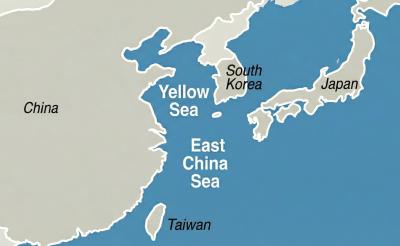
China has reserved offshore airspace in the Yellow Sea and East China Sea from March 27 to May 6, issuing alerts usually used to warn of military exercises, although no such exercises have been announced, the Wall Street Journal (WSJ) reported yesterday. Reserving such a large area for 40 days without explanation is an “unusual step,” as military exercises normally only last a few days, the paper said. These alerts, known as Notice to Air Missions (Notams), “are intended to inform pilots and aviation authorities of temporary airspace hazards or restrictions,” the article said. The airspace reserved in the alert is
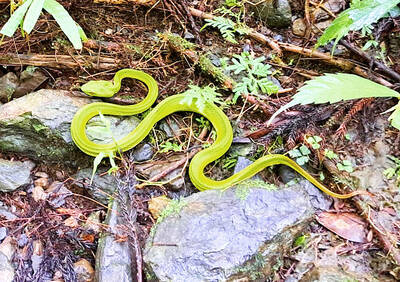
More than half of the bamboo vipers captured in Tainan in the past few years were found in the city’s Sinhua District (新化), while other districts had smaller catches or none at all. Every year, Tainan captures about 6,000 snakes which have made their way into people’s homes. Of the six major venomous snakes in Taiwan, the cobra, the many-banded krait, the brown-spotted pit viper and the bamboo viper are the most frequently captured. The high concentration of bamboo vipers captured in Sinhua District is puzzling. Tainan Agriculture Bureau Forestry and Nature Conservation Division head Chu Chien-ming (朱健明) earlier this week said that the

NAMING SPAT: The foreign ministry called on Denmark to propose an acceptable solution to the erroneous nationality used for Taiwanese on residence permits Taiwan has revoked some privileges for Danish diplomatic staff over a Danish permit that lists “Taiwan” as “China,” Eric Huang (黃鈞耀), head of the Ministry of Foreign Affairs’ Department of European Affairs, told a news conference in Taipei yesterday. Reporters asked Huang whether the Danish government had responded to the ministry’s request that it correct the nationality on Danish residence permits of Taiwanese, which has been listed as “China” since 2024. Taiwan’s representative office in Denmark continues to communicate with the Danish government, and the ministry has revoked some privileges previously granted to Danish representatives in Taiwan and would continue to review
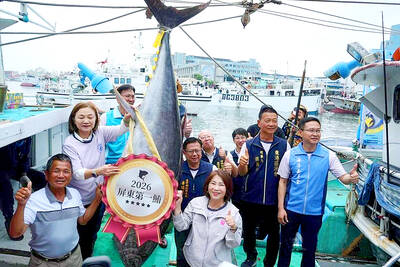
The first bluefin tuna of the season, brought to shore in Pingtung County and weighing 190kg, was yesterday auctioned for NT$10,600 (US$333.5) per kilogram, setting a record high for the local market. The auction was held at the fish market in Donggang Fishing Harbor, where the Siaoliouciou Island-registered fishing vessel Fu Yu Ching No. 2 delivered the “Pingtung First Tuna” it had caught for bidding. Bidding was intense, and the tuna was ultimately jointly purchased by a local restaurant and a local company for NT$10,600 per kilogram — NT$300 ,more than last year — for a total of NT$2.014 million. The 67-year-old skipper


 RSS
RSS