


The National Police Agency has earmarked a NT$123.41 million (US$3.79 million) budget over the next three years to upgrade training for civilian defense forces, organize local units and improve equipment, it said in a report to legislators on Monday last week.
The program also aims to enhance training for rescue operations during disasters, broaden exchanges with counterparts in other countries, and improve preparedness and resiliency when dealing with contingencies, the agency said.
Trainings, to be organized at a local level, and other planned works would follow the regulations and measures set out under the Civil Defense Act (民防法) and the Regulations Governing the Marshalling, Training, Drill and Military Operation Support of Civil Defense Forces (民防團隊編組訓練演習服勤及支援軍事勤務辦法), police officials said.
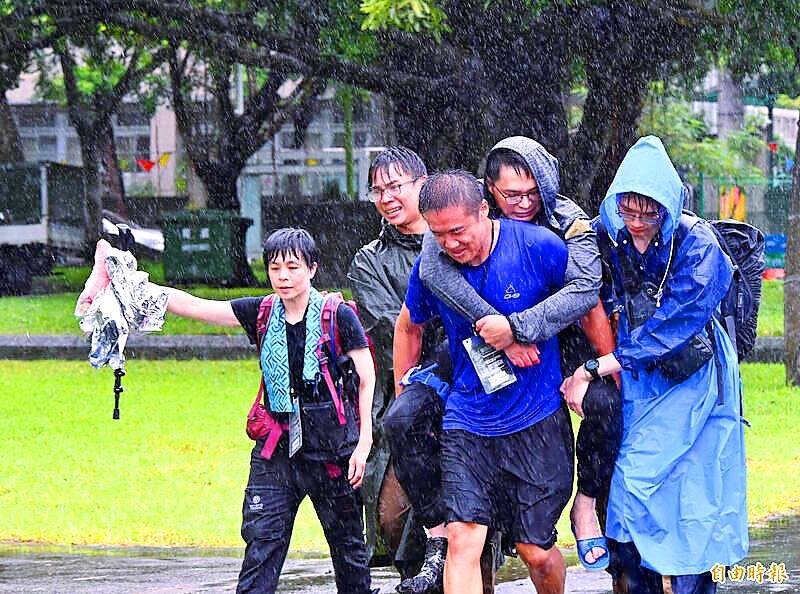
Photo: Liu Hsin-de, Taipei Times
The law states that the civil defense force should be organized into a “civil defense group” (Article 3, Item 2) under city and county governments, “special defense corps” (Article 4, II) and “defense regiment” (Article 4, III).
The “civil defense group” would be under the command of the city mayor and county commissioner; police precincts would organize a “civil defense brigade,” “volunteer police team” and “traffic police and volunteer team;” while villages and boroughs would form “watch patrol teams” for the community, and “mountain auxiliary police” teams for mountain villages, officials said.
These civilian units at local levels would undertake rescue work during disasters, combat crime and safeguard public safety, aid in traffic control, and assist in distributing emergency goods and materials during extreme situations, the report said.
City and county governments have inadequate training, lack essential equipment for their civilian defense groups, are unable to effectively mobilize these units, have insufficient personnel and are facing aging problems, the report said.
A new national upgrading program is needed to boost local units, wherein capable people undertake civilian defense tasks and take the initiative in dealing with contingencies, thereby creating a civilian defense network where society works together to maintain social order and safeguard national security, it said.
The program aims to use the NT$123.41 million budget to “effectively activate the civilian force network” and “enhance whole-of-society defense resilience,” by organizing new units, bolstering tools and equipment, strengthening training and supporting more international exchanges, the report said, adding that it would also organize competitions and set up honors and rewards systems.
Agency officials said they aim to inaugurate a “civilian defense demonstration unit” for each of the 19 city and county governments next year, set up a “volunteer police demonstration team” the following year and to increase the “under 49” age ratio of the units, with younger personnel accounting for 8 percent by 2027.
Plans are also underway to hold training and leadership programs for the higher echelons of civilian force units to build up their competence in dealing with all types of contingencies, they added.
Next year, the agency has scheduled trainings for medical emergencies for 13,700 police captains, more training programs with other countries, international collaboration at various levels and a “seed instructor” plan to boost Taiwan’s capability in responding to national disasters and contingencies, NPA officials said.
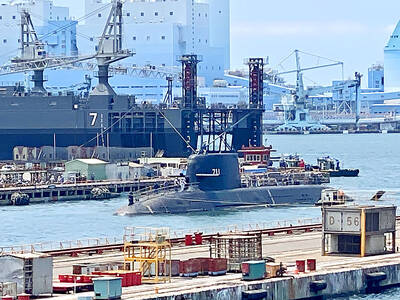
AGING: While Japan has 22 submarines, Taiwan only operates four, two of which were commissioned by the US in 1945 and 1946, and transferred to Taiwan in 1973 Taiwan would need at least 12 submarines to reach modern fleet capabilities, CSBC Corp, Taiwan chairman Chen Cheng-hung (陳政宏) said in an interview broadcast on Friday, citing a US assessment. CSBC is testing the nation’s first indigenous defense submarine, the Hai Kun (海鯤, Narwhal), which is scheduled to be delivered to the navy next month or in July. The Hai Kun has completed torpedo-firing tests and is scheduled to undergo overnight sea trials, Chen said on an SET TV military affairs program. Taiwan would require at least 12 submarines to establish a modern submarine force after assessing the nation’s operational environment and defense

A white king snake that frightened passengers and caused a stir on a Taipei MRT train on Friday evening has been claimed by its owner, who would be fined, Taipei Rapid Transit Corp (TRTC) said yesterday. A person on Threads posted that he thought he was lucky to find an empty row of seats on Friday after boarding a train on the Bannan (Blue) Line, only to spot a white snake with black stripes after sitting down. Startled, he jumped up, he wrote, describing the encounter as “terrifying.” “Taipei’s rat control plan: Release snakes on the metro,” one person wrote in reply, referring
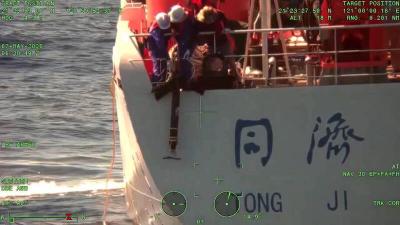
The coast guard today said that it had disrupted "illegal" operations by a Chinese research ship in waters close to the nation and driven it away, part of what Taipei sees a provocative pattern of China's stepped up maritime activities. The coast guard said that it on Thursday last week detected the Chinese ship Tongji (同濟號), which was commissioned only last year, 29 nautical miles (54km) southeast of the southern tip of Taiwan, although just outside restricted waters. The ship was observed lowering ropes into the water, suspected to be the deployment of scientific instruments for "illegal" survey operations, and the coast

Taiwan’s two cases of hantavirus so far this year are on par with previous years’ case numbers, and the government is coordinating rat extermination work, so there should not be any outbreaks, Centers for Disease Control (CDC) Director-General Philip Lo (羅一鈞) said today in an interview with the Liberty Times (the Taipei Times’ sister newspaper). An increase in rat sightings in Taipei and New Taipei City has raised concerns about the spread of hantavirus, as rats can carry the disease. In January, a man in his 70s who lived in Taipei’s Daan District (大安) tested positive posthumously for hantavirus, Taiwan’s


 RSS
RSS