


Minister of the Interior Liu Shyh-fang (劉世芳) on Wednesday said she would work “cautiously” with the legislature to ascertain whether Chinese spouse and Taiwan People’s Party (TPP) member Lee Zhen-hsiu (李貞秀) could qualify and serve as a lawmaker.
During a meeting of the legislature’s Internal Administration Committee, Liu was asked about Lee’s legal eligibility for office by Democratic Progressive Party Legislator Lee Po-yee (李柏毅).
Lee Zhen-hsiu was placed 15th on the TPP’s list of legislators-at-large in the Jan. 13 elections.

Photo: Taipei Times
Although the TPP won only eight seats, the party has pledged to rotate out its lawmakers after two years, meaning that candidates Nos. 9 to 16 on the list, including Lee, could enter the legislature in 2026.
Liu said that according to Article 20 of the Nationality Act (國籍法), Republic of China nationals who hold citizenship in another country must renounce it in order to hold public office.
When lawmakers are inaugurated, they are required to sign an affidavit on whether they have foreign citizenship, she said.
If they do, they are then required to submit documents showing they have renounced their foreign citizenship within one year of taking office, Liu said, citing a document the Ministry of the Interior sent to the legislature in 2009 detailing how the law would be enforced.
If the legislator does not renounce their foreign citizenship within one year, their credentials would be revoked under the Public Officials Election and Recall Act (公職人員選舉罷免法), Liu said.
The issue becomes more complicated when it comes to Chinese citizens, due to the status of cross-strait issues under Taiwanese law.
The Act Governing Relations Between the People of the Taiwan Area and the Mainland Area (臺灣地區與大陸地區人民關係條例) refers only to the “household registrations” of people in the two areas, not to citizenship.
People’s Republic of China (PRC) citizens who meet all other eligibility requirements can apply for Republic of China (ROC) citizen after annulling their PRC household registration.
They can then register as candidates for public office 10 years after being naturalized, as Lee Zhen-hsiu did.
Lee Po-yee said that China could agree to revoke Lee Zhen-hsiu’s household registration, but not her Chinese citizenship, in which case the interior ministry would have to be cautious in reviewing her eligibility as a legislator.
“This is something you would have to ask a Chinese national,” Liu said. “As far as the Nationality Act and the Constitution are concerned, a citizen’s loyalty has to be to the ROC, and not some other country.”
“The Ministry of the Interior will work with the Legislative Yuan with caution to resolve this issue,” she added.
Liu and Lee Po-yee noted that Taiwan has a precedent in a similar case, but it involved US, and not Chinese, citizenship.
They were likely referring to former Chinese Nationalist Party (KMT) legislator Lee Ching-an (李慶安), who was revealed in a March 2008 Next Magazine report to also be a US citizen.
Despite initially disputing the claims, Lee Ching-an resigned from the legislature in January 2009.
The Central Election Commission revoked her status as an elected official the following month.
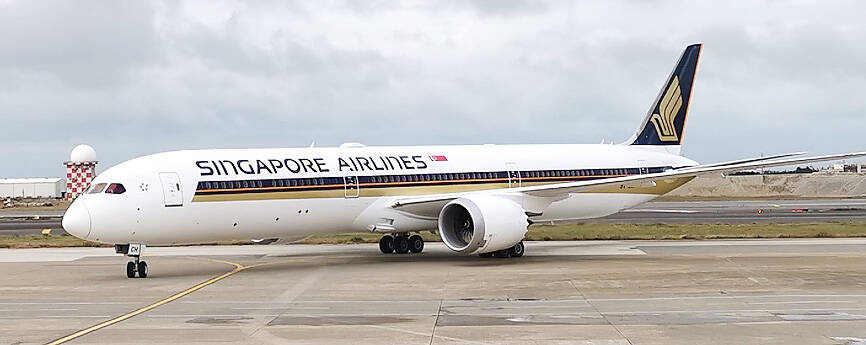
INCREASED CAPACITY: The flights on Mondays, Wednesdays, Fridays and Sundays would leave Singapore in the morning and Taipei in the afternoon Singapore Airlines is adding four supplementary flights to Taipei per week until May to meet increased tourist and business travel demand, the carrier said on Friday. The addition would raise the number of weekly flights it operates to Taipei to 18, Singapore Airlines Taiwan general manager Timothy Ouyang (歐陽漢源) said. The airline has recorded a steady rise in tourist and business travel to and from Taipei, and aims to provide more flexible travel arrangements for passengers, said Ouyang, who assumed the post in July last year. From now until Saturday next week, four additional flights would depart from Singapore on Monday, Wednesday, Friday
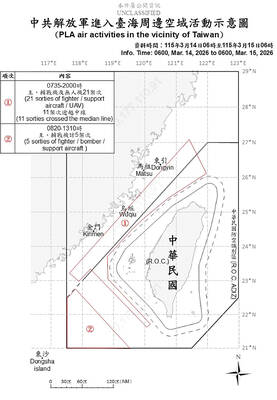
The Ministry of National Defense yesterday reported the return of large-scale Chinese air force activities after their unexplained absence for more than two weeks, which had prompted speculation regarding Beijing’s motives. China usually sends fighter jets, drones and other military aircraft around the nation on a daily basis. Interruptions to such routine are generally caused by bad weather. The Ministry of National Defense said it had detected 26 Chinese military aircraft in the Taiwan Strait over the previous 24 hours. It last reported that many aircraft on Feb. 25, when it spotted 30 aircraft, saying Beijing was carrying out another “joint combat

Taiwan successfully defended its women’s 540 kilogram title and won its first-ever men’s 640 kg title at the 2026 World Indoor Tug of War Championships in Taipei yesterday. In the women’s event, Taiwan’s eight-person squad reached the final following a round-robin preliminary round and semifinals featuring teams from Ukraine, Japan, Thailand, Vietnam, the Basque Country and South Korea. In the finals, they swept the Basque team 2-0, giving the team composed mainly of National Taiwan Normal University students and graduates its second championship in a row, and its fourth in five years. Team captain
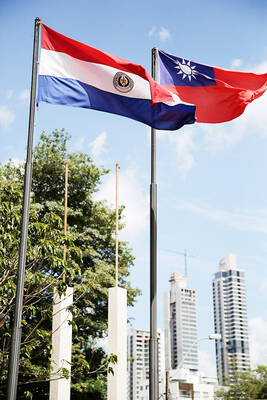
When Paraguayan opposition lawmaker Leidy Galeano returned from an all-expenses-paid tour of six Chinese cities late last year, she was convinced Paraguay risked missing out on major economic gains by sticking with longtime ally Taipei over Beijing — a message that participants on the trip heard repeatedly from Chinese officials. “Everything I saw there, I wanted for my country,” said Galeano, a member of the newly-formed Yo Creo party whose senior figures have spoken favorably about China. This trip and others like it — which people familiar with the visits said were at the invitation of the Chinese consulate in Sao Paulo


 RSS
RSS