


Taiwan hopes to cooperate further with NASA on developing a satellite to monitor air quality, Minister of Environment Peng Chi-ming (彭啟明) said yesterday at the opening ceremony of a two-day workshop on cross-border air pollution hosted by the ministry in Taipei.
Hopefully collaboration with NASA would continue and the ministry and the Taiwan Space Agency (TASA) can launch a satellite to monitor air pollution, Peng said.
The data such a satellite could gather would play an important role regionally and globally to monitor air pollution and its spread, he said.
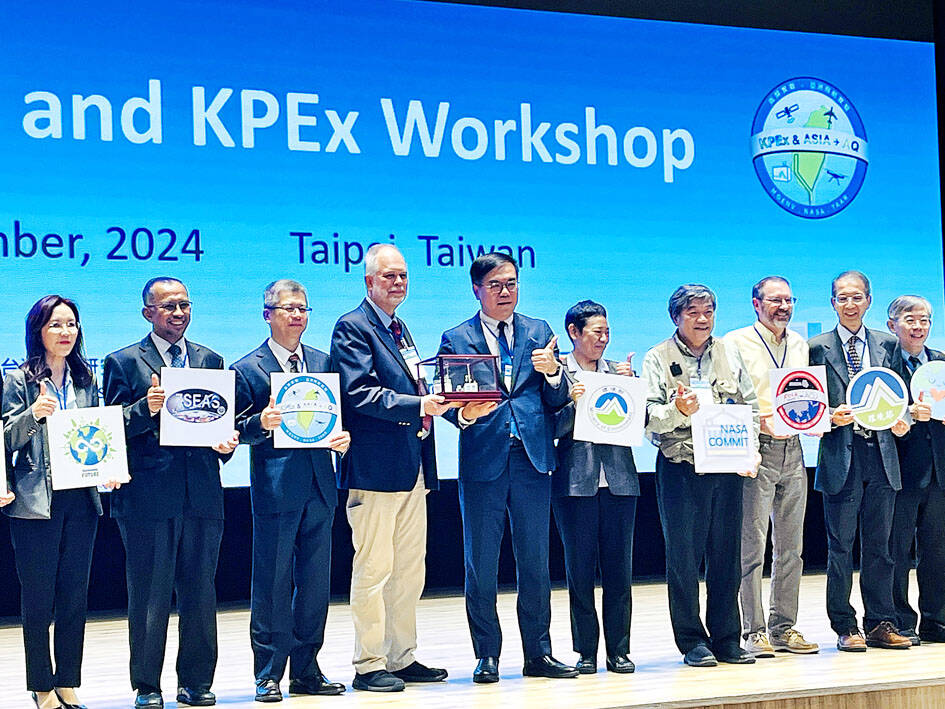
Photo: Chen Chia-yi, Taipei Times
The 2024 Seven Seas Program and Gaoping Experiment International Workshop is being attended by representatives from countries including South Korea, Thailand, Vietnam, Indonesia, Singapore, the Philippines, Malaysia and Bangladesh.
Taiwan has been collaborating with NASA and Asian countries on cross-border air pollution monitoring since the beginning of this year, the Ministry of Environment said.
From February to March, NASA research aircraft collected data over southern Taiwan four times as part of the 7-SEAS (South East Asian Studies) project studying climate interactions from Taiwan to Southeast Asia.
Results published yesterday showed that the air quality in southern Taiwan is a result of not only local pollution, but also highly affected by atmospheric circulation and transnational spread.
Taiwanese academics at the workshop shared 3D analyses of air pollution sources and pollutant concentrations in the Kaohsiung-Pingtung area based on the NASA data.
The research project would help Taiwan understand the distribution of ozone and volatile organic compounds, as well as how Taiwan’s topography affects their spread, said Lin Neng-huei (林能暉), a professor of atmospheric sciences at National Central University.
The research would provide more understanding about the effect of pollutants from foreign sources on Taiwan’s air quality, Lin said.
On March 13, pollution from abroad and a dust storm led to monitoring stations recording air quality levels three times higher than usual, he said, citing NASA’s data.
More than half of the pollution on that day could have come from abroad, he added.
Taiwan’s air quality is comparable to that of Japan and South Korea, while levels of harmful pollutants are much lower than in the other two nations, Peng said.
Unlicensed factories also contribute to pollution, meaning there is a need for increased monitoring and regulation, he said.
As pollution exists throughout the atmosphere and a large portion comes from abroad, it is necessary to work with other countries on this issue, he said.
Additional reporting by CNA

NATIONAL SECURITY: Authorities are working to confirm the identities of the military personnel involved and investigating possible illegal conduct and regulatory violations Authorities are probing possible national security implications after Kinmen police and immigration officers on Sunday found a Chinese woman allegedly posing as a tourist while engaging in prostitution involving more than 10 military personnel. The woman, surnamed Chen (陳), has since been deported, authorities said, adding that investigators are still working to confirm the identities of those implicated, as the records only listed code names and aliases. The case stemmed from a report received by the Kinmen District Prosecutors’ Office on Friday last week from the Jinhu Precinct of the Kinmen County Police Bureau. On Sunday, police, along with the National Immigration

GLOBALGIVING: ‘ Caving to external pressure is not acceptable for an organization that has cultivated justice reform and human rights for 30 years,’ one NGO said A slew of non-government organizations (NGOs) have withdrawn from the GlobalGiving fundraising platform after it announced it would use “Chinese Taipei” instead of “Taiwan” from next month. The Taiwan Good Rice Association wrote on Facebook on Friday that it was informed on April 28 via a teleconference call of the change, which was made because the platform wanted to operate in China. Taiwan Good Rice is to terminate all cooperative relationships with GlobalGiving in response to the platform’s “unilateral and non-negotiable” decision to remove references to Taiwan, the NGO said. “Taiwan is in the official name of Taiwan Good Rice Association and the
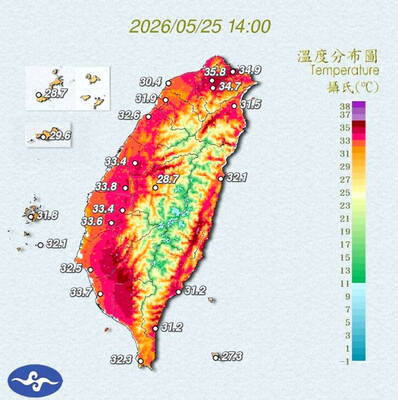
STAY COOL: The HPA recommended that people stay hydrated, use air-conditioning or fans while indoors, wear loose-fitting clothes and walk in the shade while outdoors Employers must implement measures such as installing cooling equipment, and providing drinking water and rest breaks for outdoor workers starting from Monday next week, the Taipei Department of Labor said on Sunday. Employers who fail to comply could face fines of NT$30,000 to NT$300,000 under the Occupational Safety and Health Act (職業安全衛生法), the department said. Businesses in Taipei employing fewer than 100 workers, as well as registered self-employed workers with labor insurance coverage, could receive on-site assessments and guidance from occupational safety consultants to help them apply for central government subsidies to implement or improve heat-protection measures, it said. Under the Ministry of

Chinese Nationalist Party (KMT) Chairwoman Cheng Li-wun (鄭麗文) yesterday briefed her party’s Central Standing Committee regarding her scheduled visit to the US between Monday next week and June 16, saying that her purpose would be to persuade the US that the Republic of China (ROC) Constitution was a “one China” constitution that would foster stable and peaceful cross-strait relations. The ROC Constitution is the most important defense for all Taiwanese citizens, as it upholds our democracy and has contributed to our robust economy, which aligns with international and US interests, she said. “We would not be troublemakers and drag the US under,”


 RSS
RSS