


Taiwan might demonstrate it takes US president-elect Donald Trump’s “protection” money demand seriously with large and early new arms deals, to demonstrate that it is not looking for a free ride and to show Washington its resolve to spend to defend itself, analysts said.
Trump, who won a second term as president this week, unnerved Taiwan during the campaign by saying that the nation should pay the US for its defense and that it had “stolen” semiconductor business from the US.
“Watch for Taiwan on the defense side to try and start engaging them on a big arms package — to do something significant, very large,” said Rupert Hammond-Chambers, president of the US-Taiwan Business Council which helps broker defense exchanges between Taipei and Washington.
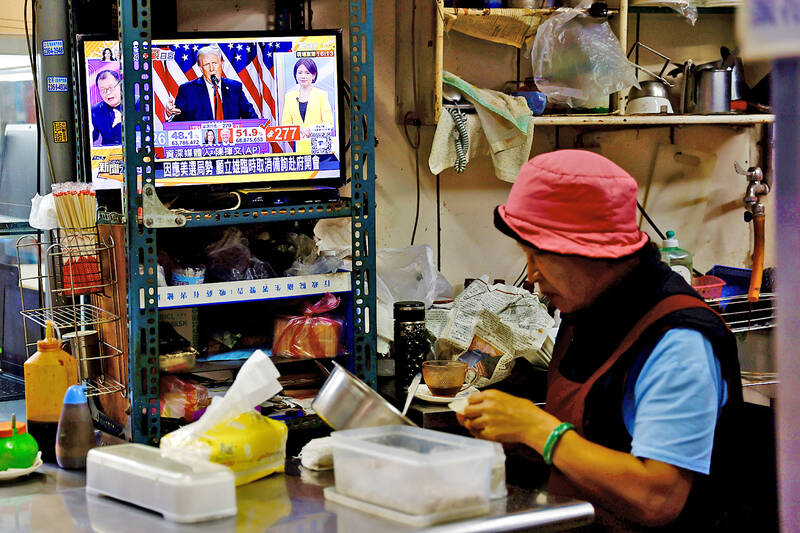
Photo: Ritchie B. Tongo, EPA-EFE
It could come in the first quarter of next year, he added.
“But think of it as a down payment, an attention-getter,” he said. “They’ll stack up several big platforms and big buys of munitions.”
The US is already Taiwan’s most important arms supplier, although Taiwan has complained of an order backlog worth about US$20 billion.
A new order, almost US$2 billion worth of missile systems, was announced last month.
China might try to test the US during the presidential transition with more drills, hacking attacks or other forms of psychological warfare, the Ministry of Foreign Affairs said in a written report to lawmakers yesterday.
One former US official said he assessed it was “highly likely” that Taiwan would move quickly to attempt to broker a major arms deal with the US to get the Trump administration onside and counter any lingering inclination he has that Taiwan fleeced the US on semiconductors.
“They will want to solidify their fealty quickly to lock in Trump’s interest,” the person said, speaking on condition of anonymity to be able to speak freely.
Minister of Foreign Affairs Lin Chia-lung (林佳龍) avoided answering questions from reporters yesterday on what “protection” money for the US might look like, but told lawmakers that defense spending, now about 2.5 percent of GDP, would increase.
“The trend is for it to keep rising,” he said.
Trump’s remarks on “protection” fees and Taiwan’s defense budget were likely exaggerated, Institute for National Defense and Security Research fellow Su Tzu-yun (蘇紫雲) said.
The real message of those remarks was that “the US is willing to support NATO, Japan, South Korea, Taiwan and other countries, but expects these nations to contribute more resources to their self-defense efforts,” he said.
In terms of arms sales to Taiwan, the incoming Trump administration might expand weapons sales to include advanced weapons such as air defense systems and drones, Institute for National Policy Research senior advisor Chen Wen-chia (陳文甲) said.
While those sales could help Taiwan counter the increasingly complex military threat it faces, the US would also request Taiwan allocate a greater portion of its budget to defense, he said.
Following the same vein, Su said that during Trump’s previous term, he started selling arms sales to Taiwan on a more flexible case-by-case review basis, while also deepening Taiwan-US military exchanges and joint training.
Asked about the outlook for joint military training between the two countries, Chen said that Trump has repeatedly emphasized that Taiwan take steps to defend itself, so US military training assistance would likely become more limited.
Direct training assistance would likely be reduced, but more technical support and equipment would be provided, he added.
The potential impact would depend on the foreign policy and national security officials Trump appoints, National Taiwan University’s Department of Political Science associate professor Chen Shih-min (陳世民) said.
Members of the traditional establishment within the Republican Party are still internationalists, holding the belief that the US should protect democratic nations, he said.
However, if the “Make America Great Again” faction takes the lead, key figures such as US vice president-elect JD Vance would prioritize US interests, avoiding entangling the US in costly wars such as the Vietnam War, Chen Shih-min said.
Several names being considered for top jobs in the new US administration are people who are strong supporters of Taiwan, including former US secretary of state Mike Pompeo, who after leaving office called for formal diplomatic relations with Taipei, and former US national security adviser Robert O’Brien, who visited Taiwan last year.
O’Brien on Wednesday thanked President William Lai (賴清德) on X for congratulating Trump.
All possible candidates being discussed publicly for Trump’s secretaries of state and defense are considered “Taiwan-friendly,” said Vincent Chao (趙怡翔), who was the spokesperson for Lai’s presidential campaign and is a regular visitor to the US.
“When it comes to Trump, people say it is about what he does, not what he says,” the Taipei City Councilor said, referring to Trump’s comments on Taiwan during the campaign. “There’s no need for Taiwanese to worry. We should have confidence.”
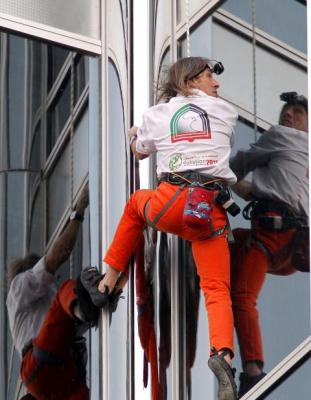
Alain Robert, known as the "French Spider-Man," praised Alex Honnold as exceptionally well-prepared after the US climber completed a free solo ascent of Taipei 101 yesterday. Robert said Honnold's ascent of the 508m-tall skyscraper in just more than one-and-a-half hours without using safety ropes or equipment was a remarkable achievement. "This is my life," he said in an interview conducted in French, adding that he liked the feeling of being "on the edge of danger." The 63-year-old Frenchman climbed Taipei 101 using ropes in December 2004, taking about four hours to reach the top. On a one-to-10 scale of difficulty, Robert said Taipei 101
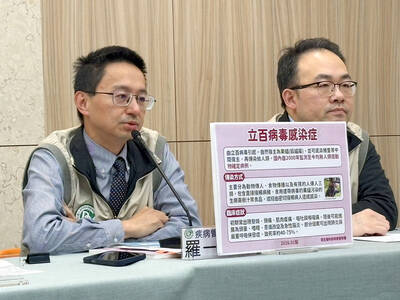
Nipah virus infection is to be officially listed as a category 5 notifiable infectious disease in Taiwan in March, while clinical treatment guidelines are being formulated, the Centers for Disease Control (CDC) said yesterday. With Nipah infections being reported in other countries and considering its relatively high fatality rate, the centers on Jan. 16 announced that it would be listed as a notifiable infectious disease to bolster the nation’s systematic early warning system and increase public awareness, the CDC said. Bangladesh reported four fatal cases last year in separate districts, with three linked to raw date palm sap consumption, CDC Epidemic Intelligence
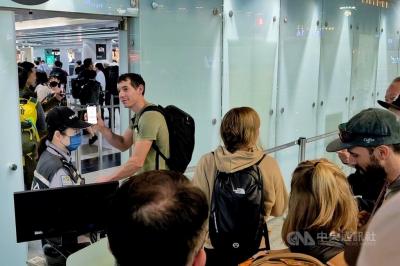
US climber Alex Honnold left Taiwan this morning a day after completing a free-solo ascent of Taipei 101, a feat that drew cheers from onlookers and gained widespread international attention. Honnold yesterday scaled the 101-story skyscraper without a rope or safety harness. The climb — the highest urban free-solo ascent ever attempted — took just more than 90 minutes and was streamed live on Netflix. It was covered by major international news outlets including CNN, the New York Times, the Guardian and the Wall Street Journal. As Honnold prepared to leave Taiwan today, he attracted a crowd when he and his wife, Sanni,
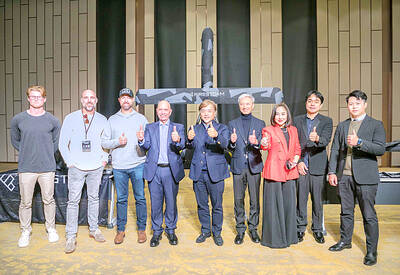
Taiwanese and US defense groups are collaborating to introduce deployable, semi-autonomous manufacturing systems for drones and components in a boost to the nation’s supply chain resilience. Taiwan’s G-Tech Optroelectronics Corp subsidiary GTOC and the US’ Aerkomm Inc on Friday announced an agreement with fellow US-based Firestorm Lab to adopt the latter’s xCell, a technology featuring 3D printers fitted in 6.1m container units. The systems enable aerial platforms and parts to be produced in high volumes from dispersed nodes capable of rapid redeployment, to minimize the risk of enemy strikes and to meet field requirements, they said. Firestorm chief technology officer Ian Muceus said


 RSS
RSS