


The US would continue its friendly approach toward Taiwan after the presidential election and Taiwan would work to prevent China "making trouble" during the transition, a senior Taiwanese security official said this morning.
Former US president Donald Trump, the Republican candidate for the US presidency and neck and neck in the polls with US Vice President Kamala Harris, has made comments on the campaign trail that Taiwan should pay to be protected and also accused the nation of stealing US semiconductor business.
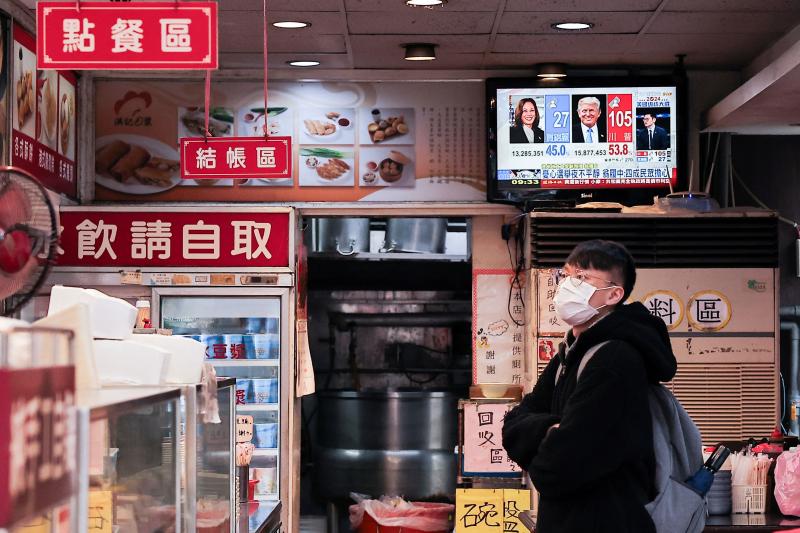
Photo: Reuters
Speaking to reporters at the legislature, National Security Bureau Director-General Tsai Ming-yen (蔡明彥) said the election's outcome was still unknown.
"On relations across the Taiwan Strait, we believe that the US will continue its current approach of constraining China and being friendly to Taiwan," he said.
Taiwan would continue communication with the current administration focusing on key issues for cooperation "in the next phase" and work with international partners to exchange information on China's intentions and military movements during the transition, Tsai added.
"This is as to prevent the Chinese communists from taking advantage of the transition of the US government and to prevent them from making trouble during the transition," he said.
China's Taiwan Affairs Office did not immediately respond to request for comment.
Also speaking to media at the legislature, Minister of Economic Affairs J.W. Kuo (郭智輝) said the government was paying great attention to the election and making preparations no matter who won.
However, Taiwan-US economic ties are deep and would not be easy to change and the impact on the economy would be small irrespective of who the next president is, he added.
National Development Council Minister Liu Chin-ching (劉鏡清) said that Trump's proposed technology curbs on China would potentially have “more pros than cons” for Taiwan.
Such restrictions are likely to prompt more Taiwanese companies to shift production back from China and redirect export orders to local manufacturers, he said.
When asked by a lawmaker yesterday about Taiwan’s preparations for the US election results, Liu said that while the nation might also face a 10 percent tariff on its goods under Trump, “the impact would be limited, as most suppliers in Taiwan are primarily doing contract manufacturing serving the US clients.”
Additional reporting by Bloomberg
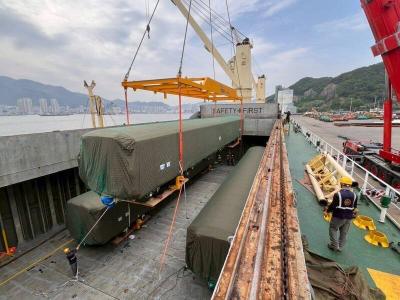
The first of 10 new high-capacity trains purchased from South Korea’s Hyundai Rotem arrived at the Port of Taipei yesterday to meet the demands of an expanding metro network, Taipei Rapid Transit Corp (TRTC) said yesterday. The train completed a three-day, 1,200km voyage from the Port of Masan in South Korea, the company said. Costing NT$590 million (US$18.79 million) each, the new six-carriage trains feature a redesigned interior based on "human-centric" transportation concepts, TRTC said. The design utilizes continuous longitudinal seating to widen the aisles and optimize passenger flow, while also upgrading passenger information displays and driving control systems for a more comfortable
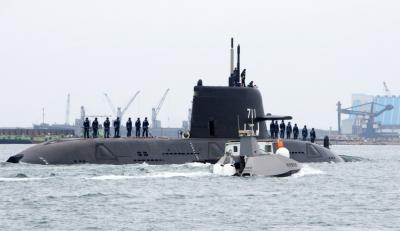
Taiwan's first indigenous defense submarine, the SS-711 Hai Kun (海鯤, or Narwhal), departed for its 13th sea trial at 7am today, marking its seventh submerged test, with delivery to the navy scheduled for July. The outing also marked its first sea deployment since President William Lai (賴清德) boarded the submarine for an inspection on March 19, drawing a crowd of military enthusiasts who gathered to show support. The submarine this morning departed port accompanied by CSBC Corp’s Endeavor Manta (奮進魔鬼魚號) uncrewed surface vessel and a navy M109 assault boat. Amid public interest in key milestones such as torpedo-launching operations and overnight submerged trials,
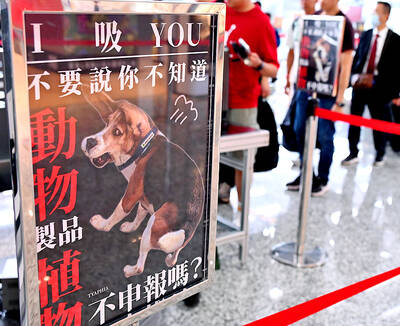
Quarantine awareness posters at Taiwan Taoyuan International Airport have gone viral for their use of wordplay. Issued by the airport branch of the Animal and Plant Health Inspection Agency, the posters feature sniffer dogs making a range of facial expressions, paired with advisory messages built around homophones. “We update the messages for holidays and campaign needs, periodically refreshing materials to attract people’s attention,” quarantine officials said. “The aim is to use the dogs’ appeal to draw focus to quarantine regulations.” A Japanese traveler visiting Taiwan has posted a photo on X of a poster showing a quarantine dog with a
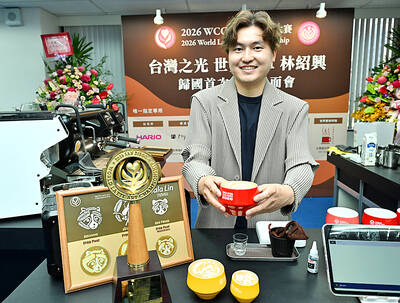
Taiwan’s coffee community has launched a “one-person-one-e-mail” campaign, calling for people to send a protest-e-mail to the World Coffee Championships (WCC) urging it to redesignate Taiwanese competitors as from “Taiwan,” rather than “Chinese Taipei.” The call followed sudden action last week after the WCC changed all references to Taiwanese competitors from “Taiwan” to “Chinese Taipei,” including recent World Latte Art champion Bala (林紹興), who won the World Latte Art Championship in San Diego earlier this month. When Bala received the trophy, he was referred to as representing Taiwan, as well as in the announcement on the WCC’s Web site, until it


 RSS
RSS