


Residents have called on the Taipei City Government to reconsider its plan to demolish a four-decades-old pedestrian overpass near Daan Forest Park.
The 42-year-old concrete and steel structure that serves as an elevated walkway over the intersection of Heping and Xinsheng roads is to be closed on Tuesday in preparation for demolition slated for completion by the end of the month.
However, in recent days some local residents have been protesting the planned destruction of the intersection overpass that is rendered more poetically as “sky bridge” in Chinese.
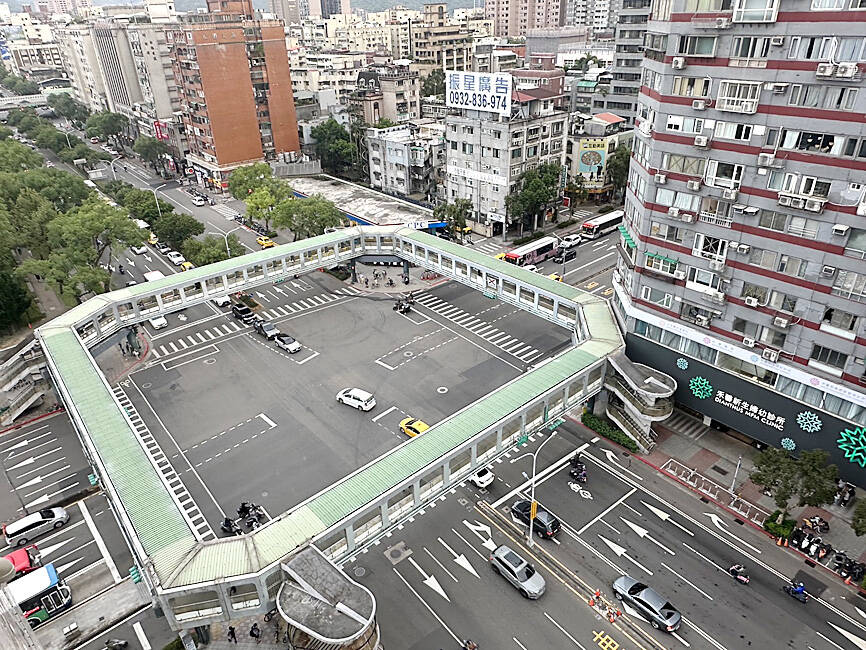
Photo courtesy of the Taipei Transportation Departmen
“This bridge carries the community’s collective memory,” said a man surnamed Chuang (莊), a local resident who recalled frequently crossing it with his children to take them to school more than 20 years ago.
“The government’s attitude of ‘just tear it down’ without listening to the public shows a lack of connection to the city and an arrogant disregard for culture,” Chuang said.
“Most residents — myself included — hope to keep the bridge,” local borough warden Huang Shih-chuan (黃世詮) said. “Separating pedestrians from vehicles is the safest way.”

Photo: Wang Yi-sung, Taipei Times
Located about 500m from National Taiwan Normal University, at the southwest corner of Daan Forest Park, the overpass allowed people to walk over the busy multiple-lane intersection for more than four decades.
Despite many residents’ fondness for the functional — if not classically attractive — pedestrian footbridge, the city government last month announced its plan to demolish it.
The city government’s main policy is to “gradually” replace all the city’s pedestrian overpasses to increase visibility for pedestrians and drivers, as well as to create more space on sidewalks, the Taipei New Construction Office said.
As the city’s population gets older on average, ground-level crossings are considered by city planners to be “safer and more convenient” than bridges.
The Taipei Department of Transportation agreed with the New Construction Office, saying that “current column placements at intersections obstruct right-turning vehicles from clearly seeing pedestrians.”
Referring to a pedestrian overpass bridge that used to stand at the intersection of Xinyi and Keelung roads, the bureau said traffic accidents involving right-turning vehicles had decreased by 60 percent one year after it was removed.
However, some residents want the bridge preserved and say that the city government has not taken their views into account.
Lin Wen-chun (林玟君), one of the organizers of a protest group, said the authorities have failed to explain the necessity of the planned demolition.
“There are 13 sky bridges exceeding 40 years old in use in Taipei City,” Lin said, adding that the oldest has been operational for 55 years.
“The inspection company’s report did not show any structural safety issues, but the city government nonetheless decided to demolish it,” he said, adding that he thinks the New Construction Office should provide “scientific” reasons for the decision.
Taipei Mayor Chiang Wan-an (蔣萬安) on Monday said he would ask the transportation and public works departments and the New Construction Office to “continue communicating” on this issue.
He is in support of the departments “doing what should be done,” Chiang told department heads during a city government meeting yesterday.

NATIONAL SECURITY: Authorities are working to confirm the identities of the military personnel involved and investigating possible illegal conduct and regulatory violations Authorities are probing possible national security implications after Kinmen police and immigration officers on Sunday found a Chinese woman allegedly posing as a tourist while engaging in prostitution involving more than 10 military personnel. The woman, surnamed Chen (陳), has since been deported, authorities said, adding that investigators are still working to confirm the identities of those implicated, as the records only listed code names and aliases. The case stemmed from a report received by the Kinmen District Prosecutors’ Office on Friday last week from the Jinhu Precinct of the Kinmen County Police Bureau. On Sunday, police, along with the National Immigration

REASONS FOR TRAVEL: An assistant professor said that proposed amendments to penalize drivers if they used drugs overseas would not deter people from traveling People who operate a motor vehicle under the influence of marijuana would have their driver’s license revoked, even if they used the substance while overseas, the Ministry of Transportation and Communications said yesterday, citing proposed amendments to the Road Traffic Management and Penalty Act (道路交通管理處罰條例). The amendments would also authorize the government to revoke the licenses of people determined to have used Category 1 or Category 2 narcotics, even if they were not operating a vehicle while under the influence of drugs, as well as ban them from taking the license test for three years, the ministry said. People aged 18 or

GLOBALGIVING: ‘ Caving to external pressure is not acceptable for an organization that has cultivated justice reform and human rights for 30 years,’ one NGO said A slew of non-government organizations (NGOs) have withdrawn from the GlobalGiving fundraising platform after it announced it would use “Chinese Taipei” instead of “Taiwan” from next month. The Taiwan Good Rice Association wrote on Facebook on Friday that it was informed on April 28 via a teleconference call of the change, which was made because the platform wanted to operate in China. Taiwan Good Rice is to terminate all cooperative relationships with GlobalGiving in response to the platform’s “unilateral and non-negotiable” decision to remove references to Taiwan, the NGO said. “Taiwan is in the official name of Taiwan Good Rice Association and the

HEAVY WEATHER: Typhoon Jangmi is due to crash straight into the Ryukyus as airlines look to shift flights to larger aircraft or cancel flights to Okinawa entirely Taiwan’s international air carriers announced flight adjustments over the weekend as Typhoon Jangmi is forecast to hit the Ryukyu Islands today and tomorrow. The Central Weather Administration (CWA) upgraded Jangmi from a tropical storm to a typhoon at 8am yesterday, with the eye located 580km south of Naha city. It was moving north at 19kph. Today, China Airlines’ CI-120, CI-121, CI-122 and CI-123 flights between Taoyuan and Naha, Okinawa, have been canceled as well as CI-132 and CI-133 between Kaohsiung and Naha. EVA Air’s BR-112, BR-113, BR-186 and BR-185 flights between Taoyuan and Naha are also canceled. Low-cost carrier Tigerair Taiwan canceled IT-230,


 RSS
RSS