


A Taiwanese volunteer soldier who was fighting on the frontlines in Ukraine to help defend the country against Russia’s invasion was recently killed, the Ministry of Foreign Affairs and a ruling party lawmaker said yesterday.
The ministry confirmed the Taiwanese’s death through the International Legion for the Defense of Ukraine, deputy spokesman Hsiao Kuangwei (蕭光偉) said.
Hsiao said they had contacted the soldier’s family in Taiwan and pledged to assist in dealing with matters related to his death.
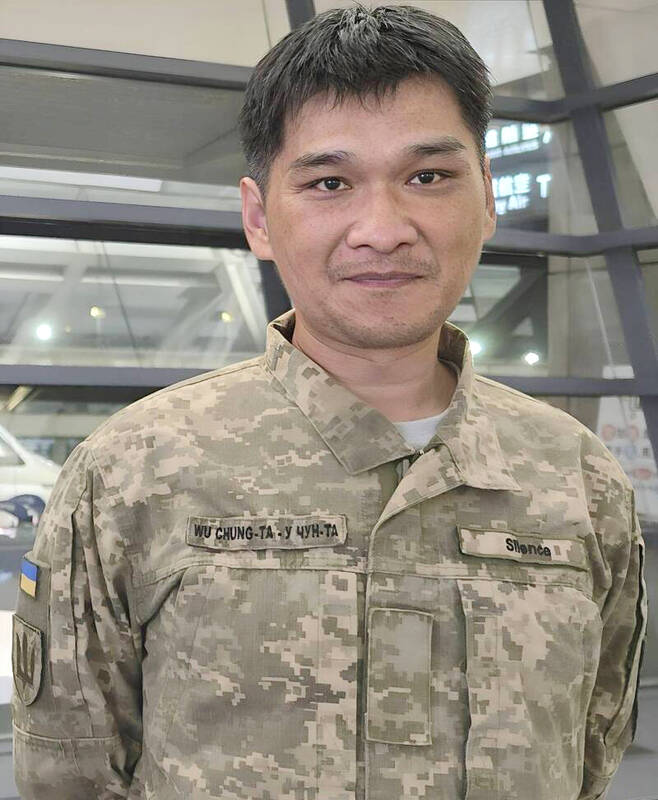
Photo: Taipei Times
The family did not want his name to be revealed to the public and did not want to talk to the media, he said, calling on journalists to respect their wishes.
However, local media have identified the deceased as 44-year-old Wu Chung-ta (吳忠達) from Kaohsiung, who was also a veteran from the Army Special Forces Command.
Wu joined the International Legion for the Defense of Ukraine last year, Chinese-language newspaper China Times reported.
After serving in the unit for half a year, he joined Ukraine’s armed forces.
He died from a Russian bombing in the Luhansk region on Saturday, the China Times reported.
Wu is the second Taiwanese solider known to have died while fighting for Ukraine since the Russian invasion began in early 2022.
Tseng Sheng-kuang (曾聖光), a 25-year-old member of the International Legion of Ukraine’s Territorial Defense Forces, was killed in action in November 2022.
Wu’s death was first reported to Taipei-based Pastor Huang Chun-sheng (黃春生) by a group of Taiwanese fighting for Ukraine, Democratic Progressive Party Legislator Puma Shen (沈伯洋) said yesterday.
Shen, a member of the legislature’s Foreign and National Defense Committee, said he contacted the ministry and Taiwan’s representative in Poland to ask them to confirm Wu’s death with Ukrainian authorities.
A Ukrainian drone has identified the location of Wu’s body, but Ukrainian forces are unable to retrieve it given that the battle was still ongoing, Shen said.
“We will make sure Wu’s remains are returned to his home in Taiwan, after his funeral and the related ceremonies are completed in Ukraine,” he said.
There are still six Taiwanese nationals serving as volunteer combatants for Ukraine, sources told the China Times.
After the news of Wu’s death, the Republic of China Marine Corps Retired Non-commissioned Officer (NCO) Association gave its condolences, saying that Taiwan had lost a true warrior.
The association chairman Chao Wu-chang (趙武章) praised Wu for upholding the values of Taiwan’s military.
Wu had trained with the International Legion before entering the conflict and had briefly returned to Taiwan this year to get treatment for injuries he sustained fighting Russia, Chao said.
Before going back to Ukraine, Wu had visited the NCO association and shared his experiences in Ukraine, Chao added.
Ukraine’s firepower was inferior to that of its enemy when the war broke out, which led the Ukrainian forces to fight in small units, he cited Wu as saying.
Although small units meant more severe injuries and casualties, Wu persevered through the long conflict, he said.
According to Chao, Wu told him that he was proud to have served as a soldier of the Republic of China.
With Wu’s death, Taiwan has lost a true warrior, but his spirit inspires the members of the armed forces, Chao said.

Considering that most countries issue more than five denominations of banknotes, the central bank has decided to redesign all five denominations, the bank said as it prepares for the first major overhaul of the banknotes in more than 24 years. Central bank Governor Yang Chin-lung (楊金龍) is expected to report to the Legislative Yuan today on the bank’s operations and the redesign’s progress. The bank in a report sent to the legislature ahead of today’s meeting said it had commissioned a survey on the public’s preferences. Survey results showed that NT$100 and NT$1,000 banknotes are the most commonly used, while NT$200 and NT$2,000

The Centers for Disease Control (CDC) yesterday reported the first case of a new COVID-19 subvariant — BA.3.2 — in a 10-year-old Singaporean girl who had a fever upon arrival in Taiwan and tested positive for the disease. The girl left Taiwan on March 20 and the case did not have a direct impact on the local community, it said. The WHO added the BA.3.2 strain to its list of Variants Under Monitoring in December last year, but this was the first imported case of the COVID-19 variant in Taiwan, CDC Deputy Director-General Lin Ming-cheng (林明誠) said. The girl arrived in Taiwan on

South Korea is planning to revise its controversial electronic arrival card, a step Taiwanese officials said prompted them to hold off on planned retaliatory measures, a South Korean media report said yesterday. A Yonhap News Agency report said that the South Korean Ministry of Foreign Affairs is planning to remove the “previous departure place” and “next destination” fields from its e-arrival card system. The plan, reached after interagency consultations, is under review and aims to simplify entry procedures and align the electronic form with the paper version, a South Korean ministry official said. The fields — which appeared only on the electronic form

The Ministry of Foreign Affairs (MOFA) is suspending retaliation measures against South Korea that were set to take effect tomorrow, after Seoul said it is updating its e-arrival system, MOFA said today. The measures were to be a new round of retaliation after Taiwan on March 1 changed South Korea's designation on government-issued alien resident certificates held by South Korean nationals to "South Korea” from the "Republic of Korea," the country’s official name. The move came after months of protests to Seoul over its listing of Taiwan as "China (Taiwan)" in dropdown menus on its new online immigration entry system. MOFA last week


 RSS
RSS