


The High Court in a second ruling yesterday found three former military officers involved in intelligence gathering and analysis guilty of embezzlement and forgery for inventing fake Chinese assets.
The verdict is not final.
Lieutenant Colonel Su Hsin-ming (蘇薪名), Colonel Chiang Fang-yu (江芳瑜) and Lieutenant Colonel Hsu Chih-hsin (徐之心) were convicted of manufacturing fake intelligence to claim bonuses and operational expenses between 2016 and last year, the court said.
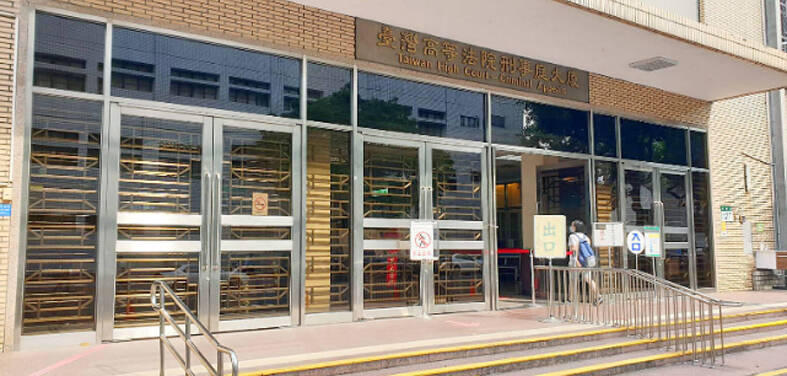
Photo: Taipei Times
Su, a former member of the Ministry of National Defense’s Communication Development Office, was sentenced to six years and four months in prison. He surrendered NT$10.53 million (US$329,392) in illicit gains.
Chiang and Hsu, formerly members of the Military Intelligence Bureau, were handed four years and eight months, and two years in prison respectively. They surrendered NT$5.69 million and NT$100,000 in illegal proceeds.
Their behavior was a betrayal of their duty as military service members and caused significant harm to national security, the High Court said in the verdict.
However, the High Court’s judgement resulted in a reduction in the trio’s sentences.
The Shilin District Court earlier this year handed Su a prison sentence of 15 years and two months, Chiang five years and 11 months, and Hsu two years and eight months. The three appealed the ruling.
The High Court in the second ruling yesterday said that the sentences given to Chiang and Hsu must be reduced, as the latter’s judgement would have been clouded by an older and more lenient version of the Money Laundering Control Act (洗錢防制法).
Meanwhile, Chiang’s good professional performance before the crime, and the financial burden of raising two children and caring for her mother, who has cancer, are mitigating circumstances under the then-effective version of the law, the High Court said.
Hsu also showed remorse by giving the bulk of the bonus to Su and severing all contact with the man, it said.
Su was the mastermind of the scheme and its main beneficiary, but since he was cooperative during questioning, it was reduced, it added.

Considering that most countries issue more than five denominations of banknotes, the central bank has decided to redesign all five denominations, the bank said as it prepares for the first major overhaul of the banknotes in more than 24 years. Central bank Governor Yang Chin-lung (楊金龍) is expected to report to the Legislative Yuan today on the bank’s operations and the redesign’s progress. The bank in a report sent to the legislature ahead of today’s meeting said it had commissioned a survey on the public’s preferences. Survey results showed that NT$100 and NT$1,000 banknotes are the most commonly used, while NT$200 and NT$2,000

The Centers for Disease Control (CDC) yesterday reported the first case of a new COVID-19 subvariant — BA.3.2 — in a 10-year-old Singaporean girl who had a fever upon arrival in Taiwan and tested positive for the disease. The girl left Taiwan on March 20 and the case did not have a direct impact on the local community, it said. The WHO added the BA.3.2 strain to its list of Variants Under Monitoring in December last year, but this was the first imported case of the COVID-19 variant in Taiwan, CDC Deputy Director-General Lin Ming-cheng (林明誠) said. The girl arrived in Taiwan on

South Korea is planning to revise its controversial electronic arrival card, a step Taiwanese officials said prompted them to hold off on planned retaliatory measures, a South Korean media report said yesterday. A Yonhap News Agency report said that the South Korean Ministry of Foreign Affairs is planning to remove the “previous departure place” and “next destination” fields from its e-arrival card system. The plan, reached after interagency consultations, is under review and aims to simplify entry procedures and align the electronic form with the paper version, a South Korean ministry official said. The fields — which appeared only on the electronic form

The Ministry of Foreign Affairs (MOFA) is suspending retaliation measures against South Korea that were set to take effect tomorrow, after Seoul said it is updating its e-arrival system, MOFA said today. The measures were to be a new round of retaliation after Taiwan on March 1 changed South Korea's designation on government-issued alien resident certificates held by South Korean nationals to "South Korea” from the "Republic of Korea," the country’s official name. The move came after months of protests to Seoul over its listing of Taiwan as "China (Taiwan)" in dropdown menus on its new online immigration entry system. MOFA last week


 RSS
RSS