


Authorities yesterday raced to remove 284 tonnes of oil from a Chinese carrier that ran aground off Taiwan after losing power in rough seas as Typhoon Kong-rey neared.
The Chinese-flagged Yu Zhou Qi Hang was transporting three cranes from Keelung to China on Tuesday when it stalled in wild weather, authorities said.
A Coast Guard Administration vessel was deployed to rescue the 17 crew and the Chinese ship drifted to the shore of Yehliu Geopark (野柳公園) in New Taipei City, where it ran aground.
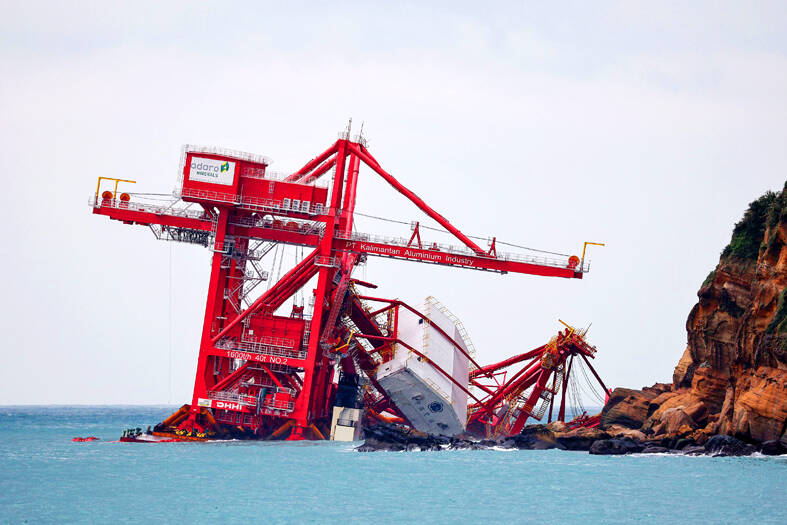
Photo: Cheng I-hwa, AFP
The Yu Zhou Qi Hang was carrying 247 tonnes of heavy fuel oil and 37 tonnes of light diesel oil, the coast guard said.
An Agence France-Presse photographer yesterday saw red cranes above the water, one leaning heavily and touching the rocky shore, while the Yu Zhou Qi Hang was submerged.
Tracking Web site vesselfinder.com said the ship was a 143m-long heavy load carrier built in 2012.
Authorities hoped to start recovering the oil yesterday afternoon, a Maritime and Port Bureau official said.
The Ocean Affairs Council estimated it would take two to three days to finish the work, with council Minister Kuan Bi-ling (管碧玲) saying no oil had been detected leaking from the ship.
“I saw early this morning that there was no oil pollution at the scene,” Kuan said in a Facebook post yesterday.
“Nature is merciful and the oil tank was not damaged,” Kuan said, adding that oil spill containment booms had been deployed.
Kong-rey made landfall in eastern Taiwan on Thursday as one of the biggest typhoons to hit the nation in decades.

Considering that most countries issue more than five denominations of banknotes, the central bank has decided to redesign all five denominations, the bank said as it prepares for the first major overhaul of the banknotes in more than 24 years. Central bank Governor Yang Chin-lung (楊金龍) is expected to report to the Legislative Yuan today on the bank’s operations and the redesign’s progress. The bank in a report sent to the legislature ahead of today’s meeting said it had commissioned a survey on the public’s preferences. Survey results showed that NT$100 and NT$1,000 banknotes are the most commonly used, while NT$200 and NT$2,000

The Centers for Disease Control (CDC) yesterday reported the first case of a new COVID-19 subvariant — BA.3.2 — in a 10-year-old Singaporean girl who had a fever upon arrival in Taiwan and tested positive for the disease. The girl left Taiwan on March 20 and the case did not have a direct impact on the local community, it said. The WHO added the BA.3.2 strain to its list of Variants Under Monitoring in December last year, but this was the first imported case of the COVID-19 variant in Taiwan, CDC Deputy Director-General Lin Ming-cheng (林明誠) said. The girl arrived in Taiwan on

South Korea is planning to revise its controversial electronic arrival card, a step Taiwanese officials said prompted them to hold off on planned retaliatory measures, a South Korean media report said yesterday. A Yonhap News Agency report said that the South Korean Ministry of Foreign Affairs is planning to remove the “previous departure place” and “next destination” fields from its e-arrival card system. The plan, reached after interagency consultations, is under review and aims to simplify entry procedures and align the electronic form with the paper version, a South Korean ministry official said. The fields — which appeared only on the electronic form

The Ministry of Foreign Affairs (MOFA) is suspending retaliation measures against South Korea that were set to take effect tomorrow, after Seoul said it is updating its e-arrival system, MOFA said today. The measures were to be a new round of retaliation after Taiwan on March 1 changed South Korea's designation on government-issued alien resident certificates held by South Korean nationals to "South Korea” from the "Republic of Korea," the country’s official name. The move came after months of protests to Seoul over its listing of Taiwan as "China (Taiwan)" in dropdown menus on its new online immigration entry system. MOFA last week


 RSS
RSS