


Three people implicated in a controversial scheme to import eggs during a domestic shortage in 2022 were released without bail after being questioned by prosecutors.
The three people questioned, all listed as possible defendants in the case, are former minister of agriculture Chen Chi-chung (陳吉仲), former National Animal Industry Foundation (NAIF) president Lin Tsung-hsien (林聰賢) and Minister of Agriculture Chen Junne-jih (陳駿季).
Prosecutors did not specify why the two Chens were named as possible suspects for contravening the Anti-Corruption Act (貪污治罪條例), although Chen Chi-chung was in office in 2022 when the alleged illegality occurred.
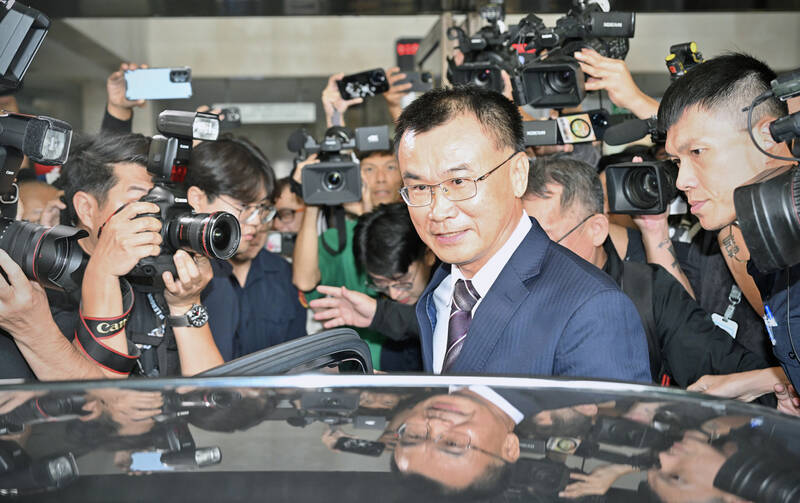
Photo: Lo Pei-de, Taipei Times
The case originated in 2022 when Taiwan faced an egg shortage, prompting the then-Council of Agriculture (COA, now the Ministry of Agriculture) to import eggs from other countries.
The Control Yuan, the government watchdog, said the NAIF was defrauded of more than NT$100 million (US$3.12 million) after being entrusted by the COA in 2022 to handle the emergency egg supply issue.
Japan was one of the countries from which Taiwan wanted to import eggs, and the NAIF commissioned Wu Yu-fei (吳諭非), a food company representative familiar with trade with Japan, coordinated the egg imports and specified Brilliance Biotechnology as the importer, before Chin Yu-chiao (秦語喬), Wu’s mother, founded Ultra Source to handle the imports, the Control Yuan said.
As a result, the NAIF contracted Brilliance Biotechnology to import eggs from Japan from March to May 2022, followed by procuring more than 25 million eggs from Ultra Source between August and November that the company had stocked after importing them from Japan, the Control Yuan report said.
The Control Yuan report said the NAIF purchased eggs from Ultra Source before the company was even registered.
The report also said that the NAIF failed to inspect the quality and quantity of the imported eggs upon delivery, and retroactively filled out contract paperwork.
The report also cited prosecutors as finding that Ultra Source repeatedly forged quotations and inflated import charges to defraud the government-funded NAIF of NT$100 million.
When the case came to light, the choice of Ultra Source was particularly scrutinized because it had no record of previous egg imports and was established with only NT$500,000 of paid-in capital.
The Taipei District Prosecutors Office last month in collaboration with other investigation units raided 14 locations and summoned eight people and three other witnesses for questioning.
After questioning, Chin, Lin I-lung (林宜龍), head of Brilliance Biotechnology; Wu Chun-ta (吳俊達), then a specialist at the foundation; and Lin Chang-hsien (林昌憲), an employee at Brilliance Biotechnology, were released on bail of NT$2 million, NT$1 million, NT$500,000 and NT$300,000 respectively.
Prosecutors have also sought to question Wu Yu-fei, but she has not answered the summons.

Considering that most countries issue more than five denominations of banknotes, the central bank has decided to redesign all five denominations, the bank said as it prepares for the first major overhaul of the banknotes in more than 24 years. Central bank Governor Yang Chin-lung (楊金龍) is expected to report to the Legislative Yuan today on the bank’s operations and the redesign’s progress. The bank in a report sent to the legislature ahead of today’s meeting said it had commissioned a survey on the public’s preferences. Survey results showed that NT$100 and NT$1,000 banknotes are the most commonly used, while NT$200 and NT$2,000

The Centers for Disease Control (CDC) yesterday reported the first case of a new COVID-19 subvariant — BA.3.2 — in a 10-year-old Singaporean girl who had a fever upon arrival in Taiwan and tested positive for the disease. The girl left Taiwan on March 20 and the case did not have a direct impact on the local community, it said. The WHO added the BA.3.2 strain to its list of Variants Under Monitoring in December last year, but this was the first imported case of the COVID-19 variant in Taiwan, CDC Deputy Director-General Lin Ming-cheng (林明誠) said. The girl arrived in Taiwan on

South Korea is planning to revise its controversial electronic arrival card, a step Taiwanese officials said prompted them to hold off on planned retaliatory measures, a South Korean media report said yesterday. A Yonhap News Agency report said that the South Korean Ministry of Foreign Affairs is planning to remove the “previous departure place” and “next destination” fields from its e-arrival card system. The plan, reached after interagency consultations, is under review and aims to simplify entry procedures and align the electronic form with the paper version, a South Korean ministry official said. The fields — which appeared only on the electronic form

The Ministry of Foreign Affairs (MOFA) is suspending retaliation measures against South Korea that were set to take effect tomorrow, after Seoul said it is updating its e-arrival system, MOFA said today. The measures were to be a new round of retaliation after Taiwan on March 1 changed South Korea's designation on government-issued alien resident certificates held by South Korean nationals to "South Korea” from the "Republic of Korea," the country’s official name. The move came after months of protests to Seoul over its listing of Taiwan as "China (Taiwan)" in dropdown menus on its new online immigration entry system. MOFA last week


 RSS
RSS