


John Hsu (徐漢強), director of the Taiwanese supernatural comedy Dead Talents Society (鬼才之道), said on Saturday at the film’s London premiere that he hopes it would shed light on what he calls Taiwan’s “social anxieties.”
Speaking at the London East Asia Film Festival, Hsu said Taiwanese society is grappling with the anxiety of “being seen” and a desire for “Taiwanese pride.”
In the movie, a group of ghosts are vying to become the spookiest urban legends and the most famous stars of the underworld through their macabre scare tactics.
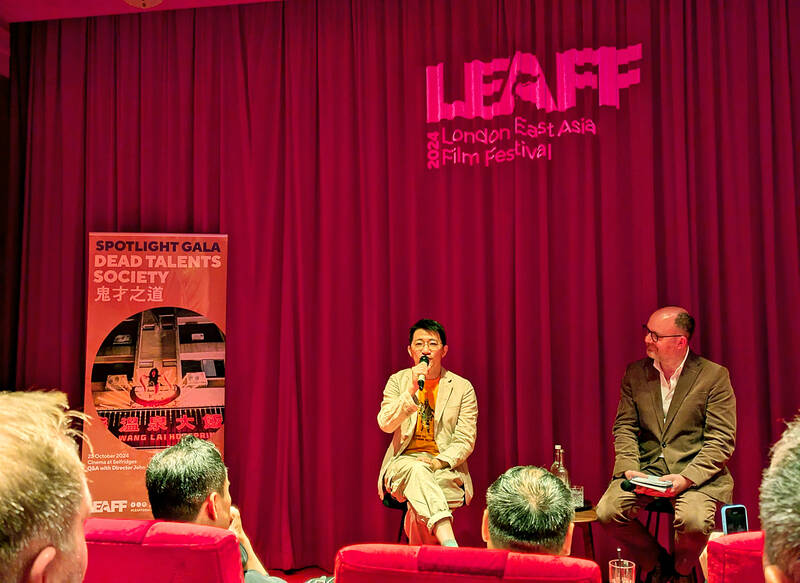
Photo: CNA
The movie received 11 nominations for the 61st Golden Horse Awards, more than any other film this year, including for Best Narrative Feature and Best Director awards.
“Perhaps due to its longstanding political situation and historical background, Taiwan has often lacked confidence in its own culture,” Hsu said.
Taiwanese society tends to believe that being seen by certain foreign parties is what validates someone or something as “worthy of attention,” he said.
However, he aimed to explore what it really means to be seen, what must be done to achieve it, and whether achieving that goal actually would resolve all the issues, he said.
Such anxieties might stem from that “we are not so sure about who we really are,” he said.
The festival, running from Wednesday last week to Sunday at the Odeon Luxe Leicester Square, showcases films from Taiwan, South Korea, Japan, China, Hong Kong, Vietnam and the Philippines, including more than 20 UK and world premieres.

Considering that most countries issue more than five denominations of banknotes, the central bank has decided to redesign all five denominations, the bank said as it prepares for the first major overhaul of the banknotes in more than 24 years. Central bank Governor Yang Chin-lung (楊金龍) is expected to report to the Legislative Yuan today on the bank’s operations and the redesign’s progress. The bank in a report sent to the legislature ahead of today’s meeting said it had commissioned a survey on the public’s preferences. Survey results showed that NT$100 and NT$1,000 banknotes are the most commonly used, while NT$200 and NT$2,000

The Centers for Disease Control (CDC) yesterday reported the first case of a new COVID-19 subvariant — BA.3.2 — in a 10-year-old Singaporean girl who had a fever upon arrival in Taiwan and tested positive for the disease. The girl left Taiwan on March 20 and the case did not have a direct impact on the local community, it said. The WHO added the BA.3.2 strain to its list of Variants Under Monitoring in December last year, but this was the first imported case of the COVID-19 variant in Taiwan, CDC Deputy Director-General Lin Ming-cheng (林明誠) said. The girl arrived in Taiwan on

South Korea is planning to revise its controversial electronic arrival card, a step Taiwanese officials said prompted them to hold off on planned retaliatory measures, a South Korean media report said yesterday. A Yonhap News Agency report said that the South Korean Ministry of Foreign Affairs is planning to remove the “previous departure place” and “next destination” fields from its e-arrival card system. The plan, reached after interagency consultations, is under review and aims to simplify entry procedures and align the electronic form with the paper version, a South Korean ministry official said. The fields — which appeared only on the electronic form

The Ministry of Foreign Affairs (MOFA) is suspending retaliation measures against South Korea that were set to take effect tomorrow, after Seoul said it is updating its e-arrival system, MOFA said today. The measures were to be a new round of retaliation after Taiwan on March 1 changed South Korea's designation on government-issued alien resident certificates held by South Korean nationals to "South Korea” from the "Republic of Korea," the country’s official name. The move came after months of protests to Seoul over its listing of Taiwan as "China (Taiwan)" in dropdown menus on its new online immigration entry system. MOFA last week


 RSS
RSS