


An experiment by the Ministry of the Interior’s research institute found that sticking tape not only fails to improve windows’ wind resistance but can be counterproductive.
It is common for people in Taiwan to duct-tape windows ahead of an approaching typhoon.
The ministry on Saturday said its Architecture and Building Research Institute conducted an experiment in which they compared taped and untaped windows with each other inside a storm test chamber.

Photo: CNA
Researchers tested different methods for taping windows such as an X shape, following the frame outline, a grid and fully covering it, on a 2.8x2m, 5mm thick window in an aluminum frame.
While the untaped window began to crack at 5,878Pa of pressure, equivalent to 250kph winds, the taped ones broke much more easily.
The frame outline lasted longest at 4,887Pa, followed by the grid at 4,206Pa, fully covered window at 4,189Pa, and finally the X shape at 3,482Pa.
Taping does not enhance a window’s protection, and in fact, might reduce its resiliency, the ministry said.
This result might be because adhesive tape concentrates pressure on particular points in the glass, causing stress fractures, it said.
Instead of taping windows before a typhoon, the ministry recommended installing doors and window frames that meet the national standards or adding blast mitigation film for the best protection against typhoons.
The research institute also conducted tests on the window frames using tempered glass of the same thickness, finding that at 9,000Pa, the window glass was intact, although the aluminum frames were deformed.
The ministry said it recommends upgrading window frames as well as installing reinforced glass for maximum protection.
The Central Weather Administration previously suggested that residents stay away from windows and refrain from duct-taping windows, as taping can create larger shards of glass if windows break.
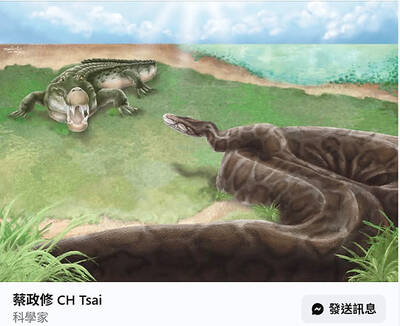
Taiwanese paleontologists have discovered fossil evidence that pythons up to 4m long inhabited Taiwan during the Pleistocene epoch, reporting their findings in the international scientific journal Historical Biology. National Taiwan University (NTU) Institute of Ecology and Evolutionary Biology associate professor Tsai Cheng-hsiu (蔡政修) led the team that discovered the largest snake fossil ever found in Taiwan. The single trunk vertebra was discovered in Tainan at the Chiting Formation, dated to between 400,000 and 800,000 years ago in the Middle Pleistocene, the paper said. The area also produced Taiwan’s first avian fossil, as well as crocodile, mammoth, saber-toothed cat and rhinoceros fossils, it said. Discoveries

WATCH FOR HITCHHIKERS: The CDC warned those returning home from Japan to be alert for any contagious diseases that might have come back with them People who have returned from Japan following the World Baseball Classic (WBC) games during the weekend are recommended to watch for symptoms of infectious gastroenteritis, flu and measles for two weeks, the Centers for Disease Control (CDC) said. Flu viruses remain the most common respiratory pathogen in Taiwan in the past four weeks and the influenza B virus accounted for 55.7 percent of the tested cases, exceeding the percentage of influenza A (H3N2) infections and becoming the local dominant strain, CDC Epidemic Intelligence Center Deputy Director Lee Chia-lin (李佳琳) said at a news conference on Tuesday. There were 82,187 hospital visits for

Alumni from Japan’s Kyoto Tachibana Senior High School marching band, widely known as the “Orange Devils,” staged a flash mob performance at the Grand Hotel in Taipei yesterday to thank Taiwan for its support after the Great East Japan Earthquake. The show, performed on the earthquake’s 15th anniversary, drew more than 100 spectators, some of whom arrived two hours before the show to secure a good viewing spot. The 26-member group played selections from “High School Musical,” “Beauty and the Beast,” and their signature piece “Sing Sing Sing” and shouted “I love
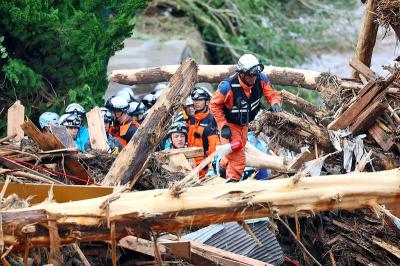
President William Lai (賴清德) today called for greater mutual aid between Taiwan and Japan in a post commemorating the 15th anniversary of the 2011 Tohoku earthquake and tsunami, saying that “true friendship reveals itself in hardship.” The magnitude 9 earthquake, the largest ever recorded in Japan, and the ensuing tsunami left 18,500 people dead or unaccounted for, and caused a meltdown at the Fukushima Dai-ichi nuclear power plant. It was the world's worst nuclear disaster since the 1986 Chernobyl accident. Japan and Taiwan share a close bond built on mutual aid and trust, Lai said on Facebook, adding that he hopes they would


 RSS
RSS