


US Senator Joni Ernst has sent the Pentagon a letter demanding explanations after a US government report had found that the US Department of Defense had sent "wet and moldy body armor" to Taiwan, then spent an additional US$730,000 trying to remedy the mistake, a US media outlet reported yesterday.
"Delivering outdated and damaged military equipment to Taiwan is no way to treat a friend. Unfortunately, undercutting our partners and emboldening adversaries has become a staple of the Biden-Harris foreign policy doctrine," Ernst, a Republican who represents the state of Iowa, said in a statement quoted by Fox News.
Ernst also said that the administration of former US president Donald Trump approved fighter jets for Taiwan in 2019 that still have not been delivered.

Photo: AP
Pentagon Inspector General Robert Storch reportedly found that more than 340 out of 504 pallets of equipment sustained water damage as they sat at Travis Air Force Base in California, while the US Army did not facilitate delivery for two months after receiving the equipment.
The base did not have proper storage facilities, according to the report cited in the story, and the pallets were exposed to blowing rain, fog, humidity and heat.
It was said that of the 340 damaged pallets, 120 were sent to Taiwan containing more than 3,000 mildewed body armor plates and 500 wet and moldy tactical vests, and that Taiwan had spent weeks trying to air out the gear.
The inspector-general's office was said to have observed that the pallets had "visible mold spores, wrapped in plastic that had trapped water, facilitating further deterioration and mold growth."
US personnel reportedly told the inspector-general’s office they spent US$619,000 in labor and materials at the base to clean and dry the wet, moldy armor that had not been sent and another US$113,000 to replace some of the equipment before it was sent to Taiwan.
It was concluded that between November last year and March, the Pentagon failed to follow guidelines on delivering the equipment through the presidential drawdown authority, which allows the US to send equipment from current stocks.
"Had policies been followed, the Defense Department would have been able to provide Taiwan with military equipment in acceptable condition," Storch said in a statement.
"Instead, the equipment arrived in Taiwan damaged and moldy. Such performance risks eroding Taiwan's confidence in the United States as a reliable source of assistance," he added.
The report determined there had been a breakdown in communication about whose responsibility it was to arrange the delivery flights to Taiwan and recommended the US Defense Security Cooperation Agency, tasked with providing equipment to US allies, come up with a standard procedure that clarifies responsibilities, timelines and quality control checks for deliveries.
As of May 31, the US had not replaced the damaged body armor plates and tactical vests that had not arrived.
The report also found the shipment contained about 2.7 million rounds of ammunition that were manufactured in 1983.
Some of the rounds were "poorly packaged," while others were expired, the inspector-general said.
Some of the rounds arrived in opened boxes, making it seem to Taiwanese officials that US service members "cleared out stuff they didn't want."
Ernst demanded answers on what steps were taken to clarify whose responsibility it was to get out such shipments, to improve oversight and to expedite replacement of the damaged equipment. She also asked what the funding source was for the US$730,000 used to fix the issue.
The report warned the mistake risked Taiwan's confidence in the US at a critical time when a Chinese invasion is a possibility.

Actor Darren Wang (王大陸) was sentenced to six months in prison, commutable to a fine, by the New Taipei District Court today for contravening the Personal Data Protection Act (個人資料保護法) in a case linked to an alleged draft-dodging scheme. Wang allegedly paid NT$3.6 million (US$114,380) to an illegal group to help him evade mandatory military service through falsified medical documents, prosecutors said. He transferred the funds to Chen Chih-ming (陳志明), the alleged mastermind of a draft-evasion ring, although he lost contact with him as he was already in detention on fraud charges, they said. Chen is accused of helping a

SECURITY: Starlink owner Elon Musk has taken pro-Beijing positions, and allowing pro-China companies to control Taiwan’s critical infrastructure is risky, a legislator said Starlink was reluctant to offer services in Taiwan because of the nation’s extremely high penetration rates in 4G and 5G services, the Ministry of Digital Affairs said yesterday. The ministry made the comments at a meeting of the legislature’s Transportation Committee, which reviewed amendments to Article 36 of the Telecommunications Management Act (電信管理法). Article 36 bans foreigners from holding more than 49 percent of shares in public telecommunications networks, while shares foreigners directly and indirectly hold are also capped at 60 percent of the total, unless specified otherwise by law. The amendments, sponsored by Chinese Nationalist Party (KMT) Legislator Ko
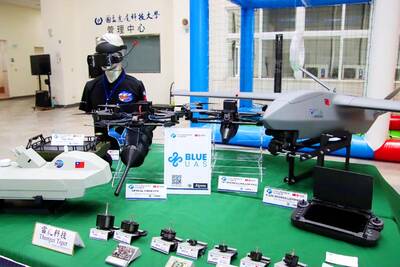
NON-RED SUPPLY: Boosting the nation’s drone industry is becoming increasingly urgent as China’s UAV dominance could become an issue in a crisis, an analyst said Taiwan’s drone exports to Europe grew 41.7-fold from 2024 to last year, with demand from Ukraine’s fight against Russian aggression the most likely driver of growth, a study showed. The Institute for Democracy, Society and Emerging Technology (DSET) in a statement on Wednesday said it found that many of Taiwan’s uncrewed aerial vehicle (UAV) sales were from Poland and the Czech Republic. These countries likely transferred the drones to Ukraine to aid it in its fight against the Russian invasion that started in 2022, it said. Despite the gains, Taiwan is not the dominant drone exporter to these markets, ranking second and fourth

The eastern extension of the Taipei MRT Red Line could begin operations as early as late June, the Taipei Department of Rapid Transit Systems said yesterday. Taipei Rapid Transit Corp said it is considering offering one month of free rides on the new section to mark its opening. Construction progress on the 1.4km extension, which is to run from the current terminal Xiangshan Station to a new eastern terminal, Guangci/Fengtian Temple Station, was 90.6 percent complete by the end of last month, the department said in a report to the Taipei City Council's Transportation Committee. While construction began in October 2016 with an


 RSS
RSS