


Carefully check the labels of Halloween candies for potential allergens when trick-or-treating on Thursday next week, the Food and Drug Administration (FDA) said yesterday.
Warnings in Mandarin must be displayed on the outer packaging of any packaged food product that contains any of the 11 ingredients that might trigger an allergic reaction, FDA Food Safety Division Deputy Director Shiau Huei-wen (蕭惠文) told a news conference in Taipei.
The 11 ingredients are crustaceans, sesame, cow milk, goat milk, fish, mango, eggs, gluten, peanuts, nuts and soybeans, Shiau said.
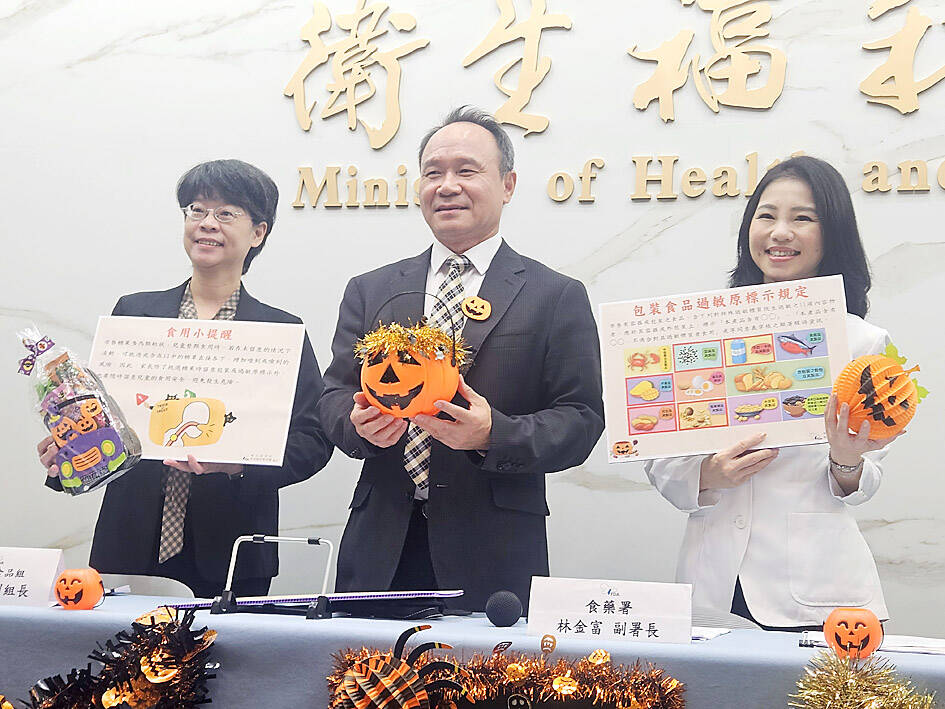
Photo: CNA
If a product uses sulfite additives during production and contains sulfur dioxide residues exceeding 10mg per kilogram, it must also have an allergen label, she added.
Asked what people who cannot read Chinese should do being unable to understand labeling, FDA Deputy Director-General Lin Chin-fu (林金富) said that they should check the outer packaging of food products, as it might include labels in foreign languages or images of allergens.
Meanwhile, Anny Hou (侯沂錚), a dietitian at Taipei Tzu Chi Hospital, said that added sugar intake should not exceed 10 percent of a person’s total daily caloric intake.
If a child aged four to six consumes about 1,800 calories per day, then the recommended added sugar limit for them should be about 180 calories, equivalent to nine sugar cubes, she said.
Separately, Lin said that the FDA has reviewed all online shopping platforms in Taiwan and ordered them to stop selling “wax candy” products from China.
Deputy Minister of Health and Welfare Lin Ching-yi (林靜儀) previously said that “wax candy” — candies with an outer layer of wax wrapped around jam or syrup — raised food safety concerns.
She urged consumers to exercise caution before purchasing the products, as it remains uncertain whether they contain illegal additives.
Lin Chin-fu said that over the past three years, “not a single wax candy product from China has undergone customs declaration and inspection at Taiwan’s borders,” indicating that all such products in Taiwan have been imported illegally.
The FDA’s regulations do not apply to “wax candy” products purchased on foreign platforms such as Douyin (the Chinese version of TikTok) through parallel imports for personal use, Lin Chin-fu said.

UPGRADE: The Kang Ding-class frigate is replacing its Chaparall missiles with Tien Chien II and Hua Yang VLS, which would provide it with long-range, 360° air defense Taiwan plans to produce 1,200 to 1,376 Hai Chien II missiles (海劍二, Sea Sword II) — also known as TC-2N — to serve as the standard air defense system of the navy’s surface combatant fleet, a source said yesterday. Last week, the Hai Chien II, the naval version of the Tien Kung II missile (天劍二, Sky Sword II), completed a live-fire test in waters off the National Chungshan Institute of Science and Technology’s Jiupeng facility (九鵬) in Pingtung County’s Manjhou Township (滿州). The MIM72 Chaparral and other dated air defense missiles that currently arm Taiwanese ships have inadequate range to combat Chinese

REASONS FOR TRAVEL: An assistant professor said that proposed amendments to penalize drivers if they used drugs overseas would not deter people from traveling People who operate a motor vehicle under the influence of marijuana would have their driver’s license revoked, even if they used the substance while overseas, the Ministry of Transportation and Communications said yesterday, citing proposed amendments to the Road Traffic Management and Penalty Act (道路交通管理處罰條例). The amendments would also authorize the government to revoke the licenses of people determined to have used Category 1 or Category 2 narcotics, even if they were not operating a vehicle while under the influence of drugs, as well as ban them from taking the license test for three years, the ministry said. People aged 18 or

HEAVY WEATHER: Typhoon Jangmi is due to crash straight into the Ryukyus as airlines look to shift flights to larger aircraft or cancel flights to Okinawa entirely Taiwan’s international air carriers announced flight adjustments over the weekend as Typhoon Jangmi is forecast to hit the Ryukyu Islands today and tomorrow. The Central Weather Administration (CWA) upgraded Jangmi from a tropical storm to a typhoon at 8am yesterday, with the eye located 580km south of Naha city. It was moving north at 19kph. Today, China Airlines’ CI-120, CI-121, CI-122 and CI-123 flights between Taoyuan and Naha, Okinawa, have been canceled as well as CI-132 and CI-133 between Kaohsiung and Naha. EVA Air’s BR-112, BR-113, BR-186 and BR-185 flights between Taoyuan and Naha are also canceled. Low-cost carrier Tigerair Taiwan canceled IT-230,
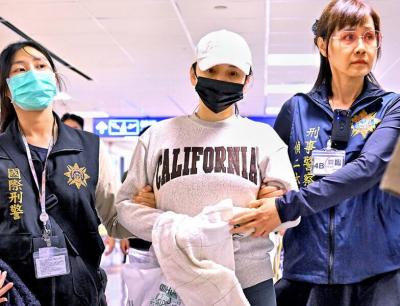
Johanne Liou (劉喬安), a Taiwanese woman who shot to unwanted fame during the Sunflower movement protests in 2014, returned to Taiwan last night after being deported from the US. She is to stand trial in Taiwan for charges involving embezzlement, fraud and drug crimes. The Criminal Investigation Bureau (CIB) said it took her into custody at Taiwan Taoyuan International Airport and would first question her before transferring her to the New Taipei District Prosecutors’ Office. She was arrested upon disembarking a flight from San Francisco that landed shortly before 7pm. Liou absconded to the US in 2019 after jumping bail


 RSS
RSS