


The Cabinet yesterday approved a plan to establish a ministry of sports by August next year, with an allocated budget of NT$20 billion (US$621.74 million).
The new ministry would include a “sports-for-all” administration and three non-departmental public bodies: the national sports training center, national sports science center and national sports industry development center, the plan proposed by the Ministry of Education showed.
The ministry would have six departments in charge of dissimilar matters: international affairs, athletics, industry and technology, facilities planning, comprehensive planning and adaptive sports.
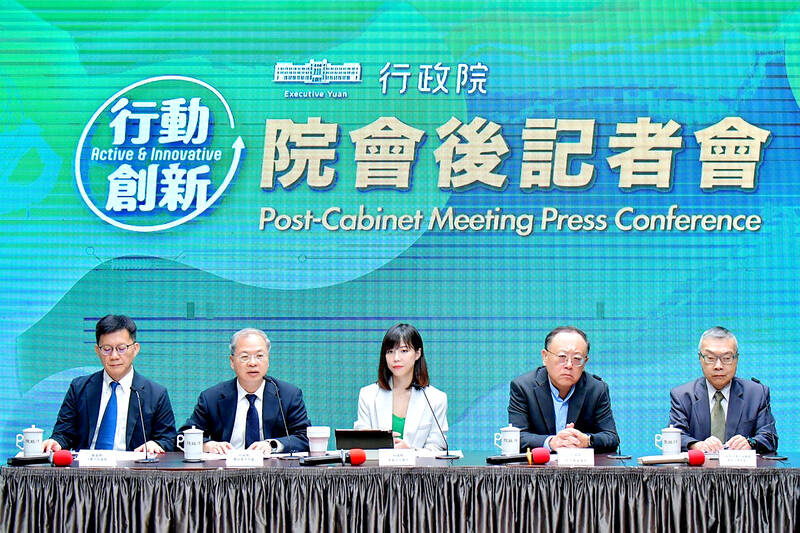
Photo courtesy of the Executive Yuan
The bills included an organic law for the ministry of sports, an organic law for the ministry’s sports-for-all administration, an act for the establishment of the ministry’s national sports industry development center and a proposal to abolish the Organic Law of the Sports Administration, Ministry of Education (教育部體育署組織法).
Amendments were proposed to the Basic Code Governing Central Administrative Agencies Organizations (中央行政機關組織基準法), the Organizational Act of the Executive Yuan (行政院組織法), the Organization Act of the Ministry of Education (教育部組織法), the Act for Establishment of the National Sports Training Center (國家運動訓練中心設置條例) and the Act for Establishment of the National Sports Science Center (國家運動科學中心設置條例).
At the post-meeting news conference, Cabinet spokesperson Michelle Lee (李慧芝) quoted Premier Cho Jung-tai (卓榮泰) as saying that the ministry would be set up in line with President William Lai’s (賴清德) policy to make Taiwan’s sports ecosystem thrive.
The goal is to build Taiwan into a nation with sports equity, social inclusion and sustainable developments, as well as enhance Taiwan’s international participation and influence, she quoted Cho as saying.
At least NT$20 billion has been allocated for the next fiscal year, Executive Yuan Secretary-General Kung Ming-hsin (龔明鑫) told the news conference, adding that he hoped the ministry could come into operation by August next year.
The ministry would employ about 400 personnel, 100 of whom would work for the sports-for-all administration, Kung said.
Although supervisors and deputy ministers are expected to be people qualified as college professors or associate professors, the Executive Yuan would respect the agency’s decisions if other specialists are recruited, Kung said.
To clearly define division of labor, the Ministry of Education would be responsible for constructing, managing and maintaining on-campus sports facilities designed for student use, such as swimming pools and all-weather running tracks, he said.
However, public use of these facilities or advanced athletic equipment outside of school, as well as the curricular design and funding for sports classes would be managed by the sports ministry, Kung said.
Asked whether the sports-for-all administration would take up the personnel quota of the new immigrants development preparatory office, another third-level agency to be established, Directorate-General of Personnel Administration Deputy Director-General Huai Hsu (懷敘) yesterday said the set-up of the ministry of sports would not make the total number of third-level agencies exceed 70, as required by the Basic Code Governing Central Administrative Agencies Organizations (中央行政機關組織基準法).
Details about the establishment of the new immigrants development preparatory office is being explored by the Ministry of the Interior and would later be sent to the Executive Yuan for further review, he said.
Additional reporting by CNA

Fast food chain McDonald's is to raise prices by up to NT$5 on some products at its restaurants across Taiwan, starting on Wednesday next week, the company announced today. The prices of all extra value meals and sharing boxes are to increase by NT$5, while breakfast combos and creamy corn soup would go up by NT$3, the company said in a statement. The price of the main items of those meals, if ordered individually, would remain the same. Meanwhile, the price of a medium-sized lemon iced tea and hot cappuccino would rise by NT$3, extra dipping sauces for chicken nuggets would go up

Yangmingshan National Park’s Qingtiangang (擎天崗) nature area has gone viral after a park livestream camera observed a couple in the throes of intimate congress, which was broadcast live on YouTube, drawing large late-night crowds and sparking a backlash over noise, bright lights and disruption to wildlife habitat. The area’s livestream footage appeared to show a couple engaging in sexual activity on a picnic table in the park on Friday last week, with the uncensored footage streamed publicly online. The footage quickly spread across social media, prompting a tide of visitors to travel to the site to “check in” and recreate the

Minister of Digital Affairs Lin Yi-ching (林宜敬) yesterday cited regulatory issues and national security concerns as an expert said that Taiwan is among the few Asian regions without Starlink. Lin made the remarks on Facebook after funP Innovation Group chief executive officer Nathan Chiu (邱繼弘) on Friday said Taiwan and four other countries in Asia — China, North Korea, Afghanistan and Syria — have no access to Starlink. Starlink has become available in 166 countries worldwide, including Ukraine, Malaysia, the Philippines and Vietnam, in the six years since it became commercial, he said. While China and North Korea block Starlink, Syria is not
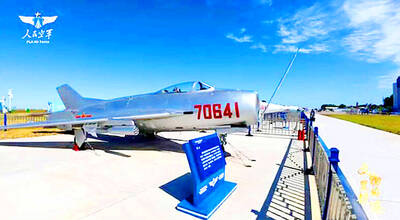
GROUNDED: A KMT lawmaker proposed eliminating drone development programs and freezing funding for counterdrone systems, despite China’s adoption of the technology China has deployed attack drones at air bases near the Taiwan Strait in a strategy aimed at overwhelming Taiwan’s air defense systems through saturation attacks, the Mainland Affairs Council (MAC) said. The council’s latest quarterly report on China said that satellite imagery and open-source intelligence indicate that the Chinese People’s Liberation Army (PLA) had converted retired J-6 fighter jets into J-6W drones, which the PLA has stationed at six air bases near Taiwan, five in China’s Fujian Province and one in Guangdong Province. The report cited J. Michael Dahm, a senior fellow at the US-based Mitchell Institute, as saying that China has


 RSS
RSS