


The Ministry of Digital Affairs (MODA) has mapped out a five-year strategic plan to promote the development and use of artificial intelligence (AI) as a tool to improve the efficiency of government operations, it said in a report to the Legislative Yuan.
The government AI development strategic plan, expected to be implemented from 2026, lays out five strategies. First, encourage government agencies to develop smart services, including building smart counters and smart secretaries, so people can apply for state services with the help of AI tools.
Second, build automated administrative services.
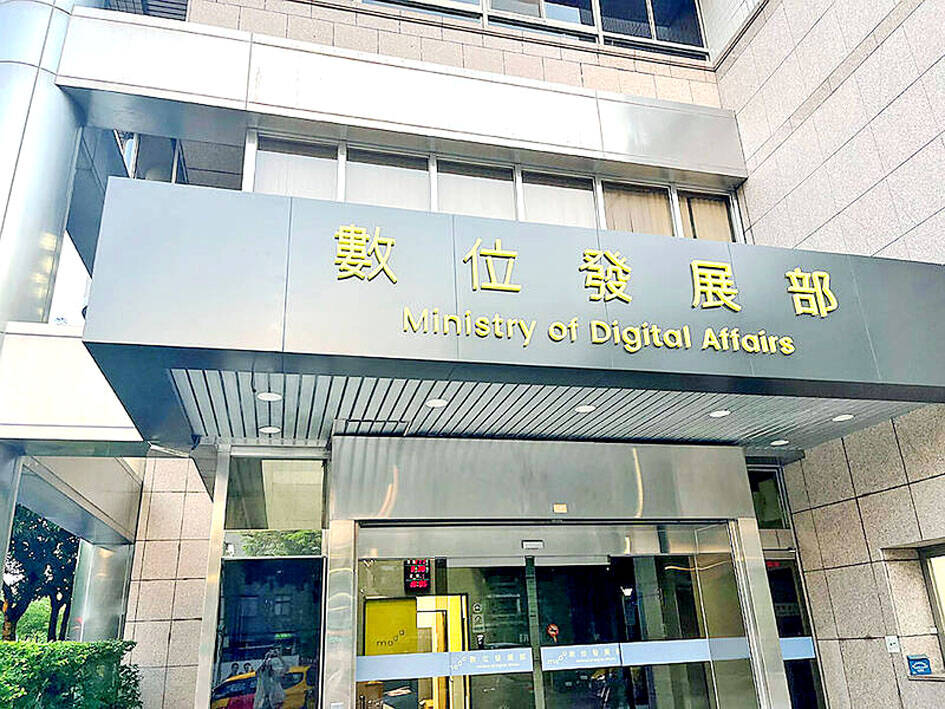
Photo: Hsu Tzu-ling, Taipei Times
The ministry said it would guide government agencies in the use of AI to assist public servants in routine and complex work, help with system construction and information security maintenance, and focus on case review or decisionmaking assistance in specific business areas.
Third, optimize AI models.
The ministry said it aims to create government data fabric and use privacy enhancement technology to allow government data to be better transmitted and used across agencies while ensuring security and anonymity of sensitive data.
Fourth, create smart services that ensure digital inclusion and equal opportunity for all and take into account the need to protect the fair participation of vulnerable groups.
Fifth, establish an environment for AI applications. The ministry would establish a secure and compliant data sharing environment so various agencies can obtain required information safely and efficiently.
The ministry has also devised several complementary measures for the government AI development plan, including the development of an AI application manual for the public sector, with a beta version of the manual to become available for trial use by government agencies before the end of this year.
In related news, Minister of Digital Affairs Huang Yen-nun (黃彥男) on Monday said that that the ministry is planning to launch a program by spending NT$10 billion (US$310.8 million) to cultivate local start-ups in AI development.
Speaking at an AI forum organized by Shih Hsin University, Huang said the ministry would disclose the details of the NT$10 billion plan at the end of this year.
The investment is scheduled to start next year aiming to help at least 20 AI start-ups to grow and allow them to raise funds on the capital market, he added.
Likening the AI boom to the industrial revolution, Huang said Taiwan should catch up with trends to add momentum to economic growth by pushing up industrial productivity.
Otherwise, the nation would be left behind, he said.
To develop AI, Taiwan needs technologies, talent and resources, he said.
However, the country is full of small and medium-sized enterprises with limited capital so financial assistance from the government is a must, he added.
A white paper published by the Small and Medium Enterprises (SME) and Startup Administration of the Ministry of Economic Affairs showed that the number of Taiwan’s SMEs hit 1.63 million as of the end of 2022.
According to the Standards for Identifying Small and Medium- sized Enterprises, an SME is a business that has paid-in capital of no more than NT$100 million or has fewer than 200 regular employees.
Capital is a critical factor for AI start-ups to expand, so MODA has secured NT$10 billion in financial assistance from the National Development Fund of the Executive Yuan to help these smaller companies, Huang said, adding that the money would be spent over 10 years from next year.
The AI start-up program is expected to result in capital formation ranging NT$100 billion to NT$200 billion in the local digital industry and raise job openings by about 10,000, while at least 20 companies would have the potential to raise funds from the capital market, he said.
The NT$10 billion spent in the 10 years is expected to create about NT$1 trillion in production value, he added.

Considering that most countries issue more than five denominations of banknotes, the central bank has decided to redesign all five denominations, the bank said as it prepares for the first major overhaul of the banknotes in more than 24 years. Central bank Governor Yang Chin-lung (楊金龍) is expected to report to the Legislative Yuan today on the bank’s operations and the redesign’s progress. The bank in a report sent to the legislature ahead of today’s meeting said it had commissioned a survey on the public’s preferences. Survey results showed that NT$100 and NT$1,000 banknotes are the most commonly used, while NT$200 and NT$2,000

The Centers for Disease Control (CDC) yesterday reported the first case of a new COVID-19 subvariant — BA.3.2 — in a 10-year-old Singaporean girl who had a fever upon arrival in Taiwan and tested positive for the disease. The girl left Taiwan on March 20 and the case did not have a direct impact on the local community, it said. The WHO added the BA.3.2 strain to its list of Variants Under Monitoring in December last year, but this was the first imported case of the COVID-19 variant in Taiwan, CDC Deputy Director-General Lin Ming-cheng (林明誠) said. The girl arrived in Taiwan on

South Korea is planning to revise its controversial electronic arrival card, a step Taiwanese officials said prompted them to hold off on planned retaliatory measures, a South Korean media report said yesterday. A Yonhap News Agency report said that the South Korean Ministry of Foreign Affairs is planning to remove the “previous departure place” and “next destination” fields from its e-arrival card system. The plan, reached after interagency consultations, is under review and aims to simplify entry procedures and align the electronic form with the paper version, a South Korean ministry official said. The fields — which appeared only on the electronic form

The Ministry of Foreign Affairs (MOFA) is suspending retaliation measures against South Korea that were set to take effect tomorrow, after Seoul said it is updating its e-arrival system, MOFA said today. The measures were to be a new round of retaliation after Taiwan on March 1 changed South Korea's designation on government-issued alien resident certificates held by South Korean nationals to "South Korea” from the "Republic of Korea," the country’s official name. The move came after months of protests to Seoul over its listing of Taiwan as "China (Taiwan)" in dropdown menus on its new online immigration entry system. MOFA last week


 RSS
RSS