


A discolored dose of an Adimmune influenza vaccine was found in Keelung from a batch of 183,000 doses that have already been distributed to six cities and counties, the Centers for Disease Control (CDC) said on Saturday.
The Keelung Health Bureau on Saturday reported that one dose of the vaccine manufactured by Adimmune Corp was found to have discoloration before being administered at Cidu District Public Health Center, the CDC said in a news release.
The dose was immediately withdrawn for further investigation, it said.
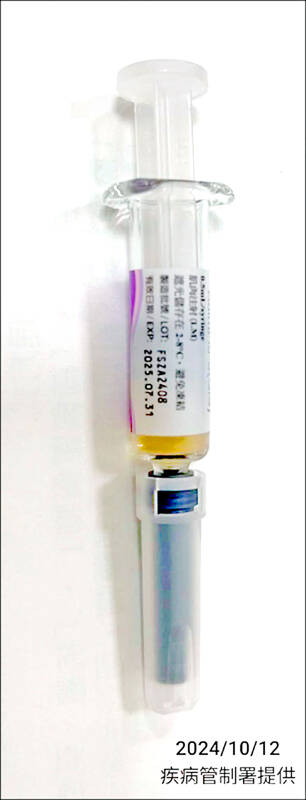
Photo courtesy of the Centers for Disease Control
The batch containing the discolored flu vaccine consisted of about 183,000 doses, which had been distributed to health bureaus in six cities and counties: Taipei, Keelung and Taoyuan, and Miaoli, Hualien and Taitung counties, CDC Deputy Director-General Philip Lo (羅一鈞) said.
From the batch, 75,000 doses had already been administered, while 108,000 doses in stock have been temporarily withdrawn, he said.
The Cidu District Public Health Center inspected more than 70 doses from the same batch (FSZA2408) produced by the Taiwan-based vaccine maker, but no others were found to have discoloration, he added.
Six years ago, a similar situation arose with a dose of a flu vaccine manufactured by French pharmaceutical company Sanofi, Lo said, adding that the incident led to the establishment of a protocol that includes immediately halting the administration of remaining doses from the same batch.
The Food and Drug Administration (FDA) has asked Adimmune to investigate the cause of the discoloration and determine if it is an isolated case or a systemic issue, he said.
The incident would not affect an ongoing free influenza and COVID-19 vaccination program, which began on Oct. 1, Lo said, adding that 6.254 million doses of flu vaccines from five different brands are still available for this year’s program.
Discoloration is usually due to issues with in the cold chain — the temperature-controlled process for storing and transporting vaccines — or improper sealing, leading to abnormalities, said Hwang Kao-pin (黃高彬), deputy head of China Medical University Hospital’ infection control center.
The discoloration could be caused by storing the vaccine at an incorrect temperature, a faulty cap that failed to seal the vaccine or an issue with how it was stored in the Keelung public health center, Hwang said, adding that it was important for health authorities to quickly check other batches to determine the cause.
Medical experts and representatives from the FDA, Keelung City Health Bureau and Adimmune are to meet today to discuss vaccine quality and administration safety, the CDC said.
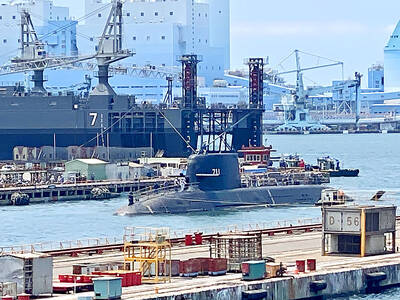
AGING: While Japan has 22 submarines, Taiwan only operates four, two of which were commissioned by the US in 1945 and 1946, and transferred to Taiwan in 1973 Taiwan would need at least 12 submarines to reach modern fleet capabilities, CSBC Corp, Taiwan chairman Chen Cheng-hung (陳政宏) said in an interview broadcast on Friday, citing a US assessment. CSBC is testing the nation’s first indigenous defense submarine, the Hai Kun (海鯤, Narwhal), which is scheduled to be delivered to the navy next month or in July. The Hai Kun has completed torpedo-firing tests and is scheduled to undergo overnight sea trials, Chen said on an SET TV military affairs program. Taiwan would require at least 12 submarines to establish a modern submarine force after assessing the nation’s operational environment and defense

A white king snake that frightened passengers and caused a stir on a Taipei MRT train on Friday evening has been claimed by its owner, who would be fined, Taipei Rapid Transit Corp (TRTC) said yesterday. A person on Threads posted that he thought he was lucky to find an empty row of seats on Friday after boarding a train on the Bannan (Blue) Line, only to spot a white snake with black stripes after sitting down. Startled, he jumped up, he wrote, describing the encounter as “terrifying.” “Taipei’s rat control plan: Release snakes on the metro,” one person wrote in reply, referring
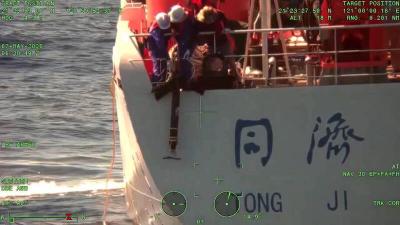
The coast guard today said that it had disrupted "illegal" operations by a Chinese research ship in waters close to the nation and driven it away, part of what Taipei sees a provocative pattern of China's stepped up maritime activities. The coast guard said that it on Thursday last week detected the Chinese ship Tongji (同濟號), which was commissioned only last year, 29 nautical miles (54km) southeast of the southern tip of Taiwan, although just outside restricted waters. The ship was observed lowering ropes into the water, suspected to be the deployment of scientific instruments for "illegal" survey operations, and the coast
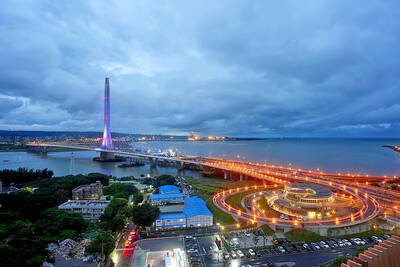
An inauguration ceremony was held yesterday for the Danjiang Bridge, the world’s longest single-mast asymmetric cable-stayed bridge, ahead of its official opening to traffic on Tuesday, marking a major milestone after nearly three decades of planning and construction. At the ceremony in New Taipei City attended by President William Lai (賴清德), Premier Cho Jung-tai (卓榮泰), Minister of Transportation and Communications Chen Shih-kai (陳世凱) and New Taipei City Mayor Hou Yu-ih (侯友宜), the bridge was hailed as both an engineering landmark and a long-awaited regional transport link connecting Tamsui (淡水) and Bali (八里)


 RSS
RSS