


Beijing is increasingly using lawfare as a means of weakening Taiwan, a source said.
Through lawfare, Beijing aims to define a legal basis for the annexation of Taiwan, employ long-arm jurisdiction, deter foreign involvement in Taiwan’s defense, facilitate the “internalization” of the Taiwan Strait and promote the misinterpretation of UN Resolution 2758, they said.
China’s “guidelines” to penalize “die-hard” Taiwanese independence separatists, including with the death penalty, were part of its lawfare strategy, they said, adding that the guidelines — originally intended to be used after Taiwan’s annexation — were implemented in advance to target active members of Taiwan’s military and demoralize the public.
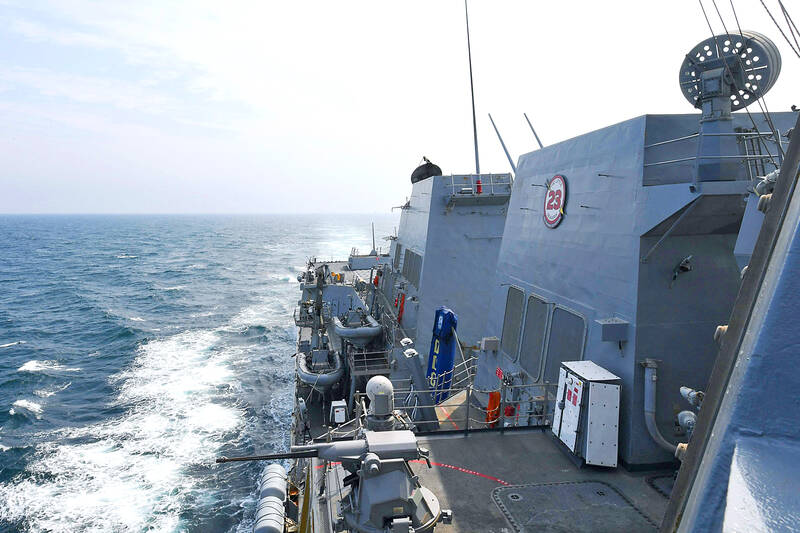
Photo: US Navy via AP
There are many local collaborators who were also helping Beijing with its strategy, which warranted close attention by authorities, the source said.
“There might be a follow-up to the [People’s Liberation Army] PLA’s large-scale joint military exercise in the near future, so Taiwan must take precautions,” they said. “Taiwan must guard against a possible shift by the PLA from drills to war, and it must also be able to strike back at critical points.”
Meanwhile, Institute for National Defense and Security Research research fellow Su Tzu-yun (蘇紫雲) said China’s “anaconda strategy” was an objective fact.
Su was referencing remarks made by Navy Commander Tang Hua (唐華) in an interview with The Economist last week that Beijing’s “anaconda strategy” aims to “strangle Taiwan” and deter foreign intervention in a Taiwan-China conflict.
“The [Chinese Communist Party] CCP does have the ability to blockade the Taiwan Strait, but it does not mean that such a blockade would be successful,” Su said on Sunday.
Article 2 of the Taiwan Relations Act stipulates that if China uses non-peaceful means, including embargoes or blockades, against Taiwan, the US would consider that a “grave concern” and might intervene, and China would face an unpredictable situation, he said.
“However, in the interim before the US could respond, Taiwan would have to be prepared to rely on itself,” he added.
China would want to achieve its aims with such a blockade as quickly as possible to avoid foreign intervention, Su said.
“If the blockade became protracted, that would likely trigger international intervention and China would face a dilemma,” Su added.
Taiwan’s military has always had anti-blockade measures planned and has held drills, he said.
“In response to the improvement of China’s naval strength, Taiwan would of course adopt new measures, including anti-ship missiles and anti-blockade equipment installed 200km offshore,” Su said.
Taiwan would also increase strategic material inventories to strengthen its defense resilience, he said.
“If submarines form combat capabilities in the future, they could also be employed to counter a Chinese blockade,” he added.

Fast food chain McDonald's is to raise prices by up to NT$5 on some products at its restaurants across Taiwan, starting on Wednesday next week, the company announced today. The prices of all extra value meals and sharing boxes are to increase by NT$5, while breakfast combos and creamy corn soup would go up by NT$3, the company said in a statement. The price of the main items of those meals, if ordered individually, would remain the same. Meanwhile, the price of a medium-sized lemon iced tea and hot cappuccino would rise by NT$3, extra dipping sauces for chicken nuggets would go up

Nvidia Corp CEO Jensen Huang (黃仁勳) arrived in Taiwan yesterday ahead of upcoming AI and technology events, saying he plans to meet with clients and Taiwan Semiconductor Manufacturing Co Chairman C.C. Wei (魏哲家) during his visit. After landing at Taipei Songshan Airport, Huang posed for photos with fans and handed out Yakult drinks to reporters and supporters waiting at the scene, saying he has “a lot to do” during the trip. Asked about reports that Nvidia’s planned headquarters site in Taipei’s Beitou Shilin Technology Park could break ground on May 27, Huang said that if the company holds an event, he would

FUKUOKA SITUATION: Japanese media reported that the pathogen is expected to be identified by the summer, while the CDC downplayed the idea that it was hMPV A “mysterious cold-like illness” reported in Japan’s Fukuoka Prefecture does not seem to be a new disease, but Japanese authorities have been asked about the situation, the Centers for Disease Control (CDC) said yesterday. The Fukuoka Prefectural Medical Association on Wednesday told a news conference that a “mystery cold” that has become a hot topic on social media is “highly likely to be caused by some kind of viral infection,” Japan’s KBC News reported. “Many people are experiencing symptoms starting with a sore throat, followed by a runny nose, phlegm and a severe cough,” KBC News reported, citing association officials. Health authorities are
Carrefour Taiwan is to begin using a new name from the start of July, but it cannot divulge the name until then, the chairman of the supermarket chain's parent company said today. President Chain Store Co chairman Lo Chih-hsien (羅智先) was asked by reporters after a shareholders' meeting to confirm whether the company has settled on a new name for the supermarket brand. In March, the government-registered name of two Carrefour Taiwan branches was quietly changed to "Le Chia Kang" (樂家康) in Chinese, raising speculation that has been selected as the name. Lo said that because of local regulations and contractual obligations, the


 RSS
RSS