


Several private companies reported that their Web sites had experienced cyberattacks from overseas, but they did not sustain any substantial damages, the Ministry of Digital Affairs (MODA) said yesterday.
Minister of Digital Affairs Huang Yen-nun (黃彥男) made the remarks on the sidelines of a meeting of the legislature’s Transportation Committee after reporters asked him about the distributed denial-of-service (DDoS) attacks reported by Formosa Petrochemical Corp, Wistron Corp and United Microelectronics Corp.
The attacks came after pro-Russia hacker group NoName57 last month launched a similar attack against 45 government agencies.
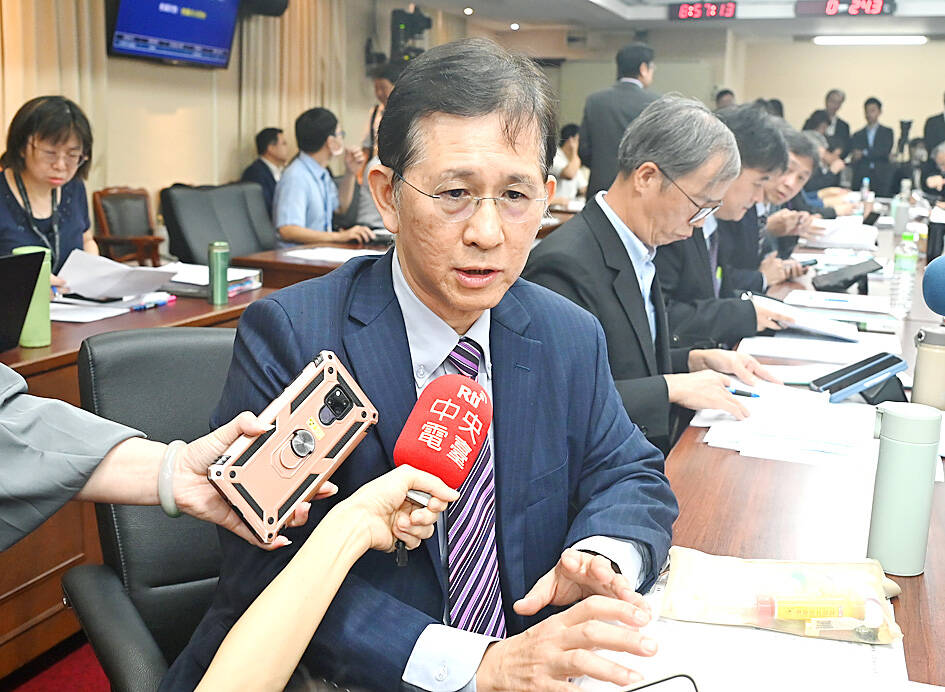
Photo: Wang Yi-sung, Taipei Times
After last month’s attacks, the ministry raised the national cybersecurity alert to the same level as the presidential election’s.
“The ministry and National Security Council officials have a full grasp of the situation. This time, some of the hackers were from NoName57, and we have shared the intelligence with other agencies,” Huang said. “However, we have yet to see if these attacks would lead to serious service disruptions or financial damages.”
Most of the recent cyberattacks were DDoS attacks, which did not invade the internal system, he said.
At the meeting, Huang told lawmakers that an Internet Fraud Reporting and Inquiry Network platform would officially be launched in December, adding that the ministry has rolled out a beta version of the platform for people to test it and provide feedback.
So far, about 2,000 people have downloaded the app, and most of the reported cases were related to investment, dating or invoice scams, he said.
Democratic Progressive Party (DPP) Legislator Lee Kun-tse (李昆澤) said some online shoppers reported that they suspected their accounts at online shopping site PChome might have been hacked, as the money they stored in their accounts was used up.
Huang said that hackers used credential stuffing, a method of cyberattack, to steal account credentials, which usually consist of usernames, e-mail addresses and passwords.
They then use the illegally obtained credentials to gain unauthorized access to user accounts in various systems, he said.
The accounts of the users who are suspicious were reportedly logged out and they were required to sign in again, he said.
“Aside from remembering their usernames and passwords, people should use multiple-step verification methods,” he said.
DPP Legislator Lin Chun-hsien (林俊憲) said that online platforms should reinstate the accounts of users who were hacked, rather than asking them to set up a new account.
“If online gaming service operators can fully reinstate their users’ accounts, so can messaging apps like Line,” Lin said, adding that Line’s service contract with users includes such an obligation.
Most of investment scam advertisements are found on Facebook, Huang said, adding that according to the Fraud Hazard Prevention Act (詐欺犯罪危害防制條例), which took effect in July, online advertising platforms could face a fine of up to NT$100 million (US$3.11 million) if they were informed about fraudulent advertising content on their platforms and fail to take action.
An amendment to the act would be proposed to hold platform operators liable for damages and financial losses caused by fraudulent content on their platforms, he said.
From the end of this year, those seeking to place advertisements on online platforms would be required to use their official names, as amendments to the Electronic Signatures Act (電子簽章法) were implemented in May, Huang said.
Facebook uses artificial intelligence to take down investment scam advertisements, which has reduced the number of investment scams from 80,000 per month to 14,000 per month, he said.
By Oct. 31, Google, Line, Meta and TikTok must have legal representation in Taiwan to make sure they comply with the government’s regulations to combat fraud, he said.

Considering that most countries issue more than five denominations of banknotes, the central bank has decided to redesign all five denominations, the bank said as it prepares for the first major overhaul of the banknotes in more than 24 years. Central bank Governor Yang Chin-lung (楊金龍) is expected to report to the Legislative Yuan today on the bank’s operations and the redesign’s progress. The bank in a report sent to the legislature ahead of today’s meeting said it had commissioned a survey on the public’s preferences. Survey results showed that NT$100 and NT$1,000 banknotes are the most commonly used, while NT$200 and NT$2,000

The Centers for Disease Control (CDC) yesterday reported the first case of a new COVID-19 subvariant — BA.3.2 — in a 10-year-old Singaporean girl who had a fever upon arrival in Taiwan and tested positive for the disease. The girl left Taiwan on March 20 and the case did not have a direct impact on the local community, it said. The WHO added the BA.3.2 strain to its list of Variants Under Monitoring in December last year, but this was the first imported case of the COVID-19 variant in Taiwan, CDC Deputy Director-General Lin Ming-cheng (林明誠) said. The girl arrived in Taiwan on

ANNUAL EVENT: Two massive Pokemon balloons are to be set up in Daan Park, with an event zone operating from 10am to 6pm This year’s Taipei Floral Picnic is to be held at Daan Park today and tomorrow, featuring an exclusive Pokemon Go event, a themed food market, a coffee rave picnic area and stage performances, the Taipei Department of Information and Tourism said yesterday. Two massive Pokemon balloons are to be set up in the park as attractions, with an exclusive event zone operating from 10am to 6pm, it said. Participants who complete designated tasks on-site would have a chance to receive limited-edition souvenirs, it added. People could also try the newly launched game Pokemon Pokopia in the trial area, the department said. Three PokeStops are

South Korea is planning to revise its controversial electronic arrival card, a step Taiwanese officials said prompted them to hold off on planned retaliatory measures, a South Korean media report said yesterday. A Yonhap News Agency report said that the South Korean Ministry of Foreign Affairs is planning to remove the “previous departure place” and “next destination” fields from its e-arrival card system. The plan, reached after interagency consultations, is under review and aims to simplify entry procedures and align the electronic form with the paper version, a South Korean ministry official said. The fields — which appeared only on the electronic form


 RSS
RSS