


The low organization rate of trade unions has led to unbalanced labor-management relations and a lack of democracy in workplaces, the Taiwan Labor Front (TLF) said yesterday, urging the government to uphold the values of “decent work” in line with global trends.
The group issued the remarks at a news conference with Democratic Progressive Party Legislator Fan Yun (范雲) to mark World Day for Decent Work, the theme of which this year is “Workers Deserve Peace and Democracy.”
Fan, who has held the news conference to mark the day with the TLF for four consecutive years, said that the Minimum Wage Act (最低工資法), passed in December last year, was part of efforts to meet decent work goals.
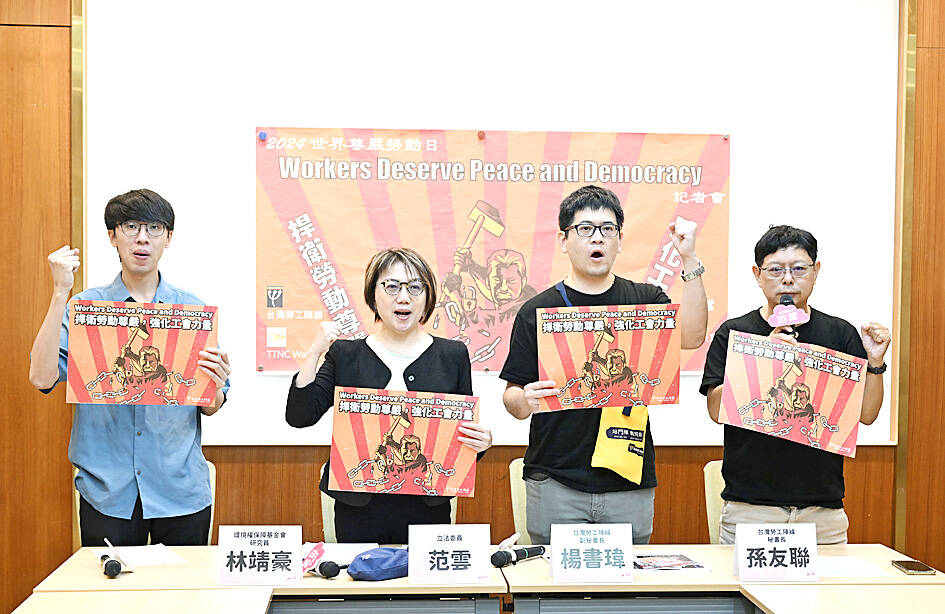
Photo: Lo Pei-de, Taipei Times
While the Sports Administration last month pledged to assist professional leagues in organizing player unions to protect athletes’ rights, the forced labor of migrant workers remains rampant in Taiwan and must be addressed, she said.
TLF deputy secretary-general Yang Hsu-wei (楊書瑋) said Taiwan faces a labor shortage, but employers tend to cut costs through exploitive labor conditions while pressuring the government to let them hire more migrant workers, resulting in the slow upgrading of industrial facilities and a low-wage crisis.
While Taiwan’s image abroad has been tainted multiple times by reporting on forced labor, regulations have not effectively curbed the practice as they are scattered across the Labor Standards Act (勞動基準法), the Employment Service Act (就業服務法) and the Human Trafficking Prevention Act (人口販運防制法), he said.
Yang also discussed incidents of foreign students being exploited as forced labor, urging the government to bolster laws against forced labor to prevent and eradicate the problem.
Collective labor-management relations in Taiwan are severely unbalanced, as democracy is absent in many workplaces and the organization rate of trade unions is low, he said.
Although Taiwan’s three major labor laws — the Labor Union Act (工會法), the Collective Agreement Act (團體協約法) and Act for Settlement of Labor-Management Disputes (勞資爭議處理法) — have been amended and enforced in 2011, the number of trade unions have not significantly increased, totaling 953 enterprise unions and 264 industrial unions as of this year, Yang said.
The rate of collective bargaining coverage also remains low, indicating that Taiwan has a lot to improve in terms of collective labor rights, he said.
Fewer than 200 of Taiwan’s 1,843 listed and over-the-counter companies have established an enterprise union, while only 50 of them, or less than 3 percent, have signed a collective bargaining agreement, he said.
To actualize decent work, trade unions must be strengthened to facilitate collective bargaining and improve collective labor-management relations, he said, adding that this is also crucial for corporate sustainability.
Yang also urged the government to step up efforts to create an act on supply chain corporate responsibility to ensure that companies protect human rights in global supply chains — especially Taiwanese firms operating in countries notorious for infringing on workers’ rights.
The TLF urged the government to include in the upcoming second edition of the Taiwan National Action Plan on Business and Human Rights (臺灣企業與人權國家行動計畫) concrete measures to protect the rights of trade unions to participate in corporate decisionmaking processes, promote democracy in workplaces and establish legal remedies to ensure companies respect labor rights.
In a statement published last month, the International Trade Union Confederation outlined the importance of decent work.
“With ongoing armed conflicts, economic inequalities, climate crises and digital disruptions affecting workers, trade unions are stepping forward to champion not just decent work, but also the foundational elements of democracy and peace that make sustainable livelihoods possible,” it said.
“Decent work is inseparable from peace and democracy,” it said, adding that “democracy goes beyond political representation and includes workplace democracy, where workers have the right to unionize, bargain collectively and participate in shaping policies that affect their labor conditions.”

The military has spotted two Chinese warships operating in waters near Penghu County in the Taiwan Strait and sent its own naval and air forces to monitor the vessels, the Ministry of National Defense (MND) said. Beijing sends warships and warplanes into the waters and skies around Taiwan on an almost daily basis, drawing condemnation from Taipei. While the ministry offers daily updates on the locations of Chinese military aircraft, it only rarely gives details of where Chinese warships are operating, generally only when it detects aircraft carriers, as happened last week. A Chinese destroyer and a frigate entered waters to the southwest

A magnitude 6.1 earthquake struck off the coast of Yilan County at 8:39pm tonight, the Central Weather Administration (CWA) said, with no immediate reports of damage or injuries. The epicenter was 38.7km east-northeast of Yilan County Hall at a focal depth of 98.3km, the CWA’s Seismological Center said. The quake’s maximum intensity, which gauges the actual physical effect of a seismic event, was a level 4 on Taiwan’s 7-tier intensity scale, the center said. That intensity level was recorded in Yilan County’s Nanao Township (南澳), Hsinchu County’s Guansi Township (關西), Nantou County’s Hehuanshan (合歡山) and Hualien County’s Yanliao (鹽寮). An intensity of 3 was

Japanese Prime Minister Sanae Takaichi’s comment last year on Tokyo’s potential reaction to a Taiwan-China conflict has forced Beijing to rewrite its invasion plans, a retired Japanese general said. Takaichi told the Diet on Nov. 7 last year that a Chinese naval blockade or military attack on Taiwan could constitute a “survival-threatening situation” for Japan, potentially allowing Tokyo to exercise its right to collective self-defense. Former Japan Ground Self-Defense Force general Kiyofumi Ogawa said in a recent speech that the remark has been interpreted as meaning Japan could intervene in the early stages of a Taiwan Strait conflict, undermining China’s previous assumptions

Instead of focusing solely on the threat of a full-scale military invasion, the US and its allies must prepare for a potential Chinese “quarantine” of Taiwan enforced through customs inspections, Stanford University Hoover fellow Eyck Freymann said in a Foreign Affairs article published on Wednesday. China could use various “gray zone” tactics in “reconfiguring the regional and ultimately the global economic order without a war,” said Freymann, who is also a nonresident research fellow at the US Naval War College. China might seize control of Taiwan’s links to the outside world by requiring all flights and ships entering or leaving Taiwan


 RSS
RSS