


The Supreme Court in a retrial on Friday upheld the life sentence handed to convicted murderer Liu Chih-ming (劉志明), formally removing him from death row, where he has been for the better part of the past decade.
Liu’s case is the first time the court commuted a death sentence to a life term, after the Constitutional Court on Sept. 20 found the death penalty constitutional, but said it should be limited to special and exceptional circumstances.
The judgement was issued in response to a court challenge made by 37 prisoners on death row, who had filed the petition through their lawyers, saying that capital punishment was unconstitutional.
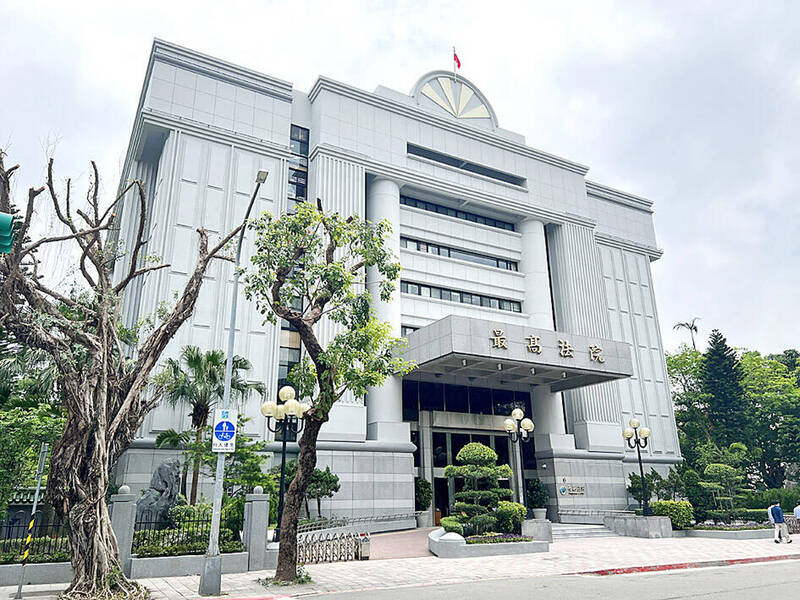
Photo: Taipei Times
Liu was convicted of sexual assault and larceny resulting in homicide for the violent murder of a woman in 2014 and was handed the death sentence.
In an appeal, the Kaohsiung branch of the High Court upheld the death penalty for Liu. The sentence was also upheld in the three retrials.
Liu, aged 52 at the time, in December 2014 was carrying a hammer while looking for his former girlfriend when he came upon a woman, a retired teacher surnamed Chen (陳), opening her car door, court documents showed.
Liu decided to rob Chen, who he had never met before, and attacked her. He used the hammer to strike her head 13 times, sexually assaulted her, bit off her nipple and took NT$2,000 from her purse, prosecutors said, citing evidence and recorded police statements.
Judges upheld the death penalty, saying it was a severe crime, as Liu had killed Chen by vicious and cruel means, and sexually assaulted her, adding that there was no likelihood of rehabilitation and that Liu should be permanently separated from society.
The High Court in the fourth retrial in May commuted Liu’s sentence to life in prison, saying there was a lack of evidence that Liu took the NT$2,000 and that Chen was a random target, so it was not premeditated murder and therefore did not fall under “most serious crimes,” according to the International Covenant on Civil and Political Rights.
It also cited results of psychological assessments and pre-sentence investigations, saying that there was a possibility of rehabilitation for Liu, as he had shown remorse for the crime. Public prosecutors disagreed and filed to appeal the fourth retrial.
The Supreme Court in its ruling then upheld the life sentence handed to Liu in the fourth retrial, which is the final verdict.
Groups in favor of the death penalty were joined by Chinese Nationalist Party (KMT) legislators in condemning the Constitutional Court’s ruling last month, saying “it effectively abolished capital punishment in Taiwan” and that “the decision runs contrary to the expectations of the majority of Taiwanese.”
They also requested the Ministry of Justice to swiftly carry out the execution of the 37 convicted prisoners currently on death row.
The Taiwan People’s Party caucus yesterday said it would propose an amendment to the Criminal Code so that those handed a life sentence would not be given parole.
Additional reporting by Liu Wan-lin

Considering that most countries issue more than five denominations of banknotes, the central bank has decided to redesign all five denominations, the bank said as it prepares for the first major overhaul of the banknotes in more than 24 years. Central bank Governor Yang Chin-lung (楊金龍) is expected to report to the Legislative Yuan today on the bank’s operations and the redesign’s progress. The bank in a report sent to the legislature ahead of today’s meeting said it had commissioned a survey on the public’s preferences. Survey results showed that NT$100 and NT$1,000 banknotes are the most commonly used, while NT$200 and NT$2,000

The Centers for Disease Control (CDC) yesterday reported the first case of a new COVID-19 subvariant — BA.3.2 — in a 10-year-old Singaporean girl who had a fever upon arrival in Taiwan and tested positive for the disease. The girl left Taiwan on March 20 and the case did not have a direct impact on the local community, it said. The WHO added the BA.3.2 strain to its list of Variants Under Monitoring in December last year, but this was the first imported case of the COVID-19 variant in Taiwan, CDC Deputy Director-General Lin Ming-cheng (林明誠) said. The girl arrived in Taiwan on

South Korea is planning to revise its controversial electronic arrival card, a step Taiwanese officials said prompted them to hold off on planned retaliatory measures, a South Korean media report said yesterday. A Yonhap News Agency report said that the South Korean Ministry of Foreign Affairs is planning to remove the “previous departure place” and “next destination” fields from its e-arrival card system. The plan, reached after interagency consultations, is under review and aims to simplify entry procedures and align the electronic form with the paper version, a South Korean ministry official said. The fields — which appeared only on the electronic form

The Ministry of Foreign Affairs (MOFA) is suspending retaliation measures against South Korea that were set to take effect tomorrow, after Seoul said it is updating its e-arrival system, MOFA said today. The measures were to be a new round of retaliation after Taiwan on March 1 changed South Korea's designation on government-issued alien resident certificates held by South Korean nationals to "South Korea” from the "Republic of Korea," the country’s official name. The move came after months of protests to Seoul over its listing of Taiwan as "China (Taiwan)" in dropdown menus on its new online immigration entry system. MOFA last week


 RSS
RSS