


Aerospace researcher Su Yu-pen (蘇玉本) was on Sunday inducted as an honorary member of the US National Academy of Engineering (NAE) at its annual meeting in Washington, a source confirmed.
Su has served at the Chungshan Institute of Science and Technology, the research and development arm of the Ministry of National Defense, since 1974, after graduating with a medical and aerospace engineering doctorate from Princeton University.
He was credited as the lead designer on some of the institute’s most significant programs including the Tien Kung (天弓, “Sky Bow”) air defense missiles and the Hsiung Feng (雄風, “Brave Wind”), and Wan Chien (萬劍, “Ten Thousand Swords”) cruise missiles, as well as rocket engines, motors and turbines.
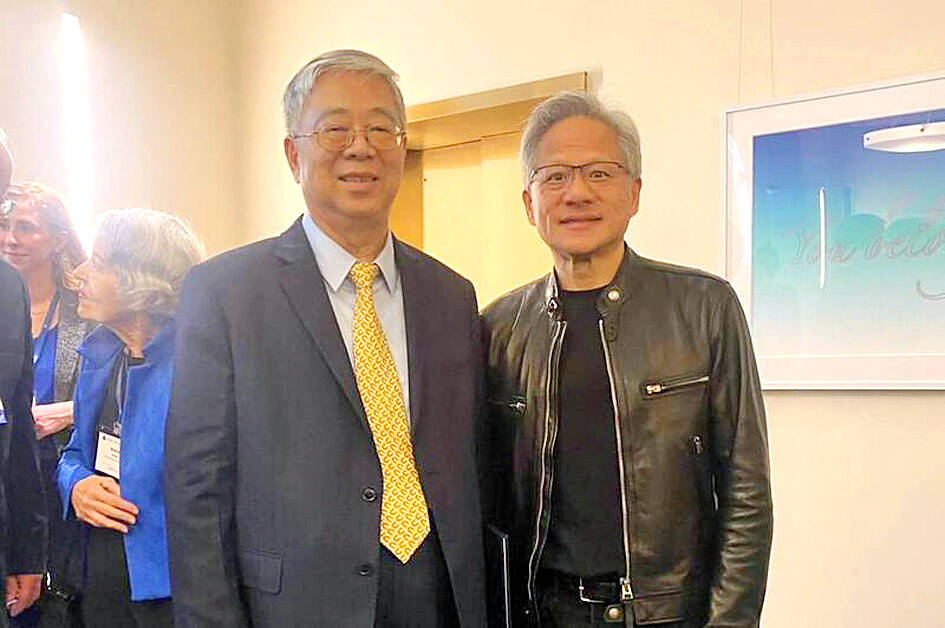
Photo courtesy of a reader
Su’s most notable recent achievement is the Hsiung Feng III (雄風三型, “Brave Wind III”) supersonic cruise missile, an advanced weapon developed almost entirely with domestic capabilities as foreign governments were reluctant to provide sensitive rocket technology.
In February, the NAE elected 114 US members and 21 international members, including Nvidia Corp cofounder Jensen Huang (黃仁勳).
A Feb. 6 NAE news release said Su was elected for the “development of aerospace propulsion and vehicle technologies for missiles and rockets,” adding that being elected as a member “is among the highest professional distinctions accorded to an engineer.”
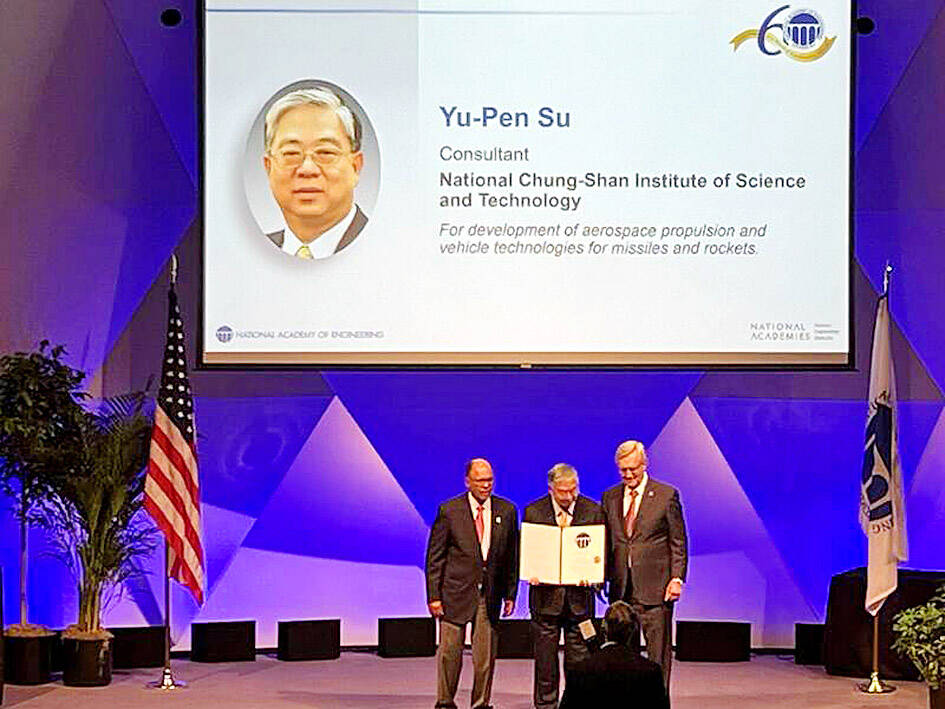
Photo courtesy of a reader
Huang joined Su at the induction ceremony at the NAE’s annual meeting, at which the Republic of China flag was displayed alongside those of the UK, Japan, South Korea and Spain, from which other international members hailed.
In May, Su told the Chinese-language Liberty Times (the Taipei Times’ sister paper) that he was unaware of being nominated as an academy member and that his election signaled global recognition for the nation’s defense industry.
Taiwan possesses significant potential in the design of arms despite a lack of manufacturing resources, Su said at the time.
Going forward, the institute should deepen its collaboration with the domestic manufacturing sector, incorporate artificial intelligence in missiles and radar design, and devote resources to electronic warfare countermeasures and missile defense, he said.
Fast food chain McDonald's is to raise prices by up to NT$5 on some products at its restaurants across Taiwan, starting on Wednesday next week, the company announced today. The prices of all extra value meals and sharing boxes are to increase by NT$5, while breakfast combos and creamy corn soup would go up by NT$3, the company said in a statement. The price of the main items of those meals, if ordered individually, would remain the same. Meanwhile, the price of a medium-sized lemon iced tea and hot cappuccino would rise by NT$3, extra dipping sauces for chicken nuggets would go up

Nvidia Corp CEO Jensen Huang (黃仁勳) arrived in Taiwan yesterday ahead of upcoming AI and technology events, saying he plans to meet with clients and Taiwan Semiconductor Manufacturing Co Chairman C.C. Wei (魏哲家) during his visit. After landing at Taipei Songshan Airport, Huang posed for photos with fans and handed out Yakult drinks to reporters and supporters waiting at the scene, saying he has “a lot to do” during the trip. Asked about reports that Nvidia’s planned headquarters site in Taipei’s Beitou Shilin Technology Park could break ground on May 27, Huang said that if the company holds an event, he would

FUKUOKA SITUATION: Japanese media reported that the pathogen is expected to be identified by the summer, while the CDC downplayed the idea that it was hMPV A “mysterious cold-like illness” reported in Japan’s Fukuoka Prefecture does not seem to be a new disease, but Japanese authorities have been asked about the situation, the Centers for Disease Control (CDC) said yesterday. The Fukuoka Prefectural Medical Association on Wednesday told a news conference that a “mystery cold” that has become a hot topic on social media is “highly likely to be caused by some kind of viral infection,” Japan’s KBC News reported. “Many people are experiencing symptoms starting with a sore throat, followed by a runny nose, phlegm and a severe cough,” KBC News reported, citing association officials. Health authorities are

Carrefour Taiwan is to begin using a new name from the start of July, but it cannot divulge the name until then, the chairman of the supermarket chain's parent company said today. President Chain Store Co chairman Lo Chih-hsien (羅智先) was asked by reporters after a shareholders' meeting to confirm whether the company has settled on a new name for the supermarket brand. In March, the government-registered name of two Carrefour Taiwan branches was quietly changed to "Le Chia Kang" (樂家康) in Chinese, raising speculation that has been selected as the name. Lo said that because of local regulations and contractual obligations, the


 RSS
RSS