


The Free Nations of Post-Russia Forum earlier this month published a draft document calling for Russia and China to decolonize and leave occupied territory, while advocating for a closer trans-Pacific alliance to counter Moscow and Beijing.
The five-point document, called “The Taipei Appeal,” was released after a forum in Taipei, called “Design of post-Russian spaces and its impact on the macro-regions of East, Southeast & Central Asia,” held on Sept. 18 and 19.
The document calls for Russia and China to “undergo complete decolonization,” and that the territories of states that they occupy “be de-occupied,” while all the territories they occupied.
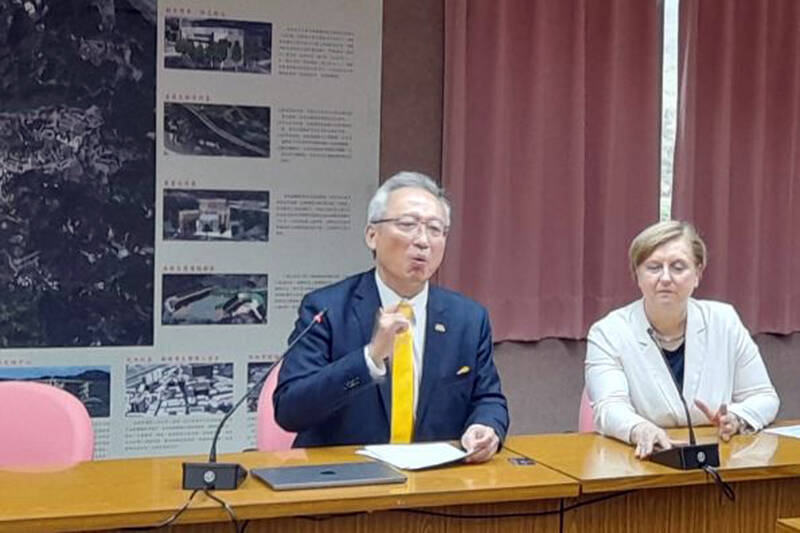
Photo: Jason Pan, Taipei Times
Nations must also provide “comprehensive support” for Ukraine’s military resistance against Russia, calling it the most important goal for the entire free world, as a victory for Ukraine would be the most effective safeguard against new attempts to start wars against NATO states and independent Asian states, it said.
It also called for building “a closer trans-Pacific alliance that can better coordinate the defense of all Asian countries” from Russia and China.
Such an alliance would underscore “common values and mutual interests to defend national independence, state sovereignty and territorial integrity,” it said.
Deputy Minister of Foreign Affairs Francois Wu (吳志中), National Dong Hwa University Center for International Indigenous Affairs director Bavaragh Dagalomai and Taiwan Stands With Ukraine member Aurora Chang (張瓊方) were among the attendees at the event at National Chengchi University.
European Parliament Security and Defence Subcommittee Chair Anna Fotyga, former European Parliament member Arunas Degutis, former UN Permanent Forum on Indigenous Issues member Oliver Loode, European Resilience Initiative Center founder Sergej Sumlenny, and Asia-Pacific Human Rights Information Center members Hidetoshi Ishii and Yoko Ishii also attended.
Forum participants met with Democratic Progressive Party legislators Chen Kuan-ting (陳冠廷) and Chiu Chih-wei (邱志偉) to discuss promoting closer relations and collaboration programs between Taiwan and their respective countries, and got to know more about Taiwan’s efforts to aid Ukraine.
The forum aimed to develop a strong partnership between Taiwan, international organizations and government representatives of European states, Free Nations of Post-Russia Forum cofounder Oleg Magaletsky said.
“Taiwan has one thing in common with the Baltic states, Poland, Ukraine and other East European countries: having to face a powerful neighbor, an authoritarian regime which openly declares its desire to use military action for occupation and to destroy their identity,” he said, adding that Russia and China are already waging a hybrid digital warfare of disinformation.
Therefore, it is vital for interaction to take place right now, for collaboration and exchanging of experience between Taiwan and the democratic nations in East European and Baltic regions, he added.

FUKUOKA SITUATION: Japanese media reported that the pathogen is expected to be identified by the summer, while the CDC downplayed the idea that it was hMPV A “mysterious cold-like illness” reported in Japan’s Fukuoka Prefecture does not seem to be a new disease, but Japanese authorities have been asked about the situation, the Centers for Disease Control (CDC) said yesterday. The Fukuoka Prefectural Medical Association on Wednesday told a news conference that a “mystery cold” that has become a hot topic on social media is “highly likely to be caused by some kind of viral infection,” Japan’s KBC News reported. “Many people are experiencing symptoms starting with a sore throat, followed by a runny nose, phlegm and a severe cough,” KBC News reported, citing association officials. Health authorities are

Nvidia Corp CEO Jensen Huang (黃仁勳) arrived in Taiwan yesterday ahead of upcoming AI and technology events, saying he plans to meet with clients and Taiwan Semiconductor Manufacturing Co Chairman C.C. Wei (魏哲家) during his visit. After landing at Taipei Songshan Airport, Huang posed for photos with fans and handed out Yakult drinks to reporters and supporters waiting at the scene, saying he has “a lot to do” during the trip. Asked about reports that Nvidia’s planned headquarters site in Taipei’s Beitou Shilin Technology Park could break ground on May 27, Huang said that if the company holds an event, he would

Carrefour Taiwan is to begin using a new name from the start of July, but it cannot divulge the name until then, the chairman of the supermarket chain's parent company said today. President Chain Store Co chairman Lo Chih-hsien (羅智先) was asked by reporters after a shareholders' meeting to confirm whether the company has settled on a new name for the supermarket brand. In March, the government-registered name of two Carrefour Taiwan branches was quietly changed to "Le Chia Kang" (樂家康) in Chinese, raising speculation that has been selected as the name. Lo said that because of local regulations and contractual obligations, the
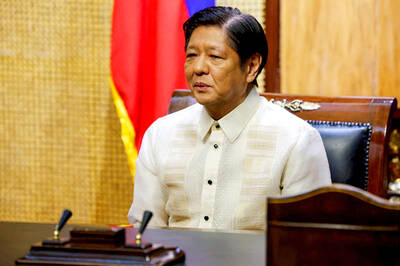
The Philippines would likely be involved in any conflict over Taiwan due to its proximity to the democracy claimed by China, President Ferdinand Marcos Jr said, reiterating a stance that risks angering Beijing. “In the Philippines, we do not have a choice because Taiwan is so close to the Philippines and we have almost 200,000 Filipino nationals living and working in Taiwan,” Marcos said in an interview with Japanese media in Manila on Monday. The Philippine leader’s comments come ahead of a state visit to Japan next week, where he is to meet with Japanese Prime Minister Sanae Takaichi to discuss security


 RSS
RSS