


The government is to beef up anti-counterfeiting technology and penalties to fight a surge in fake license plates, Minister of Transportation and Communications Chen Shih-kai (陳世凱) told lawmakers on Friday.
There were 627 cases of forged license plates since January, significantly more than the 57 reported in 2019, Democratic Progressive Party Legislator Lin Chun-hsien (林俊憲) said, citing data from the National Police Agency.
The use of counterfeit plates spiked following the amendments to the Road Traffic Management and Penalty Act (道路交通管理處罰條例) last year, which defined “severe overspeeding” as driving 40kph over the limit, down from 60kph.
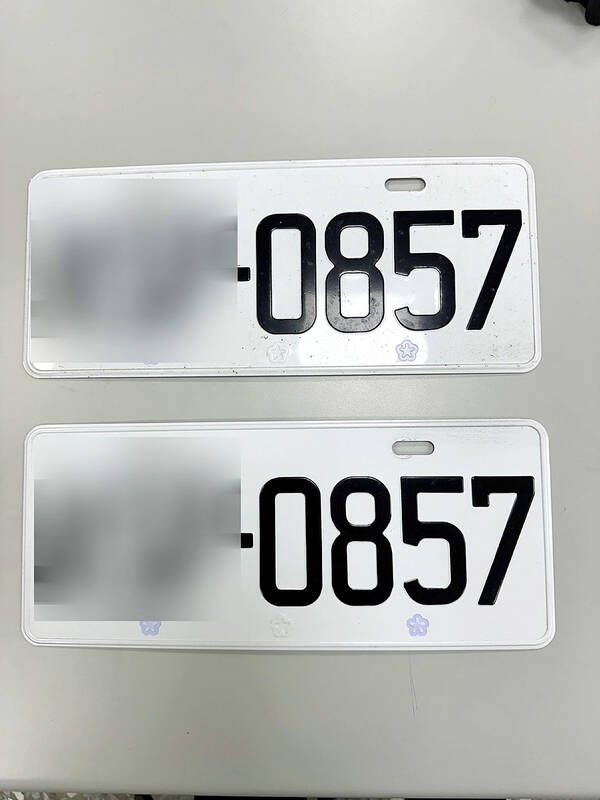
Photo: Hsu Kuo-chen, Taipei Times
The penalty for severe overspeeding includes a six-month suspension on the offender’s car license, he said, adding that speeding cases skyrocketed from 15,000 in 2019 to 62,000 cases last year.
About 40 percent of the fake license plates were used to replace suspended legal licenses, Lin said, adding that a tightening of regulations appeared to have worsened traffic contraventions.
For many, a suspended driver’s license meant losing their livelihood, ability to get to work or provide necessary transportation to family members, so it is not surprising that some would turn to using counterfeit plates, he said.
In response to Lin asking how the government plans to counter the rise in traffic contraventions and forged plates, Chen said that new license plates issued next year would feature anti-counterfeiting technology to make forgery more difficult and that the punishment for using fake plates would be increased.
The ministry would also re-examine the reasonableness of the amended law with relevant police agencies and local governments, and potentially increase the speed limit allowed on freeways, Chen said.

Considering that most countries issue more than five denominations of banknotes, the central bank has decided to redesign all five denominations, the bank said as it prepares for the first major overhaul of the banknotes in more than 24 years. Central bank Governor Yang Chin-lung (楊金龍) is expected to report to the Legislative Yuan today on the bank’s operations and the redesign’s progress. The bank in a report sent to the legislature ahead of today’s meeting said it had commissioned a survey on the public’s preferences. Survey results showed that NT$100 and NT$1,000 banknotes are the most commonly used, while NT$200 and NT$2,000

The Centers for Disease Control (CDC) yesterday reported the first case of a new COVID-19 subvariant — BA.3.2 — in a 10-year-old Singaporean girl who had a fever upon arrival in Taiwan and tested positive for the disease. The girl left Taiwan on March 20 and the case did not have a direct impact on the local community, it said. The WHO added the BA.3.2 strain to its list of Variants Under Monitoring in December last year, but this was the first imported case of the COVID-19 variant in Taiwan, CDC Deputy Director-General Lin Ming-cheng (林明誠) said. The girl arrived in Taiwan on

ANNUAL EVENT: Two massive Pokemon balloons are to be set up in Daan Park, with an event zone operating from 10am to 6pm This year’s Taipei Floral Picnic is to be held at Daan Park today and tomorrow, featuring an exclusive Pokemon Go event, a themed food market, a coffee rave picnic area and stage performances, the Taipei Department of Information and Tourism said yesterday. Two massive Pokemon balloons are to be set up in the park as attractions, with an exclusive event zone operating from 10am to 6pm, it said. Participants who complete designated tasks on-site would have a chance to receive limited-edition souvenirs, it added. People could also try the newly launched game Pokemon Pokopia in the trial area, the department said. Three PokeStops are

South Korea is planning to revise its controversial electronic arrival card, a step Taiwanese officials said prompted them to hold off on planned retaliatory measures, a South Korean media report said yesterday. A Yonhap News Agency report said that the South Korean Ministry of Foreign Affairs is planning to remove the “previous departure place” and “next destination” fields from its e-arrival card system. The plan, reached after interagency consultations, is under review and aims to simplify entry procedures and align the electronic form with the paper version, a South Korean ministry official said. The fields — which appeared only on the electronic form


 RSS
RSS