


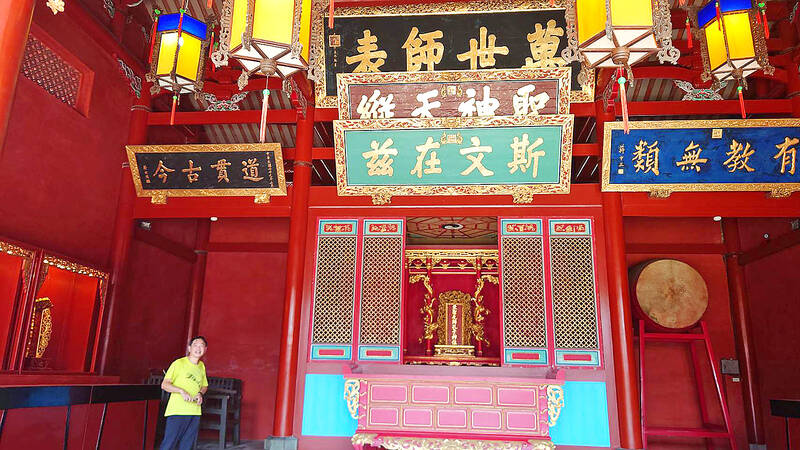
A plaque from President William Lai (賴清德) has been delivered to Tainan’s Confucius Temple and would be unveiled in a ceremony in November, which Lai is to personally attend, the temple said on Thursday last week.
Lai’s plaque would be the 16th to grace the temple’s eaves, alongside plaques from Qing Dynasty emperors and Taiwan’s presidents, making it a truly unique cultural asset.
From the Qing Dynasty to the present day, rulers and presidents have observed the tradition of presenting the temple with plaques honoring Confucius’ ideals to teach everyone, regardless of status, who came to him wishing to learn.
19.Photo: Hung Jui-chin, Taipei
The temple’s Da Cheng Hall houses all the plaques given to the temple since Emperor Kangxi (康熙) of the Qing Dynasty from 1683, except for the plaque of Emperor Aisin Gioro Puyi, or Emperor Xuan Tong (宣統), Tainan Confucius Temple Culture Foundation director Shih Mu-min (石牧民) said.
Xuan Tong ascended the throne in 1909 after the 1895 Treaty of Shimonoseki ceded Taiwan to Japan. He was the final emperor of the Qing Dynasty, which ended in 1912.
The plaques are even more precious, as they were only preserved thanks to the Fang (方) family, who had moved them to rural areas before the bombing of Tainan by the US Air Force during World War II.
The plaques from the Qing emperors were hung on the eaves over the center of the temple, while the plaques from the various presidents were hung on either side, Shih said.
The temple has eight plaques from Qing emperors — Kangxi, Yongzheng (雍正), Qianlong (乾隆), Jiaching (嘉慶), Daoguang (道光), Xianfeng (咸豐), Tongzhi (同治) and Guangxu (光緒), Shih said.
From the Republic of China government, the temple holds plaques from former presidents Chiang Kai-shek (蔣介石), Chiang Ching-kuo (蔣經國), Yen Chia-kan (嚴家淦), Lee Teng-hui (李登輝), Chen Shui-bian (陳水扁), Ma Ying-jeou (馬英九) and Tsai Ing-wen (蔡英文), Shih added.
Shih said that customarily, the plaque from the current president was always placed in the upper right corner, as the position, from the vantage point of the cartouche representing Confucius in the temple’s center, was considered the “dragon side” (龍邊) by feng shui principles.

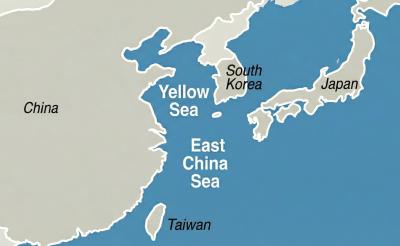
China has reserved offshore airspace in the Yellow Sea and East China Sea from March 27 to May 6, issuing alerts usually used to warn of military exercises, although no such exercises have been announced, the Wall Street Journal (WSJ) reported yesterday. Reserving such a large area for 40 days without explanation is an “unusual step,” as military exercises normally only last a few days, the paper said. These alerts, known as Notice to Air Missions (Notams), “are intended to inform pilots and aviation authorities of temporary airspace hazards or restrictions,” the article said. The airspace reserved in the alert is
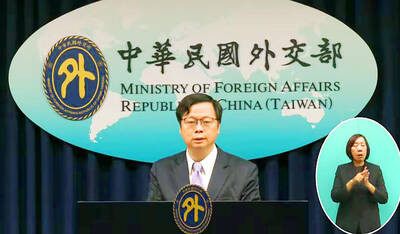
NAMING SPAT: The foreign ministry called on Denmark to propose an acceptable solution to the erroneous nationality used for Taiwanese on residence permits Taiwan has revoked some privileges for Danish diplomatic staff over a Danish permit that lists “Taiwan” as “China,” Eric Huang (黃鈞耀), head of the Ministry of Foreign Affairs’ Department of European Affairs, told a news conference in Taipei yesterday. Reporters asked Huang whether the Danish government had responded to the ministry’s request that it correct the nationality on Danish residence permits of Taiwanese, which has been listed as “China” since 2024. Taiwan’s representative office in Denmark continues to communicate with the Danish government, and the ministry has revoked some privileges previously granted to Danish representatives in Taiwan and would continue to review

More than 6,000 Taiwanese students have participated in exchange programs in China over the past two years, despite the Mainland Affairs Council’s (MAC) “orange light” travel advisory, government records showed. The MAC’s publicly available registry showed that Taiwanese college and university students who went on exchange programs across the Strait numbered 3,592 and 2,966 people respectively. The National Immigration Agency data revealed that 2,296 and 2,551 Chinese students visited Taiwan for study in the same two years. A review of the Web sites of publicly-run universities and colleges showed that Taiwanese higher education institutions continued to recruit students for Chinese educational programs without

A bipartisan group of US senators has introduced a bill to enhance cooperation with Taiwan on drone development and to reduce reliance on supply chains linked to China. The proposed Blue Skies for Taiwan Act of 2026 was introduced by Republican US senators Ted Cruz and John Curtis, and Democratic US senators Jeff Merkley and Andy Kim. The legislation seeks to ease constraints on Taiwan-US cooperation in uncrewed aerial systems (UAS), including dependence on China-sourced components, limited access to capital and regulatory barriers under US export controls, a news release issued by Cruz on Wednesday said. The bill would establish a "Blue UAS


 RSS
RSS