


Taiwan People’s Party (TPP) Chairman Ko Wen-je (柯文哲) made the main decisions and gave final approval in the Core Pacific City redevelopment project, Taipei city councilors said in a report on Tuesday, while others were questioned yesterday over details of a corruption investigation linked to the property.
Taipei prosecutors are investigating allegations that Ko, during his time as Taipei mayor, and others profited from corruption linked to the mall project.
Prosecutors yesterday questioned — for the fourth time each — former Taipei deputy mayor Pong Cheng-sheng (彭振聲) and Core Pacific Group chairman Sheen Ching-jing (沈慶京), who are both in pretrial detention, while on Tuesday they questioned for the third time former Taipei Urban Planning Commission head Lin Jou-min (林洲民).
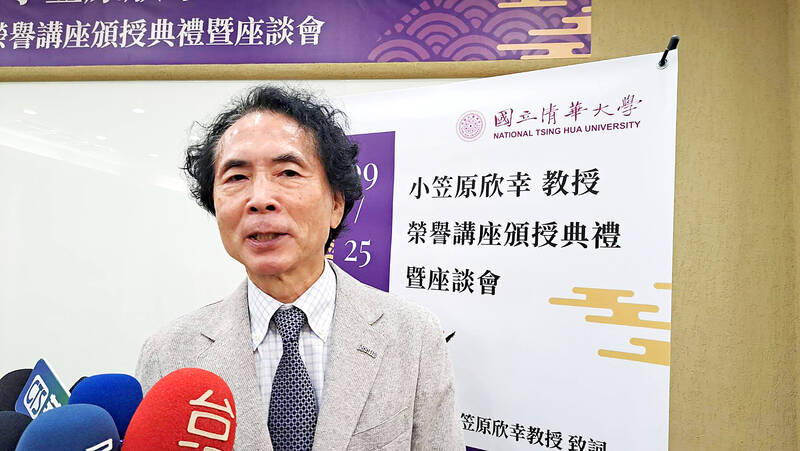
Photo: Hung Mei-hsiu, Taipei Times
Prosecutors reportedly sought to verify Pong’s earlier testimony that Ko had intervened at commission meetings in 2020 and 2021, instructing city officials to increase the floor area ratio for the project.
Pong had told prosecutors that Ko told him to ensure the ratio was raised and approved the project.
Taipei city councilors and others have accused Ko of accepting bribes and kickbacks from Sheen after the project was approved.
Investigators are looking into accounts to determine whether the floor area ratio change enabled Core Pacific Group to boost the value of the property.
Taipei City Councilor Chien Shu-pei (簡舒培) of the Democratic Progressive Party said that the ratio change added more than NT$40 billion (US$1.26 billion) to its value.
Meanwhile, at Taipei City Hall, councilors on Tuesday presented a report that said meeting minutes mostly confirmed Pong’s testimony.
Headed by Chinese Nationalist Party (KMT) Taipei City Councilor Yu Shu-hui (游淑慧), the team began work in May to compile the minutes from meetings related to the project and posted them online for public viewing.
The report quoted Pong as saying that Ko in 2020 ordered him to work on the redevelopment project, appointing him as project manager.
Separately, Japanese academic Yoshiyuki Ogasawara in Hsinchu yesterday said that Ko would fight to extend his political career, despite the corruption scandal, and that people should not count out the TPP.
Ogasawara is a guest lecturer at National Tsing Hua University’s College of Humanities and Social Sciences.
“After the presidential election, support for the TPP has declined steadily and dwindled even more after the accusations emerged, but Ko still has his core support at about 10 percent and the party still has eight legislative seats, he said.
The lawmakers can maintain their volume in public discourse and would continue to operate, until perhaps next year, when there might be a big change for it, depending on how the cases against Ko go, he added.
Separately, Taipei prosecutors are expanding their investigation into allegations that Ko illegally benefited by taking control of TPP funds and might be involved in money laundering.
My-Formosa.com chairman Wu Tzu-chia (吳子嘉) said that prosecutors have found evidence at Ko’s residence of irregular money flows and missing party funds.
Wu said that Ko set up four entities to facilitate money transfers and used a USB drive for cryptocurrency transactions.
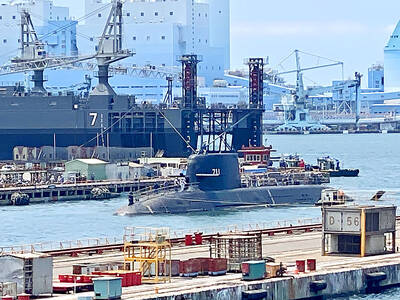
AGING: While Japan has 22 submarines, Taiwan only operates four, two of which were commissioned by the US in 1945 and 1946, and transferred to Taiwan in 1973 Taiwan would need at least 12 submarines to reach modern fleet capabilities, CSBC Corp, Taiwan chairman Chen Cheng-hung (陳政宏) said in an interview broadcast on Friday, citing a US assessment. CSBC is testing the nation’s first indigenous defense submarine, the Hai Kun (海鯤, Narwhal), which is scheduled to be delivered to the navy next month or in July. The Hai Kun has completed torpedo-firing tests and is scheduled to undergo overnight sea trials, Chen said on an SET TV military affairs program. Taiwan would require at least 12 submarines to establish a modern submarine force after assessing the nation’s operational environment and defense
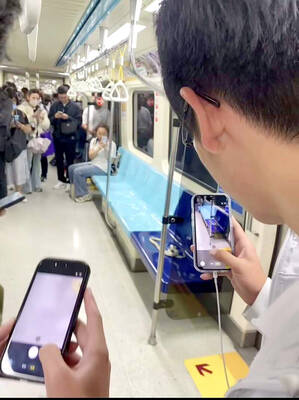
A white king snake that frightened passengers and caused a stir on a Taipei MRT train on Friday evening has been claimed by its owner, who would be fined, Taipei Rapid Transit Corp (TRTC) said yesterday. A person on Threads posted that he thought he was lucky to find an empty row of seats on Friday after boarding a train on the Bannan (Blue) Line, only to spot a white snake with black stripes after sitting down. Startled, he jumped up, he wrote, describing the encounter as “terrifying.” “Taipei’s rat control plan: Release snakes on the metro,” one person wrote in reply, referring
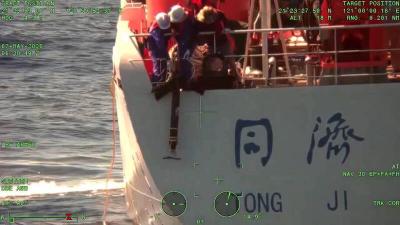
The coast guard today said that it had disrupted "illegal" operations by a Chinese research ship in waters close to the nation and driven it away, part of what Taipei sees a provocative pattern of China's stepped up maritime activities. The coast guard said that it on Thursday last week detected the Chinese ship Tongji (同濟號), which was commissioned only last year, 29 nautical miles (54km) southeast of the southern tip of Taiwan, although just outside restricted waters. The ship was observed lowering ropes into the water, suspected to be the deployment of scientific instruments for "illegal" survey operations, and the coast
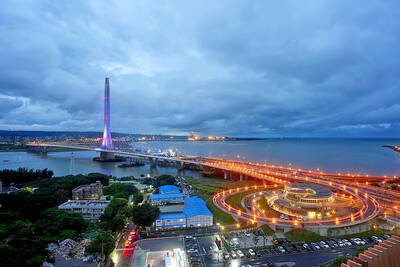
An inauguration ceremony was held yesterday for the Danjiang Bridge, the world’s longest single-mast asymmetric cable-stayed bridge, ahead of its official opening to traffic on Tuesday, marking a major milestone after nearly three decades of planning and construction. At the ceremony in New Taipei City attended by President William Lai (賴清德), Premier Cho Jung-tai (卓榮泰), Minister of Transportation and Communications Chen Shih-kai (陳世凱) and New Taipei City Mayor Hou Yu-ih (侯友宜), the bridge was hailed as both an engineering landmark and a long-awaited regional transport link connecting Tamsui (淡水) and Bali (八里)


 RSS
RSS