


Taiwan has successfully exported its electronic toll collection (ETC) service to Thailand, helping to improve traffic flow on an expressway there, Far Eastern Electronic Toll Collection Co (FETC) said yesterday.
The Taipei-based firm secured the contract to install its ETC system on expressways in Thailand through its subsidiary FETC International Thailand Co.
The Overseas Community Affairs Council on Tuesday gave the subsidiary’s artificial intelligence (AI)-based vehicle license recognition system the Overseas Taiwanese Business Excellence Award-Gold Award.
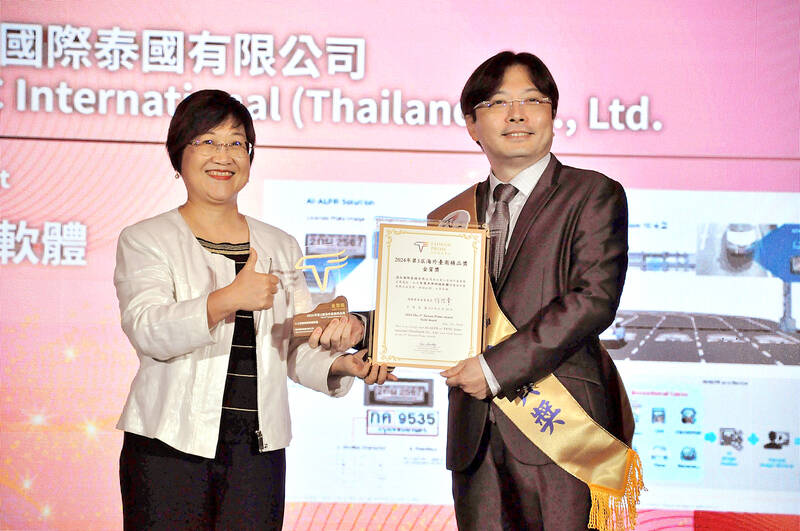
Photo courtesy of Far Eastern Electronic Toll Collection Co
FETC International Thailand is the only smart transportation software developer to win the award.
The license recognition system functions adaptively in different weather conditions and can process images taken from a broad range of angles, FETC said in a statement.
Its plate recognition rate is 98.22 percent, it said.
The technology increased traffic flow on Thailand’s M9 expressway 1.8-fold, it said.
FETC International Thailand executive director Kenny Chen (陳聲鏗) said that it secured two contracts in Thailand.
One is to build and maintain the ETC system on the M6 and M81 expressways, and the other is to upgrade the manual toll collection system on the M9 expressway to a new M-Flow system, Chen said.
Since February 2022, more than 660,000 drivers in registered vehicles have paid tolls on the M9 using the M-Flow system, he said.
The average driving speed on the M9 had increased 180 percent, while traffic flow on each standard lane was up by 43 percent, easing congestion leading up to the toll booths, he said.
The M6 and M81 expressways are to be completed by next year and 2026 respectively, Chen said.
Twenty-two of 28 ETC gantries have been installed on the two expressways on schedule, he said, adding that the company is closely monitoring opportunities to build ETCs on other expressways in the nation.
Earlier this month, the Expressway Authority of Thailand invited FETC International Thailand to participate in the Fifth International Conference on Highway Engineering in Bangkok, making it the only Taiwanese company to participate in the conference.
The company was also invited to host a Smart Mobility seminar to share Taiwan’s experience in using the ETC system.

Considering that most countries issue more than five denominations of banknotes, the central bank has decided to redesign all five denominations, the bank said as it prepares for the first major overhaul of the banknotes in more than 24 years. Central bank Governor Yang Chin-lung (楊金龍) is expected to report to the Legislative Yuan today on the bank’s operations and the redesign’s progress. The bank in a report sent to the legislature ahead of today’s meeting said it had commissioned a survey on the public’s preferences. Survey results showed that NT$100 and NT$1,000 banknotes are the most commonly used, while NT$200 and NT$2,000

The Centers for Disease Control (CDC) yesterday reported the first case of a new COVID-19 subvariant — BA.3.2 — in a 10-year-old Singaporean girl who had a fever upon arrival in Taiwan and tested positive for the disease. The girl left Taiwan on March 20 and the case did not have a direct impact on the local community, it said. The WHO added the BA.3.2 strain to its list of Variants Under Monitoring in December last year, but this was the first imported case of the COVID-19 variant in Taiwan, CDC Deputy Director-General Lin Ming-cheng (林明誠) said. The girl arrived in Taiwan on

South Korea is planning to revise its controversial electronic arrival card, a step Taiwanese officials said prompted them to hold off on planned retaliatory measures, a South Korean media report said yesterday. A Yonhap News Agency report said that the South Korean Ministry of Foreign Affairs is planning to remove the “previous departure place” and “next destination” fields from its e-arrival card system. The plan, reached after interagency consultations, is under review and aims to simplify entry procedures and align the electronic form with the paper version, a South Korean ministry official said. The fields — which appeared only on the electronic form

The Ministry of Foreign Affairs (MOFA) is suspending retaliation measures against South Korea that were set to take effect tomorrow, after Seoul said it is updating its e-arrival system, MOFA said today. The measures were to be a new round of retaliation after Taiwan on March 1 changed South Korea's designation on government-issued alien resident certificates held by South Korean nationals to "South Korea” from the "Republic of Korea," the country’s official name. The move came after months of protests to Seoul over its listing of Taiwan as "China (Taiwan)" in dropdown menus on its new online immigration entry system. MOFA last week


 RSS
RSS