


Lawmakers from all political parties should support a proposed motion that would clarify UN Resolution 2758, Democratic Progressive Party (DPP) legislators told a news conference yesterday, but opposition party members later walked out of a cross-party meeting when the topic was raised.
DPP legislators Chiu Yi-ying (邱議瑩), Michelle Lin (林楚茵), Su Chiao-hui (蘇巧慧) and Puma Shen (沈伯洋) said that the news conference was held to “oppose China’s distortion of UN Resolution 2758 and call on all political parties to speak up for Taiwan.”
UN Resolution 2758 does not have anything to do with Taiwan’s sovereignty and international status, and Taiwan rejects China’s attempts to distort the truth, they said.
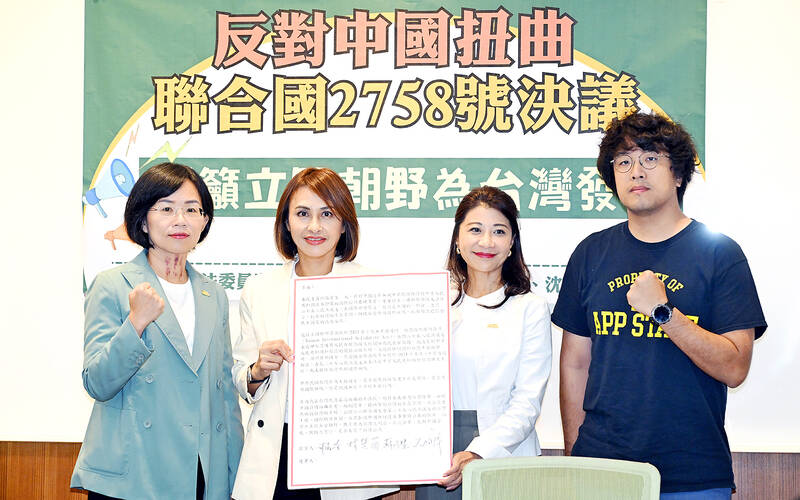
Photo: Liao Chen-huei, Taipei Times
The US House of Representatives in July last year passed the Taiwan International Solidarity Act, which affirms that UN Resolution 2758 does not refer to Taiwan, a sentiment echoed in July by the Inter-Parliamentary Alliance on China’s own resolution.
More recently, the Australian Senate and the Dutch House of Representatives also passed motions clarifying the definition of UN Resolution 2758.
Now is the time for Taiwan to unite and make its voice heard by the international community, Chiu said.
UN Resolution 2758 should no longer block Taiwan from international participation, she said.
The motions in Australia and the Netherlands reflect Taiwan’s growing support abroad, Su said.
UN Resolution 2758 directly affects issues such as encroachment of Chinese fishing vessels into Taiwan’s waters and the M503 flight route, Su said.
Clarifying Taiwan’s international status would allow for it to join international organizations, she said.
The international movement to clarify Resolution 2758, as well as the recent transit of a German ship through the Taiwan Strait, show that Taiwan is important to the world, Lin said.
Now is the time for solidarity, Lin said, adding that the Chinese Nationalist Party (KMT) and the Taiwan People’s Party (TPP) should give up their alignment with Beijing’s position and give Taiwan back to Taiwanese.
The lack of clarity regarding Resolution 2758 lies at the heart of an international legal battle between China and the world, Shen said.
As China continues to expand its jurisdiction, Taiwan must know how to respond to the country’s legal challenges.
After the news conference, Legislative Speaker Han Kuo-yu (韓國瑜) convened talks on the new legislative session.
During the meeting, the DPP caucus proposed a joint statement from all parties, but Han and other KMT legislators, as well as those from the TPP, walked out of the meeting.
“I had to fight back tears; this is the reality of Taiwan’s situation,” DPP caucus secretary-general Rosalia Wu (吳思瑤) said, describing the feeling of reading the proposed statement to a room without opposition lawmakers in attendance.
The KMT and the TPP are disregarding what is best for Taiwan, Wu said.
The DPP will appeal to the public to ensure that the international community hears the true voice of the people, she said.

The Ministry of Finance this afternoon announced the winning numbers for the March-April uniform invoice lottery. The winning number for the NT$10 million (US$318,060) special prize is 19531471, and the winning number for the NT$2 million grand prize is 85941329. Three numbers were drawn for the NT$200,000 first prize: 07225810, 20231230 and 83518781. Those with receipts matching the last seven digits of any of the first-prize numbers will win the NT$40,000 second prize, while those matching the last six digits will win the NT$10,000 third prize. Those whose receipts match the last five digits of the first-prize numbers can claim the NT$4,000 fourth prize,

SIX SUBSIDIES: The monthly allowance for older farmers is to increase to NT$10,000, and NT$5,000 is to be given to homemakers under the national pension system, Lai said The government is to implement major welfare policies for disadvantaged groups, including raising the monthly allowance for older farmers to NT$10,000 and providing homemakers with NT$5,000 per month, President William Lai (賴清德) said yesterday. Lai made the remarks during a visit to Wangling Temple in Chiayi County, saying that the planned increases were being introduced amid economic growth and an increase in tax revenue. Touting a policy, in which the government plans to provide a monthly allowance of NT$5,000 for every child under the age of 18 in a bid to address Taiwan’s low birthrate, Lai said that if received for the

NATIONAL SECURITY: Authorities are working to confirm the identities of the military personnel involved and investigating possible illegal conduct and regulatory violations Authorities are probing possible national security implications after Kinmen police and immigration officers on Sunday found a Chinese woman allegedly posing as a tourist while engaging in prostitution involving more than 10 military personnel. The woman, surnamed Chen (陳), has since been deported, authorities said, adding that investigators are still working to confirm the identities of those implicated, as the records only listed code names and aliases. The case stemmed from a report received by the Kinmen District Prosecutors’ Office on Friday last week from the Jinhu Precinct of the Kinmen County Police Bureau. On Sunday, police, along with the National Immigration
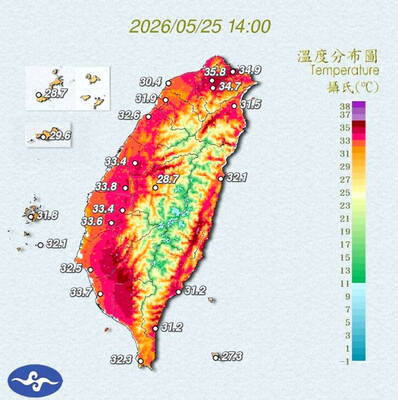
STAY COOL: The HPA recommended that people stay hydrated, use air-conditioning or fans while indoors, wear loose-fitting clothes and walk in the shade while outdoors Employers must implement measures such as installing cooling equipment, and providing drinking water and rest breaks for outdoor workers starting from Monday next week, the Taipei Department of Labor said on Sunday. Employers who fail to comply could face fines of NT$30,000 to NT$300,000 under the Occupational Safety and Health Act (職業安全衛生法), the department said. Businesses in Taipei employing fewer than 100 workers, as well as registered self-employed workers with labor insurance coverage, could receive on-site assessments and guidance from occupational safety consultants to help them apply for central government subsidies to implement or improve heat-protection measures, it said. Under the Ministry of


 RSS
RSS