


The Ministry of Education yesterday said it would take action against universities that might not be upholding students’ rights to privacy, following a report that nearly 40 percent of universities send grades to their parents.
The ministry said it would prosecute institutes that fail to observe students’ rights to privacy.
The announcement was made in light of changes to the Civil Code last year that lowered the age of majority to 18.
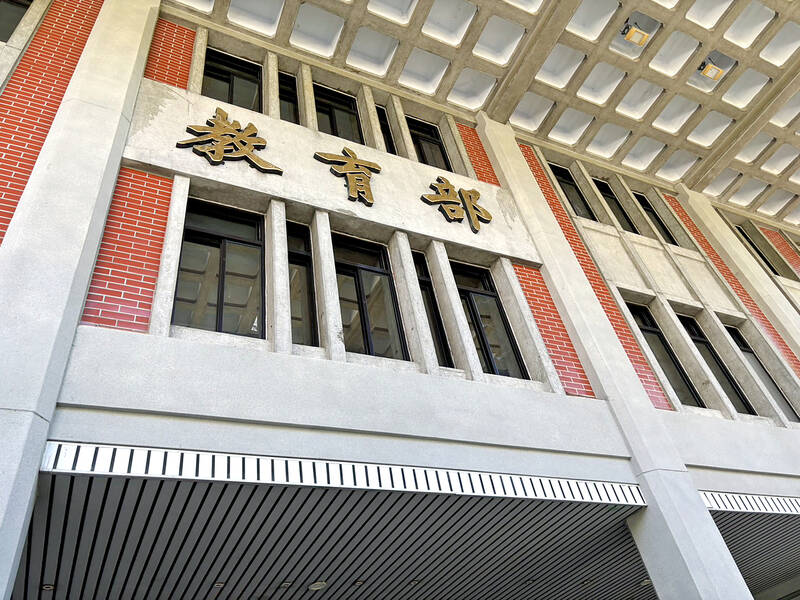
Photo: Rachel Lin, Taipei Times
The new age of majority has prompted universities to drop specific requirements such as requiring parents’ signatures for students to suspend their studies or drop out, as well as sending report cards to their parents.
The ministry said in its student rights report that only 61.8 percent of 152 institutes it surveyed had observed students’ privacy rights and did not send report cards to their parents.
The ministry commissioned National Taiwan Normal University to conduct the survey.
The ministry is complying with Constitutional Interpretation No. 684, which stated that university students can file administrative lawsuits to uphold their rights and that universities must uphold them.
The survey showed that 94.1 percent of institutes achieved “general” standards in upholding students’ rights, up from 91.7 percent in 2020.
It showed that 99.9 percent upheld students’ rights to work and equality.
Institutes have made the most progress in the categories of “punishments, rewards and complaints” and “freedom of expression,” the ministry said.
For example, 96.7 percent of student-funded posters, and institute news or other publications did not require a review by university staff, an immense improvement compared with 59.4 percent in 2020, it said.
However, institutes must improve their observance of students’ rights to privacy, the report said.
Twenty-six institutes have not told students that their personal information, including fingerprints and facial recognition data, is being used for educational purposes, it said.
Seventeen did not have dedicated personnel overseeing the storage of student information, which increased the risks of personal data being leaked, it said.
Most institutes observed regulations and had student representatives on-site when conducting dorm inspections, but 13 did not, it added.

FUKUOKA SITUATION: Japanese media reported that the pathogen is expected to be identified by the summer, while the CDC downplayed the idea that it was hMPV A “mysterious cold-like illness” reported in Japan’s Fukuoka Prefecture does not seem to be a new disease, but Japanese authorities have been asked about the situation, the Centers for Disease Control (CDC) said yesterday. The Fukuoka Prefectural Medical Association on Wednesday told a news conference that a “mystery cold” that has become a hot topic on social media is “highly likely to be caused by some kind of viral infection,” Japan’s KBC News reported. “Many people are experiencing symptoms starting with a sore throat, followed by a runny nose, phlegm and a severe cough,” KBC News reported, citing association officials. Health authorities are

Nvidia Corp CEO Jensen Huang (黃仁勳) arrived in Taiwan yesterday ahead of upcoming AI and technology events, saying he plans to meet with clients and Taiwan Semiconductor Manufacturing Co Chairman C.C. Wei (魏哲家) during his visit. After landing at Taipei Songshan Airport, Huang posed for photos with fans and handed out Yakult drinks to reporters and supporters waiting at the scene, saying he has “a lot to do” during the trip. Asked about reports that Nvidia’s planned headquarters site in Taipei’s Beitou Shilin Technology Park could break ground on May 27, Huang said that if the company holds an event, he would

The Ministry of Finance this afternoon announced the winning numbers for the March-April uniform invoice lottery. The winning number for the NT$10 million (US$318,060) special prize is 19531471, and the winning number for the NT$2 million grand prize is 85941329. Three numbers were drawn for the NT$200,000 first prize: 07225810, 20231230 and 83518781. Those with receipts matching the last seven digits of any of the first-prize numbers will win the NT$40,000 second prize, while those matching the last six digits will win the NT$10,000 third prize. Those whose receipts match the last five digits of the first-prize numbers can claim the NT$4,000 fourth prize,
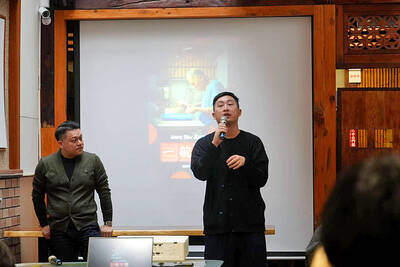
Taiwan Travelogue (臺灣漫遊錄), which earlier this week became the first Taiwanese novel to win the International Booker Prize, is to be adapted into a television series through a Taiwan-Japan coproduction, producer Chang Chen-yu (張辰漁) said yesterday. Chang, a producer at World Softest Production Film Co, wrote on Facebook that the company had been searching for projects with international appeal that retain a strong Taiwanese identity after colleagues and Japanese partners strongly recommended the novel. After reading the book, Chang said he immediately decided to pursue the screen rights. “A great story has the power to transcend time and borders, and connect countless people,”


 RSS
RSS