


The Control Yuan on Tuesday censured the Ministry of Education (MOE) for failing to ensure the safety of students doing internships in the private sector as part of academia-enterprise collaborative programs, following the death of a Vietnamese student intern last year.
A Vietnamese student from the Lee-Ming Institute of Technology on May 17 last year was crushed to death by a loaded 1.8m-high dough cart that weighed more than 100kg at a pastry company factory in New Taipei Industrial Park, the Control Yuan said.
The student was an intern at the factory as part of a special program aimed at boosting collaboration between universities and the private sector under the government’s New Southbound Policy.
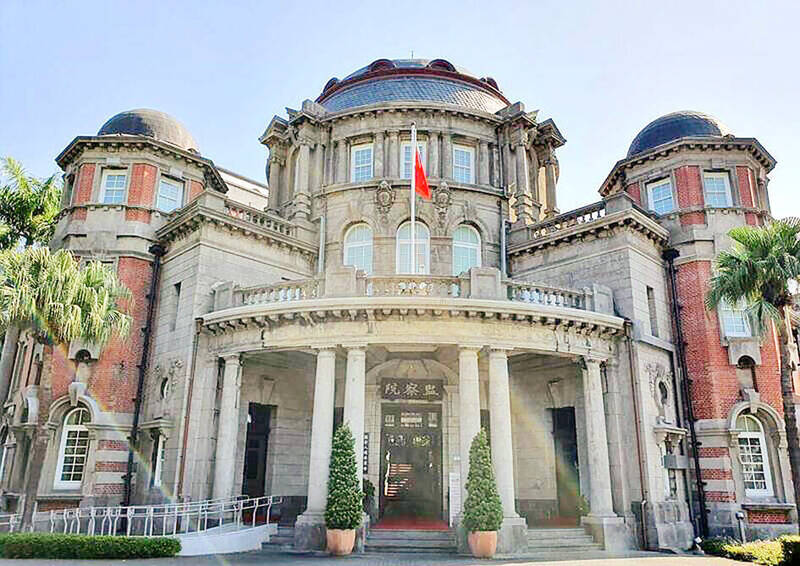
Photo: Hsieh Chun-lin, Taipei Times
Control Yuan members Wang Yu-ling (王幼玲) and Wang Mei-yu (王美玉) on Tuesday presented screenshots of surveillance camera footage showing the student trying to push the cart up a short ramp while another intern pulled the cart from the other side.
The cart then slid towards the student and fell on top of her, crushing her to death, Wang Yu-ling said.
One day after the incident, the New Taipei City Labor Standards Inspection Office conducted an on-site inspection and determined that there was a “failure to take prevention measures,” such as using a more suitable cart or loading the dough differently.
It ruled out that the two people moving the cart had used “unsafe practices” and said that the company was responsible.
The two Control Yuan members cited the ministry’s failure to tender a draft student internship bill despite having begun work on it in April 2017 as one of the reasons for the censure.
The ministry’s evaluation form, which universities filled in with details on companies being considered to run student internship programs, was a formality, the members said, adding the ministry did not rate premises on their occupational safety.
The pastry company had received a near-perfect score on its evaluation before the incident, which provided grounds for the school’s initial refusal in July last year to replace the company over the incident, Wang Yu-ling said.
However, the office’s inspection of the company’s premises in May last year found 13 violations under the Occupational Safety and Health Act (職業安全衛生法), she said.
This showed that even though the ministry forwarded registers of companies selected for academia-enterprise internship programs to local labor authorities, there was still a failure to rule out companies with poor track records of occupational safety standards, she added.
Although the ministry said it ordered the company to make improvements after the accident, Control Yuan members who launched a surprise inspection at the pastry factory on Jan. 26 said they found other potential occupational hazards.
These included the lack of signs posted near ovens to warn people of high temperatures, and near walk-in freezers warning that those could only be opened from the outside, they said.
In response, the ministry said it has ordered universities to evaluate the occupational safety of company premises where student internship programs are to take place to make sure they conform to safety standards.

Considering that most countries issue more than five denominations of banknotes, the central bank has decided to redesign all five denominations, the bank said as it prepares for the first major overhaul of the banknotes in more than 24 years. Central bank Governor Yang Chin-lung (楊金龍) is expected to report to the Legislative Yuan today on the bank’s operations and the redesign’s progress. The bank in a report sent to the legislature ahead of today’s meeting said it had commissioned a survey on the public’s preferences. Survey results showed that NT$100 and NT$1,000 banknotes are the most commonly used, while NT$200 and NT$2,000

The Centers for Disease Control (CDC) yesterday reported the first case of a new COVID-19 subvariant — BA.3.2 — in a 10-year-old Singaporean girl who had a fever upon arrival in Taiwan and tested positive for the disease. The girl left Taiwan on March 20 and the case did not have a direct impact on the local community, it said. The WHO added the BA.3.2 strain to its list of Variants Under Monitoring in December last year, but this was the first imported case of the COVID-19 variant in Taiwan, CDC Deputy Director-General Lin Ming-cheng (林明誠) said. The girl arrived in Taiwan on

South Korea is planning to revise its controversial electronic arrival card, a step Taiwanese officials said prompted them to hold off on planned retaliatory measures, a South Korean media report said yesterday. A Yonhap News Agency report said that the South Korean Ministry of Foreign Affairs is planning to remove the “previous departure place” and “next destination” fields from its e-arrival card system. The plan, reached after interagency consultations, is under review and aims to simplify entry procedures and align the electronic form with the paper version, a South Korean ministry official said. The fields — which appeared only on the electronic form

The Ministry of Foreign Affairs (MOFA) is suspending retaliation measures against South Korea that were set to take effect tomorrow, after Seoul said it is updating its e-arrival system, MOFA said today. The measures were to be a new round of retaliation after Taiwan on March 1 changed South Korea's designation on government-issued alien resident certificates held by South Korean nationals to "South Korea” from the "Republic of Korea," the country’s official name. The move came after months of protests to Seoul over its listing of Taiwan as "China (Taiwan)" in dropdown menus on its new online immigration entry system. MOFA last week


 RSS
RSS