


Migrant worker rights groups on Wednesday called for a revision to the labor insurance program to make it easier for migrant workers to claim retirement benefits at the end of their employment contracts.
The Serve the People Association in Taoyuan held a forum in Taipei highlighting the issues facing migrant workers in the labor insurance program, which manages the payout of their Old-Age Benefits.
Under current rules, people who reach the age of 60 and have been covered by labor insurance for less than 15 years can claim the benefits as a lump sum.
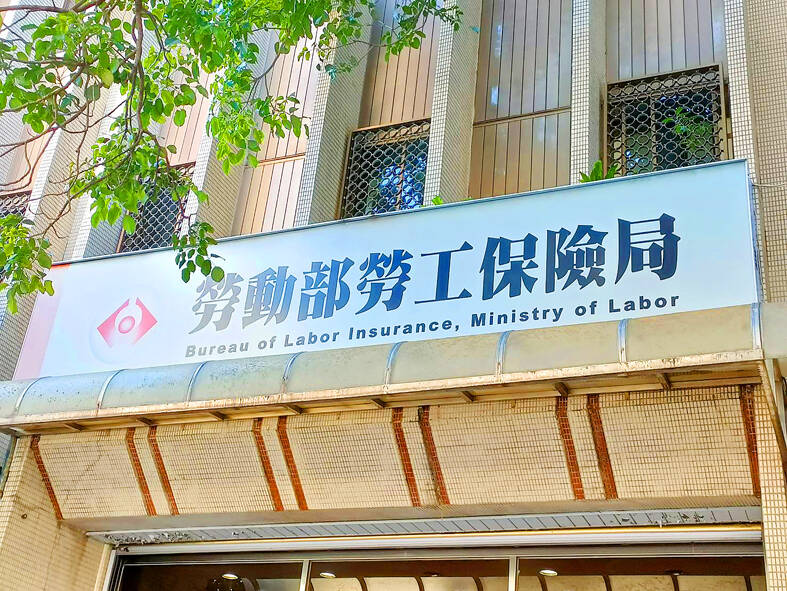
Photo: Lee Ching-hui, Taipei Times
Women who retire over the age of 55 and those who retire after hitting 60, whose labor insurance coverage dates back to before Jan. 1, 2009, and who have been insured for at least one year are also eligible to claim the lump sum.
However, migrant worker employment rules state that domestic caregivers can only work in Taiwan for 12 years, the association said in a statement.
Ministry of Labor statistics showed that most migrant workers in Taiwan are aged 25 to 44, and leave the country between the ages of 45 and 50, it said.
Lennon Wang (汪英達), director of the group’s migrant worker policies, said that the problem is compounded by the fact migrant workers have shorter life expectancies than Taiwanese, so applying the same age rule is unfair.
Most migrant workers do not even know how to claim the lump sum, and they have to pay a processing fee equivalent to thousands of New Taiwan dollars if they want to have the lump sum transferred to them after they return to their home country, Wang said.
Robert Owen Ganado, a researcher at the association, suggested setting up an online system through which migrant workers can apply for and receive the benefits.
He added that the government could establish support offices in migrant workers’ home countries, permit non-governmental organizations and representatives to claim the lump sum on a worker’s behalf and improve the Labor Insurance Program by modeling it after those in Japan or Germany to make the benefits more accessible to migrant workers.
Chung Ping-cheng (鍾秉正), a law professor at National Defense University, said the government could introduce an amendment that would allow migrant workers to claim the lump sum whenever they choose to dissolve their contracts or when their contracts expire and they have to leave Taiwan.
Under the current system, workers contribute 20 percent to their labor insurance premium, employers 70 percent and the government 10 percent, Chung said.
Migrant workers should be allowed to claim at least 90 percent of the aggregated premiums that they and their employers paid for, Chung added.
National Human Rights Commission vice chairperson Wang Yu-ling (王幼玲) and Cesar Chavez Jr, director of migrant workers services at the Manila Economic and Cultural Office, voiced their support for the group’s demands in their speeches at the forum.
Lee Hui-an (李蕙安), a section chief at the Ministry of Labor, said that she would relay the opinions given at the forum to the ministry as a reference for policymaking.
However, she also defended the rules, saying that having the same Old-Age Benefits rules for Taiwanese and foreigners eliminates discrimination.
Chiu Mi-chu (邱咪珠), a section chief at the Bureau of Labor Insurance, said that as long as the applicant’s identification documents and application form are complete, up-to-date and validated by the competent Taiwanese agency in their home country, “there shouldn’t be many issues.”
Other civic groups, including the Rerum Novarum Center, the Garden of Hope Foundation and the Taiwan International Workers’ Association, also attended the event.
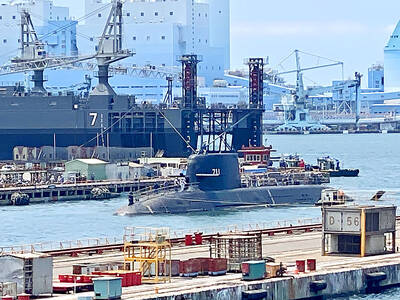
AGING: While Japan has 22 submarines, Taiwan only operates four, two of which were commissioned by the US in 1945 and 1946, and transferred to Taiwan in 1973 Taiwan would need at least 12 submarines to reach modern fleet capabilities, CSBC Corp, Taiwan chairman Chen Cheng-hung (陳政宏) said in an interview broadcast on Friday, citing a US assessment. CSBC is testing the nation’s first indigenous defense submarine, the Hai Kun (海鯤, Narwhal), which is scheduled to be delivered to the navy next month or in July. The Hai Kun has completed torpedo-firing tests and is scheduled to undergo overnight sea trials, Chen said on an SET TV military affairs program. Taiwan would require at least 12 submarines to establish a modern submarine force after assessing the nation’s operational environment and defense

A white king snake that frightened passengers and caused a stir on a Taipei MRT train on Friday evening has been claimed by its owner, who would be fined, Taipei Rapid Transit Corp (TRTC) said yesterday. A person on Threads posted that he thought he was lucky to find an empty row of seats on Friday after boarding a train on the Bannan (Blue) Line, only to spot a white snake with black stripes after sitting down. Startled, he jumped up, he wrote, describing the encounter as “terrifying.” “Taipei’s rat control plan: Release snakes on the metro,” one person wrote in reply, referring
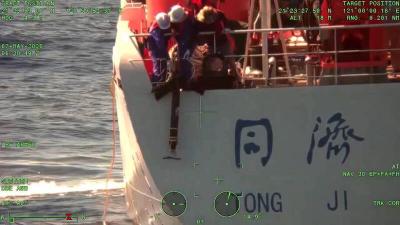
The coast guard today said that it had disrupted "illegal" operations by a Chinese research ship in waters close to the nation and driven it away, part of what Taipei sees a provocative pattern of China's stepped up maritime activities. The coast guard said that it on Thursday last week detected the Chinese ship Tongji (同濟號), which was commissioned only last year, 29 nautical miles (54km) southeast of the southern tip of Taiwan, although just outside restricted waters. The ship was observed lowering ropes into the water, suspected to be the deployment of scientific instruments for "illegal" survey operations, and the coast
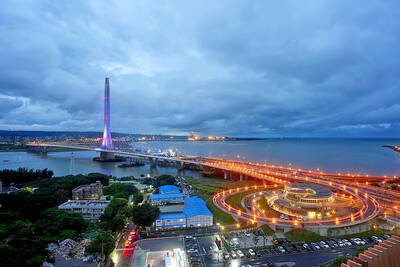
An inauguration ceremony was held yesterday for the Danjiang Bridge, the world’s longest single-mast asymmetric cable-stayed bridge, ahead of its official opening to traffic on Tuesday, marking a major milestone after nearly three decades of planning and construction. At the ceremony in New Taipei City attended by President William Lai (賴清德), Premier Cho Jung-tai (卓榮泰), Minister of Transportation and Communications Chen Shih-kai (陳世凱) and New Taipei City Mayor Hou Yu-ih (侯友宜), the bridge was hailed as both an engineering landmark and a long-awaited regional transport link connecting Tamsui (淡水) and Bali (八里)


 RSS
RSS