


Climate change turbocharged the winds and rain of Typhoon Gaemi, which killed dozens of people across Taiwan, the Philippines and China last month, a group of scientists said yesterday.
Gaemi skirted the Philippines, triggering floods and landslides that killed at least 40 people, before making landfall in Taiwan and China.
In China, the weather system caused torrential downpours that killed 50 people and prompted authorities to evacuate 300,000.
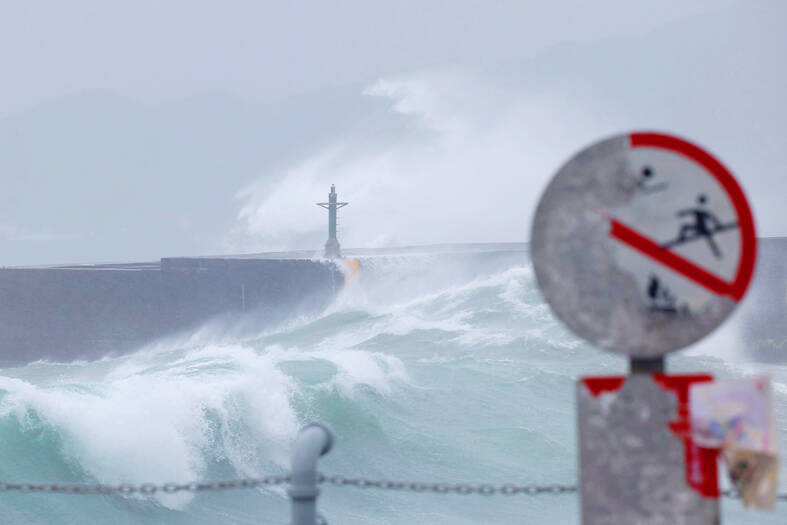
Photo: Carlos Garcia Rawlins, Reuters
World Weather Attribution (WWA), a network of scientists who have pioneered peer-reviewed methods for assessing the role of climate change in extreme events, looked at three regions worst affected by the typhoon: the northern Philippines, Taiwan and China’s Hunan Province.
It found the system’s wind speeds were 7 percent more intense due to human-caused climate change, and its rainfall was 14 percent heavier in Taiwan and 9 percent heavier in Hunan.
The study could not draw definitive conclusions about the role of climate change on the rainfall in the Philippines, because of the region’s complex monsoon rain patterns.
Still, they found the warm seas that helped form and fuel Typhoon Gaemi “would have been virtually impossible” in a world that had not warmed to the current 1.2°C above preindustrial levels.
RISING FREQUENCY
The group’s modeling found this warming has already increased the number of similarly strong storms by 30 percent — up from about five per year to six or seven.
“This study confirms what we’ve expected — hotter seas and atmospheres are giving rise to more powerful, longer-lived and deadlier typhoons,” said Ralf Toumi, director of the Grantham Institute-Climate Change and the Environment at Imperial College London.
Teasing out the impact of climate change on tropical cyclones is complicated, but scientists are focusing more work on these weather systems.
WWA’s method involves assessing how unusual an extreme event is, then modeling the likelihood of a similar event and its intensity in two scenarios: today’s world and one without current levels of warming.
The scientists used that method and a new approach developed by Imperial College London that is tailored specifically to tropical storms.
It uses computer modeling to overcome the relative lack of historical data on tropical cyclones.
PREPAREDNESS
While the Asia-Pacific region has long dealt with typhoons, the scientists warned that their work highlighted “gaps in typhoon preparedness and the massive impacts caused by Gaemi.”
They called for better urban flood management and targeted warnings that offer more information on the likely impacts of a storm.
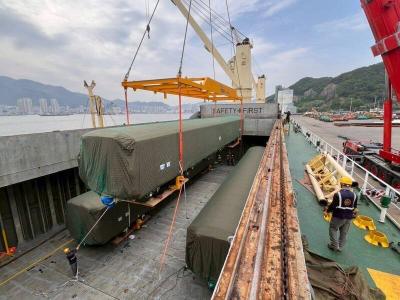
The first of 10 new high-capacity trains purchased from South Korea’s Hyundai Rotem arrived at the Port of Taipei yesterday to meet the demands of an expanding metro network, Taipei Rapid Transit Corp (TRTC) said yesterday. The train completed a three-day, 1,200km voyage from the Port of Masan in South Korea, the company said. Costing NT$590 million (US$18.79 million) each, the new six-carriage trains feature a redesigned interior based on "human-centric" transportation concepts, TRTC said. The design utilizes continuous longitudinal seating to widen the aisles and optimize passenger flow, while also upgrading passenger information displays and driving control systems for a more comfortable
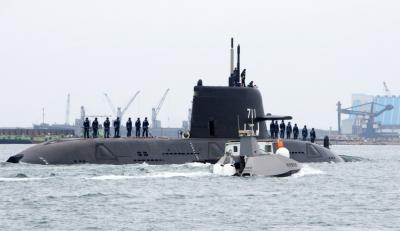
Taiwan's first indigenous defense submarine, the SS-711 Hai Kun (海鯤, or Narwhal), departed for its 13th sea trial at 7am today, marking its seventh submerged test, with delivery to the navy scheduled for July. The outing also marked its first sea deployment since President William Lai (賴清德) boarded the submarine for an inspection on March 19, drawing a crowd of military enthusiasts who gathered to show support. The submarine this morning departed port accompanied by CSBC Corp’s Endeavor Manta (奮進魔鬼魚號) uncrewed surface vessel and a navy M109 assault boat. Amid public interest in key milestones such as torpedo-launching operations and overnight submerged trials,
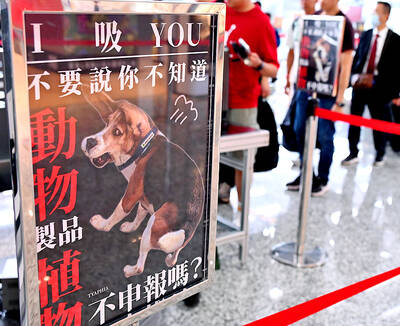
Quarantine awareness posters at Taiwan Taoyuan International Airport have gone viral for their use of wordplay. Issued by the airport branch of the Animal and Plant Health Inspection Agency, the posters feature sniffer dogs making a range of facial expressions, paired with advisory messages built around homophones. “We update the messages for holidays and campaign needs, periodically refreshing materials to attract people’s attention,” quarantine officials said. “The aim is to use the dogs’ appeal to draw focus to quarantine regulations.” A Japanese traveler visiting Taiwan has posted a photo on X of a poster showing a quarantine dog with a

Taiwan’s coffee community has launched a “one-person-one-e-mail” campaign, calling for people to send a protest-e-mail to the World Coffee Championships (WCC) urging it to redesignate Taiwanese competitors as from “Taiwan,” rather than “Chinese Taipei.” The call followed sudden action last week after the WCC changed all references to Taiwanese competitors from “Taiwan” to “Chinese Taipei,” including recent World Latte Art champion Bala (林紹興), who won the World Latte Art Championship in San Diego earlier this month. When Bala received the trophy, he was referred to as representing Taiwan, as well as in the announcement on the WCC’s Web site, until it


 RSS
RSS