


Democratic Progressive Party (DPP) lawmakers yesterday criticized Taoyuan Mayor Simon Chang (張善政) after the city disregarded an online poll and gave four new Taoyuan MRT stations names that included “Jhongjheng” (中正) — a name adopted by Chiang Kai-shek (蔣介石).
DPP Legislator Ariel Chang (張雅琳) said that commemorating dictators is unhealthy for democracy, adding that the Transitional Justice Commission had called for the practice to end, and for such names to be removed.
Taiwan does not need four more metro stations with Chiang’s name to add to the 355 streets, lanes and alleys already named after the former president, she said, adding that the city’s decision is a setback for democracy.
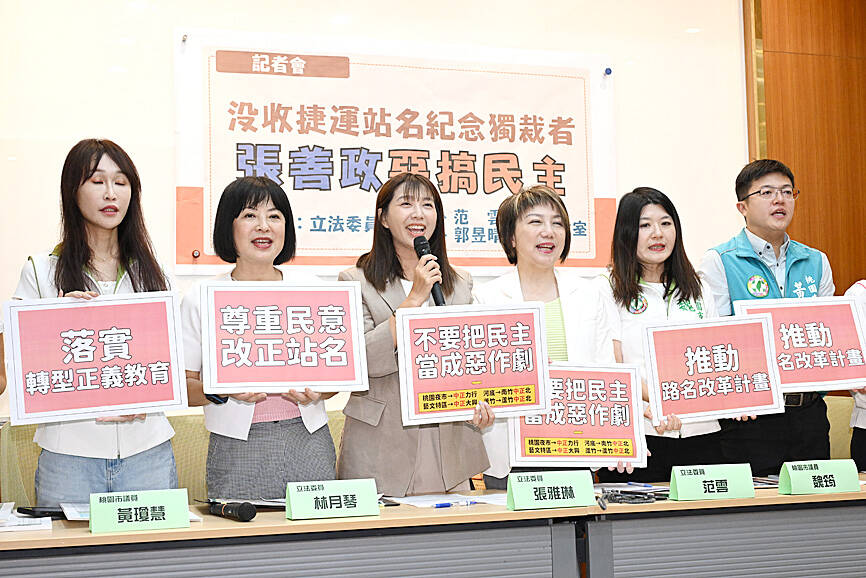
Photo: Chen Yi-kuan, Taipei Times
The Taoyuan City Government’s christening of the MRT stations, which are part of the new Green Line expected to open in 2026 connecting to the Taoyuan Airport MRT, ignored a city-wide online poll to name the stations, she said.
The Taoyuan Department of Rapid Transit Systems on Wednesday last week said that under its guidelines, stations should be named after the most recognized street or place in their vicinity and that polls were for reference only.
However, Ariel Chang said that Chiang Kai-shek had no links to Taoyuan’s history or culture and is of no use to the municipality’s efforts to promote tourism.

Photo courtesy of the Taoyuan City Government
Taiwan has disposed of 197 authoritarian symbols in compliance with the Act on Promoting Transitional Justice (促進轉型正義條例), while Taoyuan has been idle in taking action on 65 of such symbols in its jurisdiction, DPP Legislator Fan Yun (范雲) said.
The city’s refusal to deal with the nation’s authoritarian legacy or to follow its legal obligation shows contempt for the rule of law and transitional justice, she said.
The lawmakers called on Simon Chang to give due respect to the will of the people, recognize that voters support transitional justice and obey the principles of democracy, she said.

Considering that most countries issue more than five denominations of banknotes, the central bank has decided to redesign all five denominations, the bank said as it prepares for the first major overhaul of the banknotes in more than 24 years. Central bank Governor Yang Chin-lung (楊金龍) is expected to report to the Legislative Yuan today on the bank’s operations and the redesign’s progress. The bank in a report sent to the legislature ahead of today’s meeting said it had commissioned a survey on the public’s preferences. Survey results showed that NT$100 and NT$1,000 banknotes are the most commonly used, while NT$200 and NT$2,000

The Centers for Disease Control (CDC) yesterday reported the first case of a new COVID-19 subvariant — BA.3.2 — in a 10-year-old Singaporean girl who had a fever upon arrival in Taiwan and tested positive for the disease. The girl left Taiwan on March 20 and the case did not have a direct impact on the local community, it said. The WHO added the BA.3.2 strain to its list of Variants Under Monitoring in December last year, but this was the first imported case of the COVID-19 variant in Taiwan, CDC Deputy Director-General Lin Ming-cheng (林明誠) said. The girl arrived in Taiwan on

South Korea is planning to revise its controversial electronic arrival card, a step Taiwanese officials said prompted them to hold off on planned retaliatory measures, a South Korean media report said yesterday. A Yonhap News Agency report said that the South Korean Ministry of Foreign Affairs is planning to remove the “previous departure place” and “next destination” fields from its e-arrival card system. The plan, reached after interagency consultations, is under review and aims to simplify entry procedures and align the electronic form with the paper version, a South Korean ministry official said. The fields — which appeared only on the electronic form

The Ministry of Foreign Affairs (MOFA) is suspending retaliation measures against South Korea that were set to take effect tomorrow, after Seoul said it is updating its e-arrival system, MOFA said today. The measures were to be a new round of retaliation after Taiwan on March 1 changed South Korea's designation on government-issued alien resident certificates held by South Korean nationals to "South Korea” from the "Republic of Korea," the country’s official name. The move came after months of protests to Seoul over its listing of Taiwan as "China (Taiwan)" in dropdown menus on its new online immigration entry system. MOFA last week


 RSS
RSS