


President William Lai (賴清德) today presided over the opening of this year’s Ketagalan Forum in Taipei, emphasizing in his speech his “four pillars of peace” plan for maintaining security in the Taiwan Strait.
Authoritarianism is now a global challenge, Lai said, citing Chinese military expansionism, economic coercion and use of hybrid warfare tactics such as cyberattacks and cognitive warfare.
“We are all fully aware that China’s growing authoritarianism will not stop with Taiwan, nor is Taiwan the only target of China’s economic pressures,” he said. “China intends to change the rules-based international order. That is why democratic countries must come together and take concrete action.”
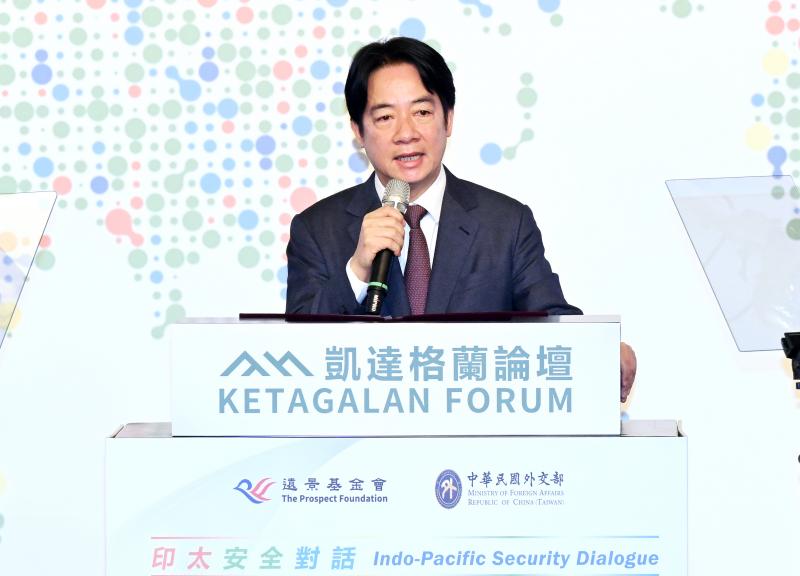
Photo: Liao Chen-hui, Taipei Times
Saying that Taiwan “will not be intimidated,” Lai reiterated his “four pillars of peace” action plan to strengthen national defense, build economic security, strengthen democratic partnerships and engage in stable and principled cross-strait leadership.
“Taiwan is determined to serve as a key driver for the development of global democracy, peace and prosperity,” Lai said. “More than anything, we hope our partners can be united as we support the democratic umbrella.”
Hosted by the Ministry of Foreign Affairs and the Prospect Foundation, the Ketagalan Forum: 2024 Indo-Pacific Security Dialogue is the eighth edition of the annual event.
Keynote speakers include former Japanese prime minister Yoshihiko Noda, former Slovakian prime minister Eduard Heger and former US ambassador to the UN Nikki Haley.
Attendees include representatives from 11 nations, including the US, Canada, Japan, Australia, India, Israel, Lithuania, Latvia, Estonia and Denmark.
Discussion topics were to include gray-zone conflict in the Taiwan Strait and South and East China Seas, economic resilience, and how digital authoritarianism is spread through false information, according to the Ministry of Foreign Affairs.

Considering that most countries issue more than five denominations of banknotes, the central bank has decided to redesign all five denominations, the bank said as it prepares for the first major overhaul of the banknotes in more than 24 years. Central bank Governor Yang Chin-lung (楊金龍) is expected to report to the Legislative Yuan today on the bank’s operations and the redesign’s progress. The bank in a report sent to the legislature ahead of today’s meeting said it had commissioned a survey on the public’s preferences. Survey results showed that NT$100 and NT$1,000 banknotes are the most commonly used, while NT$200 and NT$2,000

The Centers for Disease Control (CDC) yesterday reported the first case of a new COVID-19 subvariant — BA.3.2 — in a 10-year-old Singaporean girl who had a fever upon arrival in Taiwan and tested positive for the disease. The girl left Taiwan on March 20 and the case did not have a direct impact on the local community, it said. The WHO added the BA.3.2 strain to its list of Variants Under Monitoring in December last year, but this was the first imported case of the COVID-19 variant in Taiwan, CDC Deputy Director-General Lin Ming-cheng (林明誠) said. The girl arrived in Taiwan on

South Korea is planning to revise its controversial electronic arrival card, a step Taiwanese officials said prompted them to hold off on planned retaliatory measures, a South Korean media report said yesterday. A Yonhap News Agency report said that the South Korean Ministry of Foreign Affairs is planning to remove the “previous departure place” and “next destination” fields from its e-arrival card system. The plan, reached after interagency consultations, is under review and aims to simplify entry procedures and align the electronic form with the paper version, a South Korean ministry official said. The fields — which appeared only on the electronic form

The Ministry of Foreign Affairs (MOFA) is suspending retaliation measures against South Korea that were set to take effect tomorrow, after Seoul said it is updating its e-arrival system, MOFA said today. The measures were to be a new round of retaliation after Taiwan on March 1 changed South Korea's designation on government-issued alien resident certificates held by South Korean nationals to "South Korea” from the "Republic of Korea," the country’s official name. The move came after months of protests to Seoul over its listing of Taiwan as "China (Taiwan)" in dropdown menus on its new online immigration entry system. MOFA last week


 RSS
RSS