


Former Penghu County council speaker Liu Chen Chao-ling (劉陳昭玲) of the Chinese Nationalist Party (KMT), was convicted on corruption charges and sentenced to more than 10 years in prison, a court ruling said Wednesday.
After initiating a corruption probe in 2022, public prosecutors indicted Liu last year, resulting in her having to resign as speaker of the Penghu County Council, which she had been for more than 20 years since 2002.
The court found Liu guilty of charges in six combined cases, including taking bribes for personal profit and contravening the Anti-Corruption Act (貪污治罪條例). She was given a sentence of ten years and two months and would be stripped of her civil rights for six years.

Photo: Liu Yu-ching, Taipei Times
Judges also convicted Liu’s office secretary Chen Shu-mei (陳淑美) as an accomplice in engaging in corruption and taking bribes, sentencing her to three years and 10 months in prison and suspending her civil rights for three years.
As this is the first ruling, both can still file an appeal to the high court.
Liu is best known for setting a record in Taiwan’s local council governance after serving as the council speaker for six straight terms over two decades from 2002 until her resignation last year.
Liu ran for county councilor when she was only 25 and after winning a councilor seat in 1982, served for more than 40 years in the Penghu County Council, first as councilor then deputy speaker and lastly council speaker for the past two decades.
After gathering evidence and testimonies, investigators said Liu received bribes totaling NT$1.76 million (US$54,487) through influence peddling and abusing her authority as council speaker to influence the appointment and hiring of employees at local government agencies such as education, health, transportation and the fire department.
An investigation revealed that after successfully facilitating appointments and hirings from 2017 to 2021, Liu received bribes from “persons willing to pay for a local government position,” such as luxury gifts, brand-name tote bags, donations to local temples and other indirect ways of transferring financial benefits to avoid getting caught accepting bribes in cash.
In the court filing, the judge said Liu and Chen “harmed the local government through corrupt practices and taking bribes, thereby eroding the public’s trust in the civil service system and casting doubt on clean, ethical conduct of government officials.”
During the investigation, Liu and Chen had received a warning about prosecutors and tried to erase video footage of county council meetings, contacted people who had bribed them to tamper with evidence and took other actions to interfere with the investigation, the court filing added.
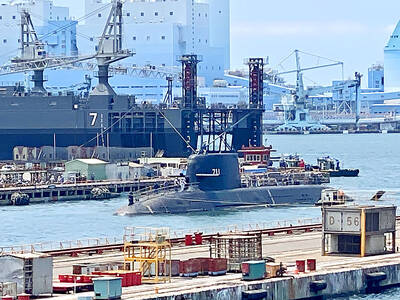
AGING: While Japan has 22 submarines, Taiwan only operates four, two of which were commissioned by the US in 1945 and 1946, and transferred to Taiwan in 1973 Taiwan would need at least 12 submarines to reach modern fleet capabilities, CSBC Corp, Taiwan chairman Chen Cheng-hung (陳政宏) said in an interview broadcast on Friday, citing a US assessment. CSBC is testing the nation’s first indigenous defense submarine, the Hai Kun (海鯤, Narwhal), which is scheduled to be delivered to the navy next month or in July. The Hai Kun has completed torpedo-firing tests and is scheduled to undergo overnight sea trials, Chen said on an SET TV military affairs program. Taiwan would require at least 12 submarines to establish a modern submarine force after assessing the nation’s operational environment and defense

A white king snake that frightened passengers and caused a stir on a Taipei MRT train on Friday evening has been claimed by its owner, who would be fined, Taipei Rapid Transit Corp (TRTC) said yesterday. A person on Threads posted that he thought he was lucky to find an empty row of seats on Friday after boarding a train on the Bannan (Blue) Line, only to spot a white snake with black stripes after sitting down. Startled, he jumped up, he wrote, describing the encounter as “terrifying.” “Taipei’s rat control plan: Release snakes on the metro,” one person wrote in reply, referring
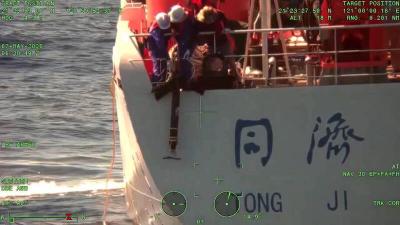
The coast guard today said that it had disrupted "illegal" operations by a Chinese research ship in waters close to the nation and driven it away, part of what Taipei sees a provocative pattern of China's stepped up maritime activities. The coast guard said that it on Thursday last week detected the Chinese ship Tongji (同濟號), which was commissioned only last year, 29 nautical miles (54km) southeast of the southern tip of Taiwan, although just outside restricted waters. The ship was observed lowering ropes into the water, suspected to be the deployment of scientific instruments for "illegal" survey operations, and the coast
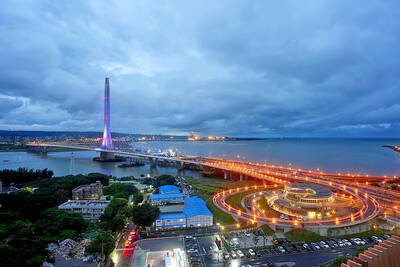
An inauguration ceremony was held yesterday for the Danjiang Bridge, the world’s longest single-mast asymmetric cable-stayed bridge, ahead of its official opening to traffic on Tuesday, marking a major milestone after nearly three decades of planning and construction. At the ceremony in New Taipei City attended by President William Lai (賴清德), Premier Cho Jung-tai (卓榮泰), Minister of Transportation and Communications Chen Shih-kai (陳世凱) and New Taipei City Mayor Hou Yu-ih (侯友宜), the bridge was hailed as both an engineering landmark and a long-awaited regional transport link connecting Tamsui (淡水) and Bali (八里)


 RSS
RSS