


A Criminal Investigation Bureau crackdown on falsified license plates last week resulted in the arrest of a suspected middleman and 14 buyers, while 12 vehicles found with falsified plates were confiscated.
The use of falsified plates in Taiwan, has jumped to 450 from January to last month, up from 281 for the whole of last year and 172 for 2022, bureau data showed.
The bureau said that it has forwarded all cases to the Hsinchu County District Prosecutors’ Office, which would be leading a joint task force investigating the increase in falsified plates.
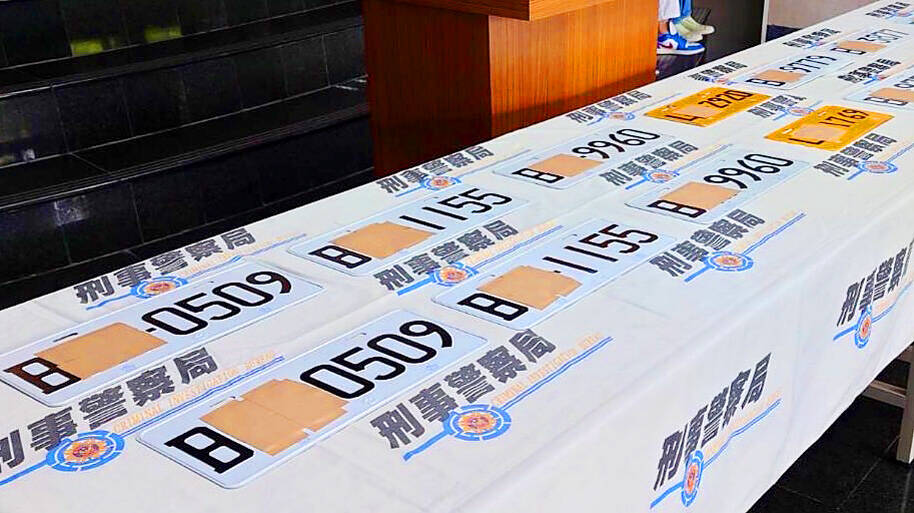
Photo courtesy of the police
Investigations began on Monday last week, and the general areas in which falsified plates originated and the residences of drivers using falsified plates were located, the bureau said.
The crackdown was launched simultaneously across New Taipei City, Hsinchu City, Taichung, Kaohsiung, and Changhua and Chiayi counties, it said.
Twelve falsified car license plates, six falsified motorcycle plates and the 12 vehicles using the falsified plates were confiscated, and police also detained a 36 year-old suspect surnamed Kuo (郭), the bureau said.
All of the plates were ordered from Taiwan, manufactured in China, and shipped back to Taiwan for distribution, it said.
Police and local motor vehicle offices said that drivers’ attempts to avoid heavier fines for traffic offenses might be driving the use of falsified plates, and that some drivers might be acquiring falsified plates to conduct illegal activities.
Wei Wu-sheng (魏武盛), an official with the Ministry of Transportation and Communications’ Monitoring and Surveillance Division, said that local motor vehicle offices are creating a “gray list” of license plate numbers they suspect have been duplicated for use as falsified plates.
Multiple measures are being considered to stop the proliferation of falsified plates, adding that the Highway Bureau is also looking into measures to compensate potential victims, Wei said.
The bureau said that any attempt to forge or sell falsified license plates contravenes Article 212 of the Criminal Code and is punishable by up to a year in prison.
Using falsified plates is in contravention of Article 216 of the Criminal Code, and perpetrators can be sentenced to up to a year in prison and fined NT$3,600 to NT$10,800 for contravening the Road Traffic Management and Penalty Act (道路交通管理處罰條例), it said.
Additional reporting by Chiu Chun-fu and Wu Liang-yi

Considering that most countries issue more than five denominations of banknotes, the central bank has decided to redesign all five denominations, the bank said as it prepares for the first major overhaul of the banknotes in more than 24 years. Central bank Governor Yang Chin-lung (楊金龍) is expected to report to the Legislative Yuan today on the bank’s operations and the redesign’s progress. The bank in a report sent to the legislature ahead of today’s meeting said it had commissioned a survey on the public’s preferences. Survey results showed that NT$100 and NT$1,000 banknotes are the most commonly used, while NT$200 and NT$2,000

The Centers for Disease Control (CDC) yesterday reported the first case of a new COVID-19 subvariant — BA.3.2 — in a 10-year-old Singaporean girl who had a fever upon arrival in Taiwan and tested positive for the disease. The girl left Taiwan on March 20 and the case did not have a direct impact on the local community, it said. The WHO added the BA.3.2 strain to its list of Variants Under Monitoring in December last year, but this was the first imported case of the COVID-19 variant in Taiwan, CDC Deputy Director-General Lin Ming-cheng (林明誠) said. The girl arrived in Taiwan on

South Korea is planning to revise its controversial electronic arrival card, a step Taiwanese officials said prompted them to hold off on planned retaliatory measures, a South Korean media report said yesterday. A Yonhap News Agency report said that the South Korean Ministry of Foreign Affairs is planning to remove the “previous departure place” and “next destination” fields from its e-arrival card system. The plan, reached after interagency consultations, is under review and aims to simplify entry procedures and align the electronic form with the paper version, a South Korean ministry official said. The fields — which appeared only on the electronic form

The Ministry of Foreign Affairs (MOFA) is suspending retaliation measures against South Korea that were set to take effect tomorrow, after Seoul said it is updating its e-arrival system, MOFA said today. The measures were to be a new round of retaliation after Taiwan on March 1 changed South Korea's designation on government-issued alien resident certificates held by South Korean nationals to "South Korea” from the "Republic of Korea," the country’s official name. The move came after months of protests to Seoul over its listing of Taiwan as "China (Taiwan)" in dropdown menus on its new online immigration entry system. MOFA last week


 RSS
RSS